
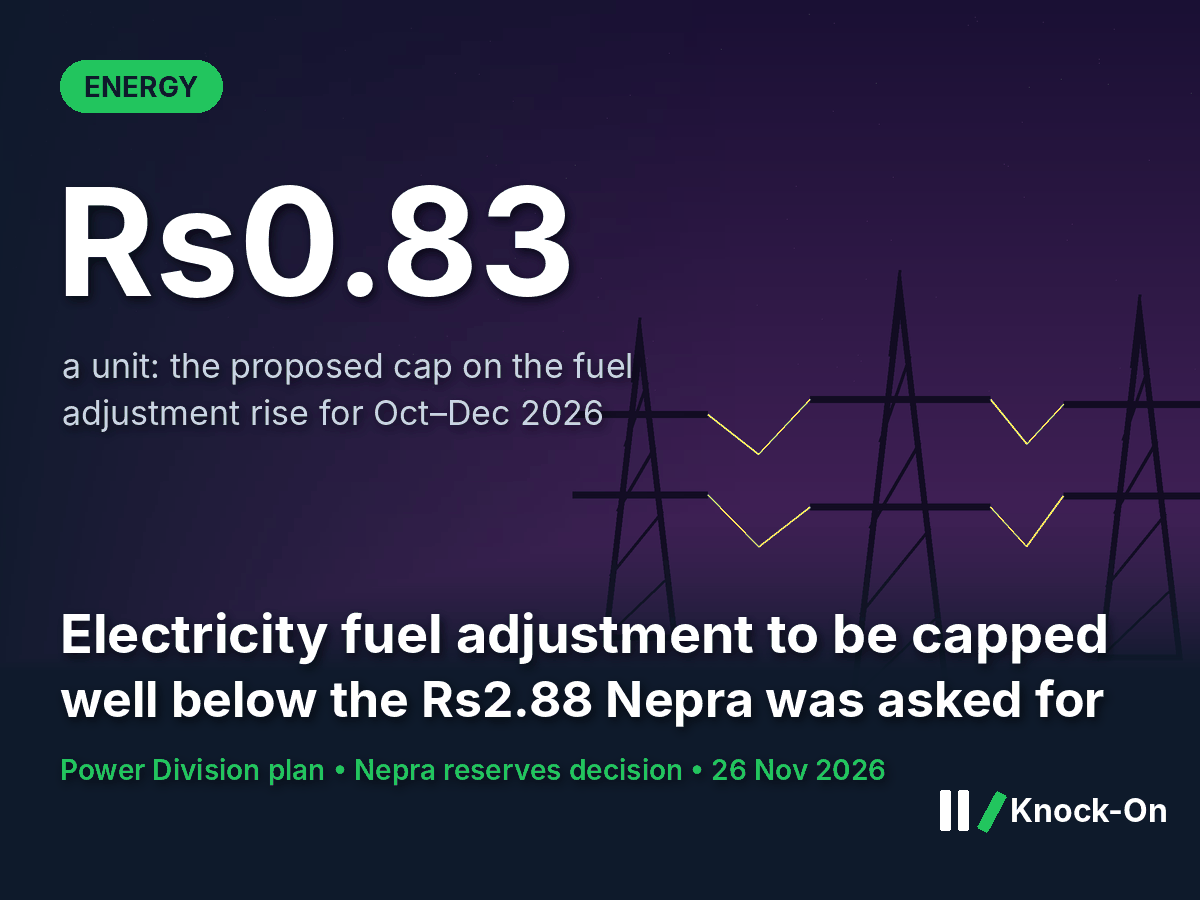
The government says it will hold the electricity fuel adjustment increase to about Rs0.83 a unit, including taxes, for October to December 2026. The announcement came on Thursday at a Nepra hearing on a request for Rs2.88 a unit for October fuel costs. For factories, shops and households, the plan matters as much for the certainty it offers over the winter as for the lower number. Nepra has reserved its decision, and the final terms depend on formal policy guidelines from the Power Division.
The short version
- The Central Power Purchasing Agency (CPPA-G) asked Nepra for a fuel charge adjustment of Rs2.8819 a unit for October, to be billed in December.
- The Power Division proposed a “forward-looking” adjustment that would limit the increase to about Rs0.83 a unit, including taxes, over the September FCA, for October–December 2026.
- Nepra reserved its decision. Policy guidelines were to be placed before the regulator by Friday morning, according to Dawn.
- The petition covered all distribution companies, including K-Electric.
What happened
CPPA-G’s petition said fuel for power delivered to the distribution companies cost Rs10.7515 a unit in October, against a reference of Rs7.8696 in the tariff, The Express Tribune reported. That gap produced the Rs2.88 electricity fuel adjustment request. Expensive fuels drove it: diesel-fired power cost Rs69.59 a unit and furnace oil Rs46.43, according to CPPA data reported by Aaj and Dunya.
At the hearing, Power Division Additional Secretary Mehfooz Bhatti said “the government has cleared the policy directive covering the October-December period”, Dawn reported, and asked Nepra to hold an early hearing if needed. Nepra member Amina Ahmed said the regulator would complete its due diligence as soon as possible after receiving the guidelines. Geo reported that Nepra reserved its decision. None of the sources says how the difference between the requested and capped amounts will be handled.
The government wants about Rs0.83, not Rs2.88
Fuel charge adjustment, rupees per unit, November 2026
Why it matters
Winter is when Pakistan’s power costs bite. Hydropower falls and, the Power Division says, thermal fuels make up more than 80% of generation in some winter months. RLNG and coal prices have risen with the Iran–US war, the same shock that is pushing up oil (see how the Saudi refinery attack put Pakistan’s run of petrol price cuts at risk). A fixed electricity fuel adjustment for three months lets businesses budget power costs instead of guessing each month.
The Power Division also used the statement to set out its tariff record: the national average tariff fell from Rs53.04 a unit in March 2024 to Rs44.28 by March 2026, and the industrial tariff from Rs62.99 to Rs44.50. It says load management saved consumers a possible Rs6–7 a unit in extra fuel charges between April and September, with combined FCA and quarterly adjustments held to an average of Rs2.38 a unit.
Industry gained most from two years of tariff cuts
Average electricity tariff incl. taxes, rupees per unit, March 2024 vs March 2026
The knock-on effects
First order: a smaller fuel charge on winter bills
If Nepra applies the guidelines, the electricity fuel adjustment on bills for the quarter would rise far less than the Rs2.88 petition implied. Households and businesses on K-Electric and the ex-Wapda companies would both be affected, since the petition covered all of them. Separately, Nepra reserved its decision on 17 November on a quarterly adjustment of about Rs1.34 a unit that the Discos want for December to February, The Express Tribune reported (see the Rs24bn quarterly tariff claim industrial users are contesting).
Second order: steadier costs for exporters
Textile mills and other power-heavy exporters price orders months ahead. A known fuel charge for the quarter reduces the risk of margin shocks, and adds to the gain from the industrial power tariff incentive package.
Third order: where the unrecovered cost sits
Fuel costs that are not billed now still have to be met somewhere: by later adjustments, by the budget, or by the power sector’s cash flow. Until the guidelines are public, that is the main open question for the circular debt and for the IMF programme’s power-sector targets.
Who could benefit
- Industry: textile, steel and cement plants with large winter power bills.
- Retail and services: commercial users, whose consumption has been rising, according to CPPA figures cited by Aaj.
- Households: a smaller fuel charge in the costliest season.
Who may face pressure
- Distribution companies and CPPA-G, if fuel costs are not recovered on time.
- The federal budget, if the gap is funded by the government.
- Fuel suppliers waiting on payments from the power sector.
What to watch
- Power Division policy guidelines to Nepra under section 31(4), due by Friday 27 November, according to Dawn.
- Nepra’s decision on the October FCA, and on the quarterly adjustment heard on 17 November.
- Whether the guidelines say how the unbilled fuel cost will be recovered.
- December bills, the first to reflect the decision.
Sources
- Dawn, Govt to limit additional fuel cost charges to consumers at 83 paise per unit, 26 Nov 2026
- Geo News, Govt proposes fixing fuel adjustment for October-December to limit power tariff hike, 26 Nov 2026
- Energy Update, Statement of Power Division regarding fixation of FCA for three months, 26 Nov 2026
- The Express Tribune, Rs1.34-per-unit tariff hike likely, 18 Nov 2026
- Aaj News, Electricity may become costlier by Rs2.88 per unit, 26 Nov 2026
- Dunya News, Electricity tariff likely to rise by Rs2.88 per unit across Pakistan today, 26 Nov 2026
This is analysis, not investment advice. Figures are as of 26 Nov 2026.

Leave a Reply