
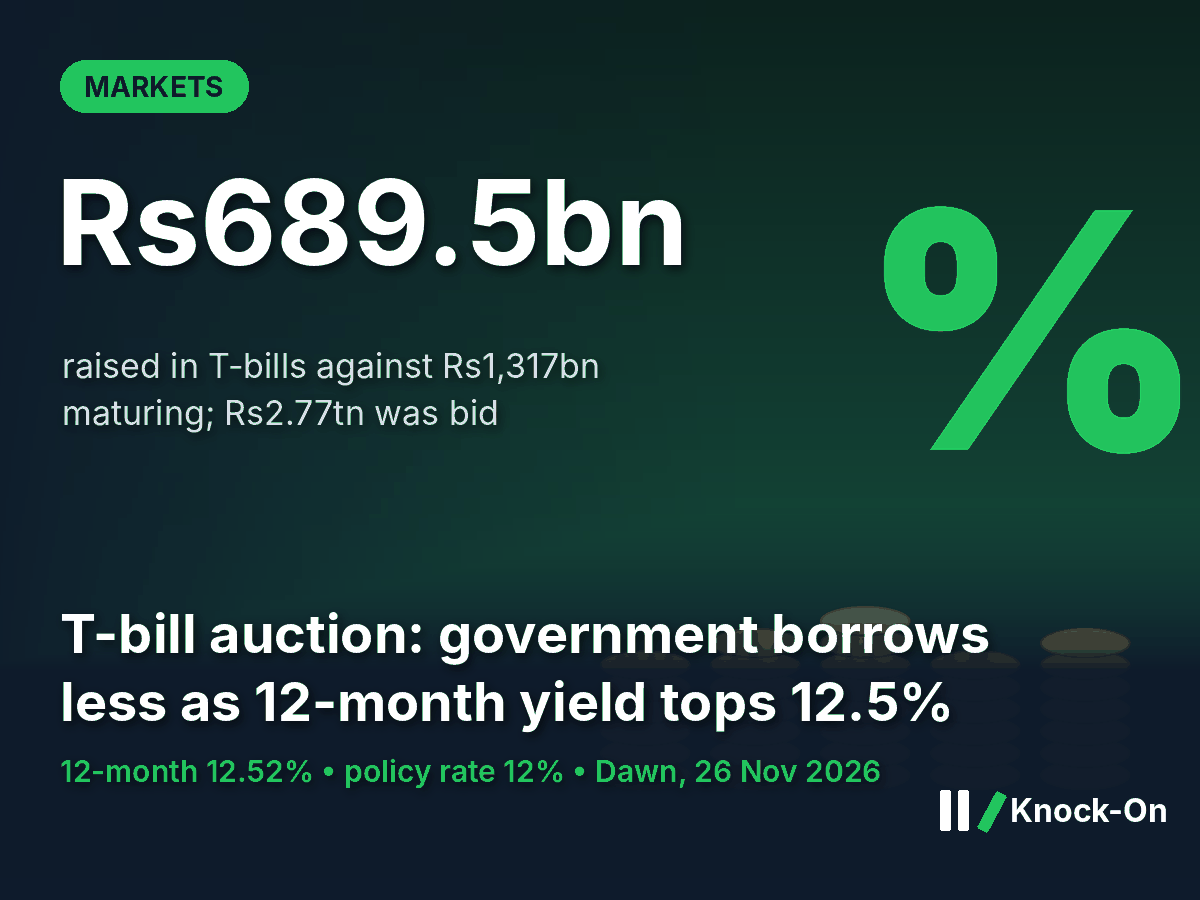
The government raised Rs689.5bn in the latest T-bill auction, short of its Rs750bn target and roughly half of the Rs1,317bn falling due, Dawn reported on 26 November. Banks were not short of cash: they bid Rs2.77tn. The T-bill auction instead shows a government choosing to borrow less short-term money, and a market pricing in higher rates at the longer end, with the 12-month yield rising to 12.52%, above the State Bank’s 12% policy rate.
The short version
- Rs689.5bn raised against a Rs750bn target and Rs1,317bn of maturities; bids totalled Rs2.77tn.
- Cut-off yields: 1-month 11.69% (down 19bps), 3-month 11.99% (unchanged), 6-month 12.29% (up 10bps), 12-month 12.52% (up 11bps).
- Most of the money, Rs515.9bn, came through non-competitive bids; Rs173.6bn was accepted in the auction itself.
- Some in the financial sector see room for another 50bps policy rate rise, Dawn reports.
What happened
According to Dawn, the 3-month bill drew the most interest, with bids of Rs902.8bn, but the government accepted only Rs69bn. It took Rs78.5bn in 12-month paper, Rs25bn in 1-month bills and just Rs1bn in 6-month bills, where bids were Rs483.9bn. Experts quoted by the paper said the bidding showed ample bank liquidity and a government less interested in short-term borrowing. Long-term Pakistan Investment Bonds remain the priority, and their outstanding stock is now double that of T-bills.
Banks offered Rs2.77tn; the government took Rs689.5bn
T-bill auction, Rs billion, reported 26 Nov 2026
Why it matters
T-bill yields are the base for bank deposit and lending rates. The 12-month yield is now 52bps above the 12% policy rate, which suggests investors expect rates to stay high or rise. Dawn reports that some in the financial sector see room for a 50bps increase, citing double-digit average inflation over the past four months, while the State Bank of Pakistan expects inflation to ease to 5–7% by the end of FY27. Standard Chartered has also forecast the SBP interest rate could rise to 13% by June 2027.
The knock-on effects
First order: cash goes back to banks
By retiring about Rs627bn more than it raised (a Knock-On calculation), the government returns liquidity to banks. That continues the trend in our report that Pakistan’s domestic debt fell Rs1.64tr in July–September.
Second order: borrowing costs for business
Rising longer-tenor yields tend to feed into KIBOR-linked loan pricing. Firms with floating-rate working-capital loans would feel any rise first, even before the SBP moves.
Third order: the policy signal
Shifting debt to longer bonds lowers refinancing risk, which matters as the IMF board meets on 11 December, as covered in our story on the $1.21bn IMF tranche for Pakistan. Banks with excess liquidity may push more into private lending, or into long bonds.
Who could benefit
- Savers and money-market funds, as 12-month paper yields above the policy rate.
- Banks, which earn more on longer-dated government paper.
- The federal budget, over time, from lower short-term refinancing needs.
Who may face pressure
- Borrowers on floating rates, including SMEs and consumer-finance customers.
- Leveraged companies listed on the PSX, if rate-rise expectations firm up.
- Property and auto demand, which depend on loan costs.
What to watch
- November CPI inflation data, due in early December.
- 11 December: IMF board meeting on Pakistan’s next tranche.
- The SBP’s next monetary policy decision and the next T-bill and PIB auctions.
Sources
- Dawn, Govt raises Rs689bn via treasury bills, 26 Nov 2026
This is analysis, not investment advice. Figures are as of 26 November 2026.


Leave a Reply