
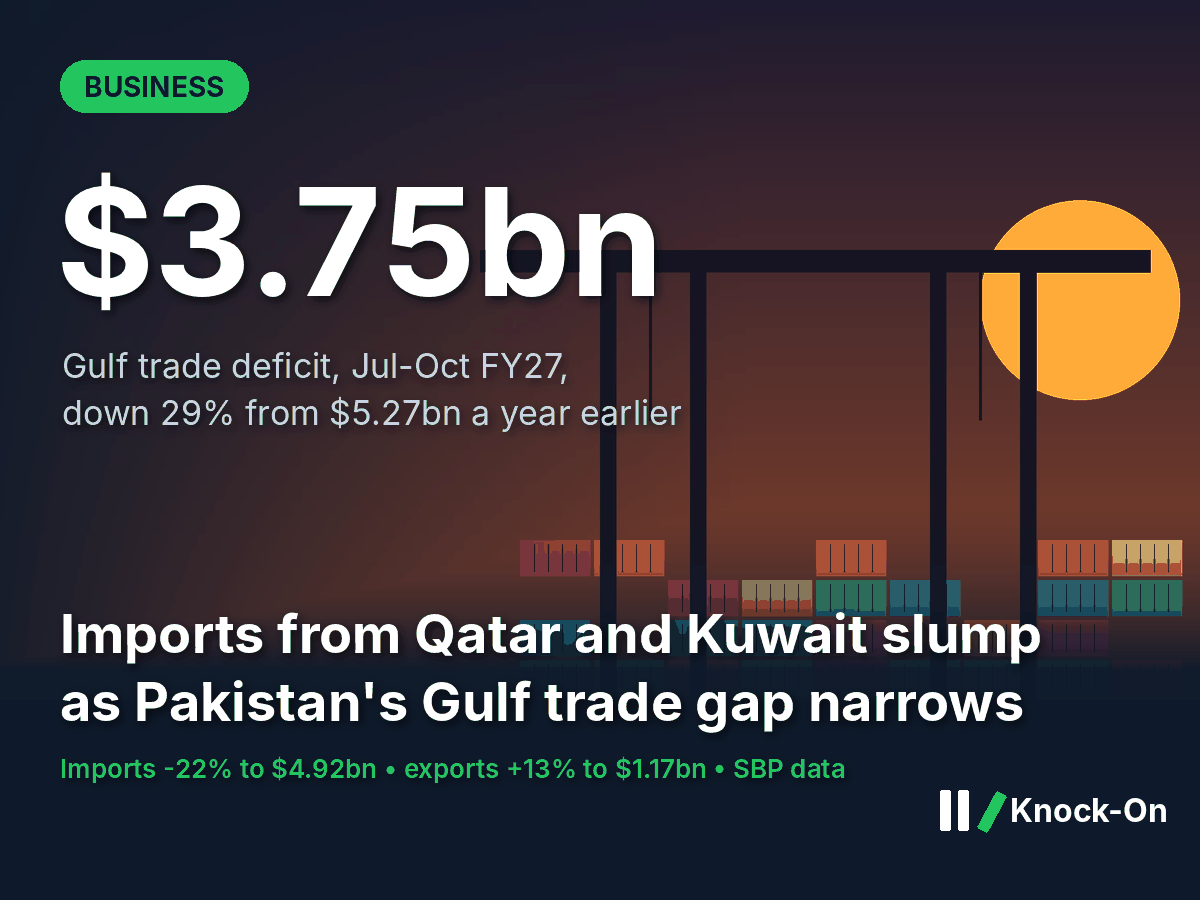
Pakistan’s Gulf trade deficit narrowed sharply in the first four months of the fiscal year, to $3.75bn from $5.27bn a year earlier, according to State Bank of Pakistan data compiled by Dawn. On paper that is good news for the current account. But the detail shows the gap shrank mainly because Pakistan bought far less from Qatar and Kuwait, at a time when Gulf energy routes have been disrupted, while exports grew only modestly. For businesses, the question is whether this is a lasting improvement or a supply squeeze.
The short version
- The deficit with seven Middle Eastern countries fell 28.96% to $3.747bn in July–October FY27.
- Import payments fell 22.09% to $4.920bn; export receipts rose 12.76% to $1.173bn.
- 91.31% of the improvement came from lower imports; lower purchases from Qatar and Kuwait alone cut imports by $1.212bn.
- Imports from Oman rose by $343m, nearly doubling the deficit with Oman.
What happened
Data from the State Bank of Pakistan for Saudi Arabia, the UAE, Qatar, Kuwait, Oman, Bahrain and Jordan show the Gulf trade deficit falling to $3.747bn in July–October, from $5.274bn in the same months last year, Dawn reported. Imports dropped to $4.920bn from $6.315bn, while exports rose to $1.173bn from $1.041bn.
Falling imports, not rising exports, shrank the Gulf gap
Pakistan’s trade with seven Middle Eastern countries, July–October, $bn
The country detail explains the swing. Imports from Kuwait fell 85.88% and from Qatar 73.01%; together they account for 86.89% of the net fall in import payments. Imports from Saudi Arabia fell 18.61% and from the UAE 9.70%. Imports from Oman went the other way, up 78.59%. On exports, sales to the UAE rose 17.58%, to Oman 20.77% and to Saudi Arabia 9.52%, while exports to Qatar fell 32.27% and to Kuwait 8.89%. The UAE and Saudi Arabia together took 85.75% of Pakistan’s export receipts from the region and supplied 75.05% of its imports.
Why it matters
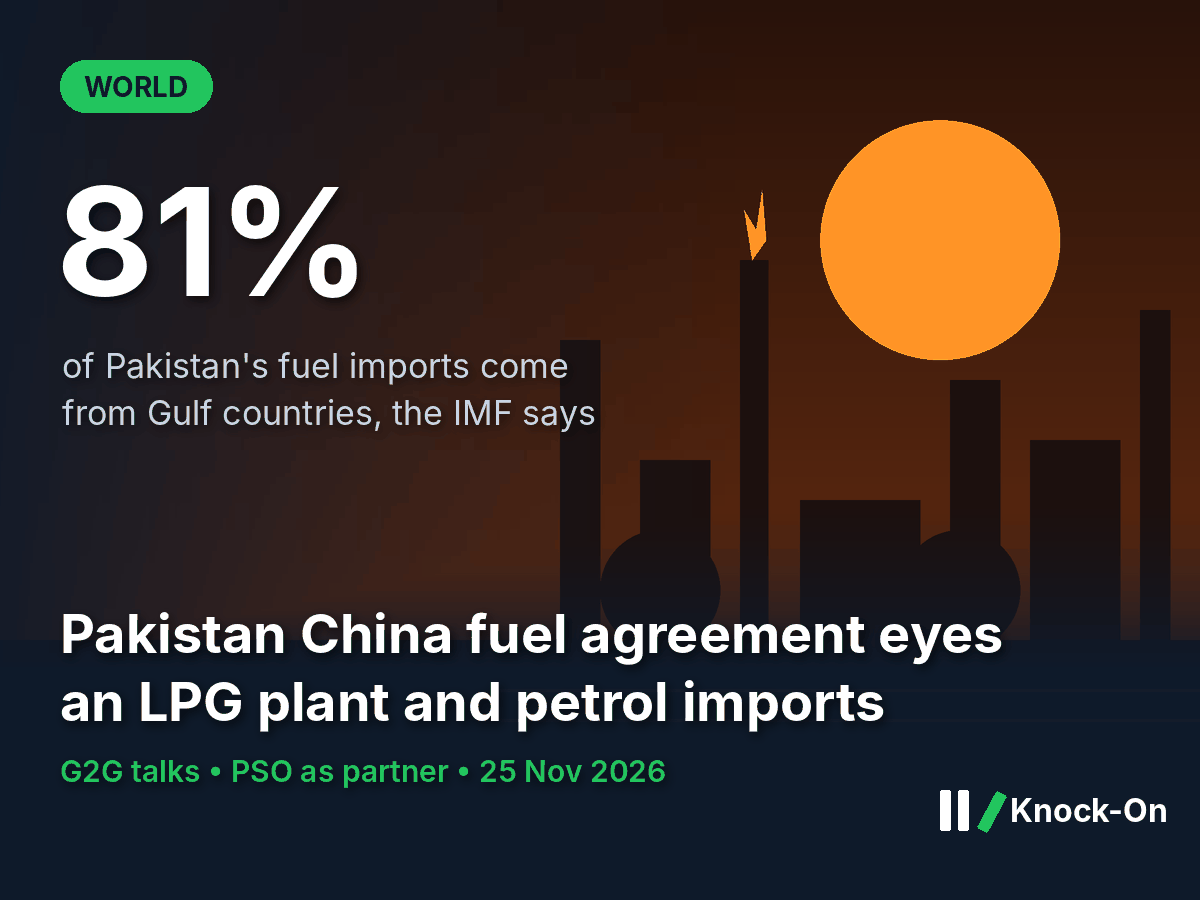
The Gulf is Pakistan’s main source of fuel and one of its biggest export and remittance markets, so this corridor drives a large part of the external account. A smaller Gulf trade deficit eases pressure on dollars. But Dawn notes these imports are sensitive to disruption in energy supply routes, and the sharpest drops came from two energy suppliers while trade with Oman, which has stepped up as a fuel source, grew. That pattern points to rerouted and constrained supply as much as to lower demand. It fits the Oman oil credit facility for PSO agreed this month.
The knock-on effects
First order: a better Gulf trade balance for the current account
About $1.4bn less spent on imports from the region over four months (Knock-On calculation) means less demand for dollars, which supports the rupee and reserves ahead of the IMF board review due on 11 December.
Second order: supply concentration shifts
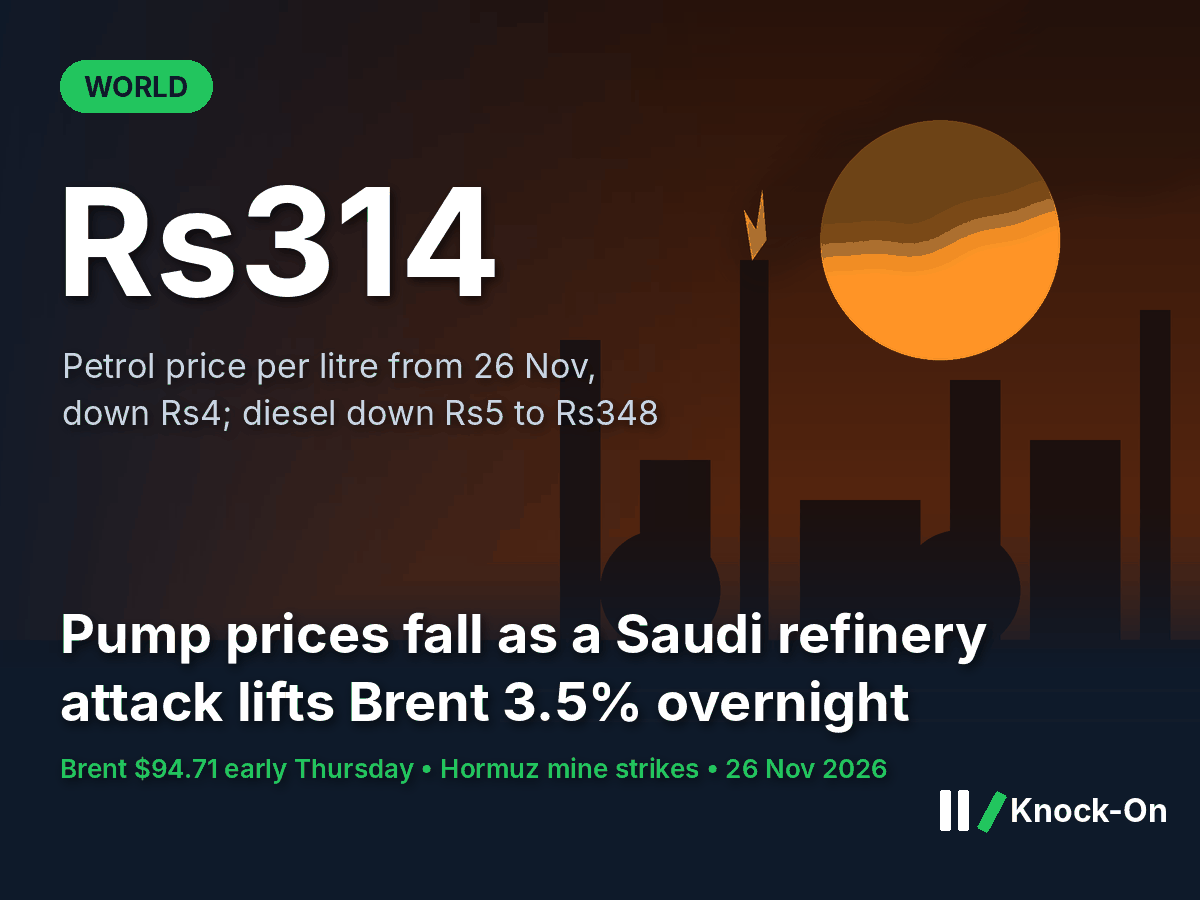
Buyers are leaning more on Saudi Arabia, the UAE and Oman. New attacks on Saudi energy sites and shipping, covered in our story on the petrol price in Pakistan and the Ras Tanura attack, show the risk of that concentration.
Third order: exporters still lag
Exports covered under a quarter of imports from the region. Only 8.69% of the improvement came from higher exports, so a rebound in energy imports could quickly widen the gap again.
Who could benefit
- Exporters to the UAE and Oman, where sales rose 17.58% and 20.77%.
- The SBP and the rupee, from lower dollar outflows.
- Omani suppliers and traders handling the extra volumes.
Who may face pressure
- Exporters to Qatar and Kuwait, where sales fell 32.27% and 8.89%.
- Energy-dependent industry, if lower imports mean tighter supply rather than lower need.
- Shippers and freight forwarders on disrupted Gulf routes, as discussed in our piece on Hormuz shipping attacks.
What to watch
- November trade data from PBS and SBP in early December.
- The IMF board meeting on 11 December.
- Whether imports from Qatar and Kuwait recover if Gulf shipping normalises.
Sources
- Dawn, Trade gap with Gulf narrows, 26 Nov 2026
- Dawn, Stocks falter on geopolitical uncertainty, 26 Nov 2026
This is analysis, not investment advice. Figures are as of 26 November 2026.
Leave a Reply