
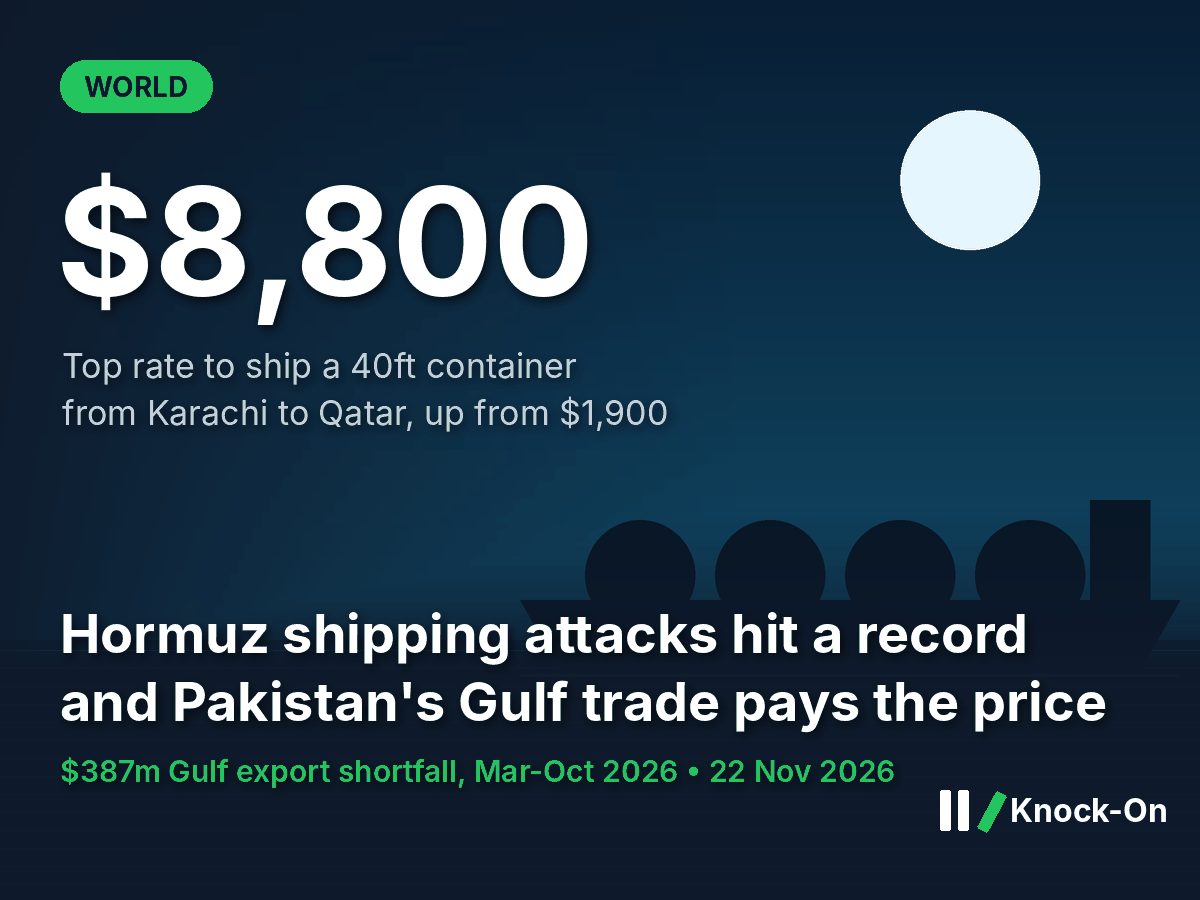
Hormuz shipping attacks have climbed to their highest level since the US–Iran war began in late February, according to maritime data reported by ABC News on 21 November. For Pakistan, the issue is not only the diplomacy. It is the cost of moving goods to its Gulf customers, which has already cut exports to the region by $387m since March, and the oil price, which still moves on every new strike in the strait.
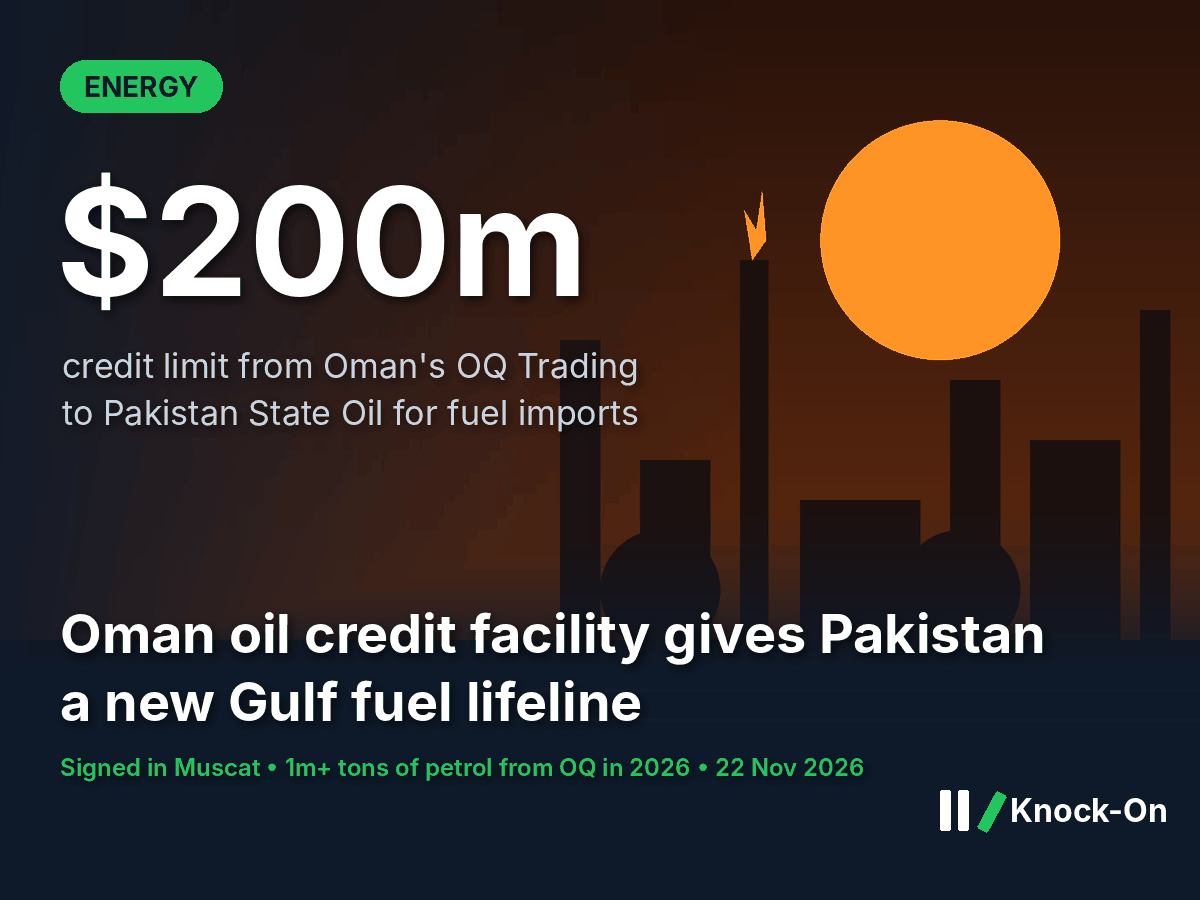
Update, 22 Nov 2026, 9:00 pm PKT: Pakistan is widening its fuel supply base in response to the Gulf disruption. Oman’s OQ Trading has agreed to give Pakistan State Oil a $200 million credit limit for petroleum purchases, the Petroleum Division said on Sunday (Arab News). Read our analysis: what the Oman oil credit facility means for fuel supply.
The short version
- The UK Maritime Trade Operations centre (UKMTO) counted 31 attacks in and around the Strait of Hormuz in October and about 19 in November up to 18 November, more than in any earlier month of the war.
- Pakistan’s commerce ministry puts the shortfall in exports to the six Gulf Cooperation Council (GCC) states at $387m for March–October 2026.
- A 40-foot container from Karachi to Qatar’s Hamad port now costs $8,500–$8,800, against $1,300–$1,900 before the war.
- Brent still ended last week down about 3.4% at $92.57, its third weekly fall, so the risk is showing up in freight and insurance more than in crude.
What happened
UKMTO logged 53 incidents from March to September. October alone brought 31, and November had about 19 by the 18th, ABC News reported. The International Maritime Organization, which counts more conservatively, recorded 34 attacks in October and November so far. Most of the tankers hit were in the southern part of the strait, close to the Omani coast. That is the route the US has used to keep some oil moving through ship-to-ship transfers while it blockades Iranian ports, a blockade that began on 13 April.
Analysts quoted by ABC said Tehran appears to be trying to make those workarounds more costly and less reliable. Iran’s Revolutionary Guards said on Saturday that they had shot down two US drones over the strait, Al Jazeera reported; the US military made no immediate comment. Iran’s foreign minister, Abbas Araghchi, said Iran’s seven conditions “must be implemented for the Strait of Hormuz to reopen”. President Donald Trump said on Friday that Iran wants a deal, but not one he can accept.
For Pakistani exporters, the cost is already visible. In a presentation to a parliamentary panel reported by Arab News on 12 November, the commerce ministry said exports to the GCC fell $316.9m, or 32.3%, in March–June compared with a year earlier. The fall narrowed to $69.8m, or 6.4%, in July–October as firms adapted. In the first phase, exports to the UAE fell 42.7% ($264.8m) and to Qatar 49.8%, while Saudi Arabia slipped only 1.7%.
Shipping a box from Karachi to the Gulf now costs three to four times more
Freight for one 40-foot container, top of the quoted range, US$, before the war vs now (Nov 2026)
Why it matters
The Gulf is one of Pakistan’s closest export markets, buying meat, other farm goods and textiles, and it is also where its oil, LNG and remittances come from. When Hormuz shipping attacks rise, Pakistan pays twice: once in freight and insurance on what it sells, and again in the risk premium on what it buys. A US Maritime Administration alert from October, obtained by Al Jazeera, warned of “further war-risk premium spikes, crew refusals and effective tanker capacity contraction”. OPEC data cited in the same report showed insurance for a Middle East–East Asia crude cargo rising about 200-fold between January and end-October, to $12.29 a barrel. We saw the same squeeze in Pakistan’s mango exports, which fell 36% this year.
The knock-on effects
First order: dearer freight on Hormuz-linked routes
Exporters to Qatar and Kuwait face freight four times higher than before the war, and to the UAE about three times higher. The government has cut port handling charges by up to 60%, negotiated air-freight rates with Gulf carriers and added cargo flights for meat, the commerce ministry said.
Second order: oil stays a hostage to the strait
Brent rose 59 cents on Friday after reports of tanker incidents near Hormuz, even in a week when it fell overall on surplus forecasts. That cushion has helped Pakistan’s frequent fuel price revisions, as we noted when the oil price fall brought petrol to Rs322. A sharper escalation could reverse it quickly.
Third order: market share and orders
Some shipments have been redirected to Southeast Asia and Africa and through the Khunjerab border with China, the ministry said. If high costs persist, Gulf buyers may settle on other suppliers, which would be harder to win back than a lost season.
Who could benefit
- Air-cargo operators carrying perishable goods such as meat to the Gulf on extra flights.
- Exporters to Saudi Arabia, where sales held up far better than elsewhere in the GCC.
- Firms with diversified markets in Southeast Asia, Africa or China that can redirect cargo.
Who may face pressure
- Small exporters to the UAE, Qatar and Kuwait selling on thin margins.
- Textile and farm-goods exporters that rely on sea freight to the Gulf.
- Importers of fuel and LNG if war-risk premiums keep rising.
What to watch
- 29 November: the OPEC+ meeting that sets 2027 output levels.
- Early December: November trade data from the Pakistan Bureau of Statistics, for any change in Gulf exports.
- Talks: whether US–Iran contacts move beyond public statements; earlier coverage of Hormuz tanker attacks and Pakistan’s call at the UN sets out Islamabad’s position.
- Weekly fuel prices: the next revision will show whether Friday’s oil bounce holds.
Sources
- ABC News, Strait of Hormuz attacks have increased to highest level since Iran war began, 21 Nov 2026
- Arab News Pakistan, Pakistan suffers $387 million Gulf export shortfall due to US-Iran war, 12 Nov 2026
- Al Jazeera, US maritime agency warned Iran blockade was adding to rising Gulf premiums, 20 Nov 2026
- Al Jazeera, Iran says it downed US drones over Hormuz as bid to end war remains stalled, 21 Nov 2026
- FinanceFeeds, Brent Crude Price $92.57: 8 Days to OPEC+ 2027 Quota Call, 21 Nov 2026
- Arab News Pakistan, Pakistan secures $200 million Oman oil credit facility amid Iran war disruptions, 22 Nov 2026
This is analysis, not investment advice. Figures are as of 22 November 2026. Knock-On is not affiliated with any political party.
Leave a Reply