
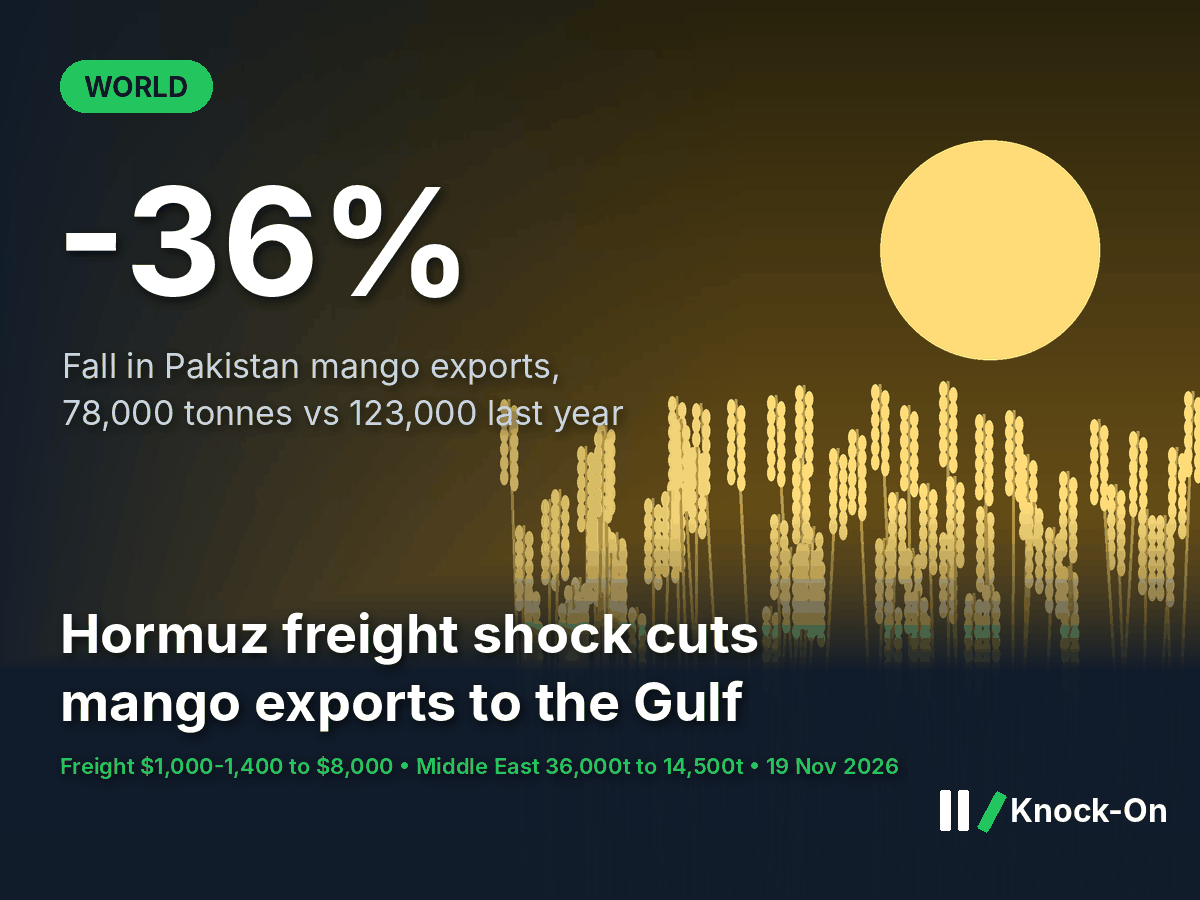
Pakistan’s mango exports fell 36% this year to 78,000 tonnes, from 123,000 tonnes last year, according to the All Pakistan Fruit and Vegetables Exporters Association. The association blames the US-Iran war: the months-long near-closure of the Strait of Hormuz lengthened shipping times and pushed freight rates to the Middle East, Pakistan’s biggest mango market, from $1,000-1,400 to about $8,000. Export earnings fell from about $100m to around $60m, the association’s chief told Anadolu Agency.
The short version
- Mango exports fell to 78,000 tonnes from 123,000 tonnes, a 36% drop, exporters say.
- Sales to the Middle East fell from 36,000 tonnes to 14,500 tonnes, about 60% lower (Knock-On calculation).
- Freight rates rose from $1,000-1,400 before the war to about $8,000, the association says.
- Earnings fell from about $100m to around $60m, a loss of roughly $40m in foreign exchange.
What happened
Waheed Ahmed, who heads the exporters’ association, told Anadolu Agency, in a report carried by Dawn on 19 November, that the near-closure of the Strait of Hormuz and higher freight costs hit Middle East shipments hardest. “The freight rate that was $1,000-1,400 before the US-Iran war, now stands at $8,000,” he said. Longer transit times also hurt a perishable fruit that must reach shelves within days.
The UAE and Oman are the main Gulf buyers, especially of the Chaunsa variety, followed by Saudi Arabia, with Kuwait and Qatar also importing significant quantities. Exports to Afghanistan were disrupted by repeated border closures. The association also says climate change has cut Pakistan’s total mango production by 35%; output was about 1.9m tonnes a year until 2018.
Gulf sales fell much faster than total mango exports
Pakistan mango exports, tonnes, last year vs this year
Why it matters
The fall in mango exports shows how the Iran war reaches Pakistani businesses far from the oil market. The Middle East took about 29% of Pakistan’s mango exports last year but only about 19% this year (Knock-On calculation). A roughly $40m loss is small against the national trade deficit of $14.63bn in July-October, but it lands on a narrow group of orchard owners, packers and exporters in southern Punjab and Sindh.
Freight to the Gulf is up to eight times higher
Freight rate quoted by mango exporters, US$, before the war vs now
The knock-on effects
First order: mango exporters lose their closest market
Higher freight and slower voyages make Gulf shipments uneconomic for a fruit with a short shelf life. Exporters either sell less or absorb costs that wipe out margins.
Second order: growers and packers feel the price squeeze
Fruit that cannot be shipped stays in the domestic market, which can push down farm-gate prices. Packing houses, cold storage operators and transporters that depend on export volumes see less work.
Third order: horticulture’s export case weakens
Pakistan has been trying to grow farm exports to new markets, including the US, where mangoes are part of ongoing trade talks. A falling crop and war-driven freight costs make it harder to show buyers a steady supply.
Who could benefit
- Domestic buyers: fruit diverted from export may keep local supply ample in season.
- Processors: pulp, juice and dried-fruit makers could find cheaper raw mangoes.
- Exporters to other markets: those with routes that avoid the Gulf face less disruption.
Who may face pressure
- Mango exporters reliant on the UAE, Oman and Saudi Arabia.
- Orchard owners in southern Punjab and Sindh, already facing lower yields.
- Exporters of other perishables, such as fruit and vegetables, that ship to the Gulf by sea.
What to watch
- Whether shipping through the Strait of Hormuz returns to normal before the next season; the oil market outlook is one signal.
- Freight rates quoted to Gulf ports in the months before the next mango season starts.
- Progress on Pakistan-US trade talks covering mangoes.
- The Pakistan-Afghanistan border, which has repeatedly closed.
Sources
- Dawn (Anadolu Agency), Pakistan’s mango exports fall 36pc amid US-Iran war: exporters’ association, 19 Nov 2026
This is analysis, not investment advice. Figures are as of 19 November 2026 and are the exporters’ association’s own estimates. Knock-On is not affiliated with any political party.

Leave a Reply