
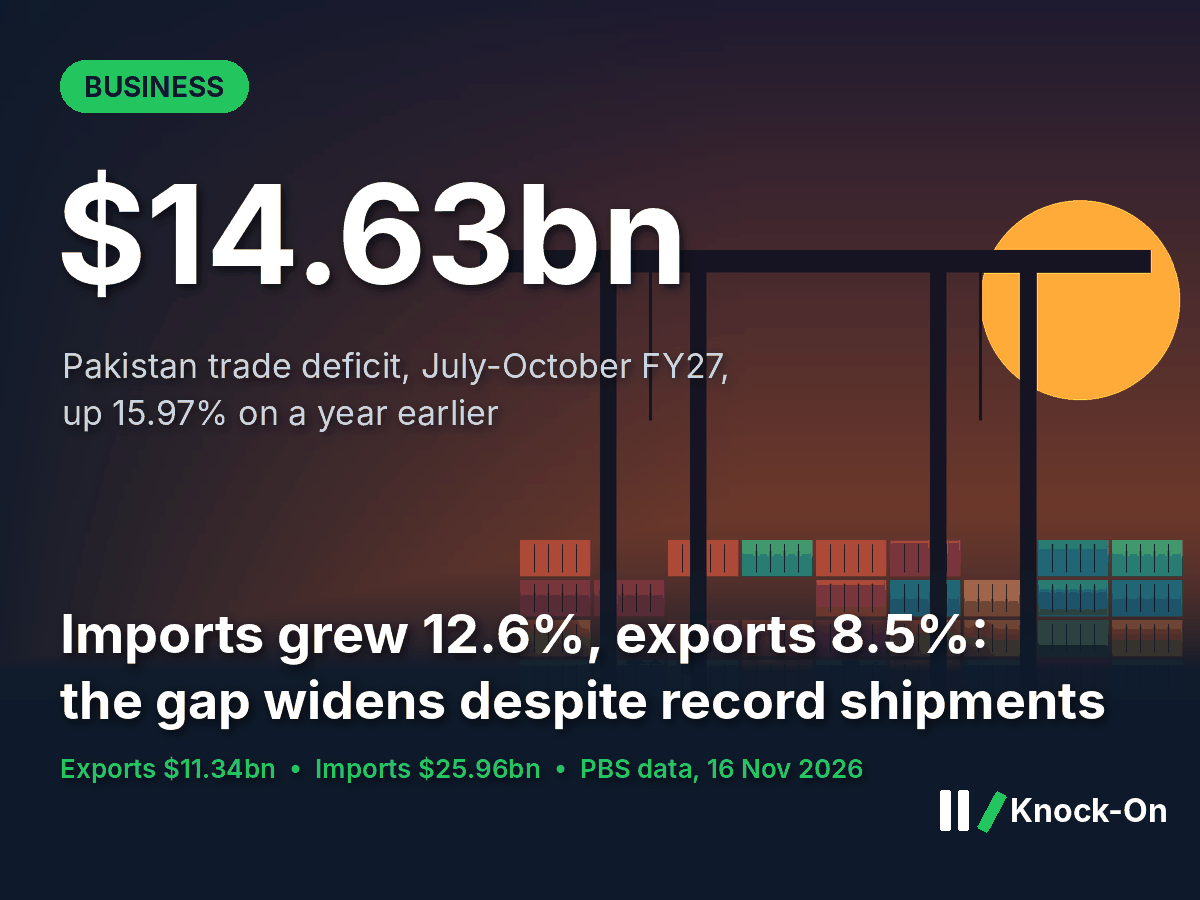
Pakistan’s trade deficit widened to $14.63bn in the first four months of the 2026-27 fiscal year, up 15.97% from a year earlier, according to provisional data from the Pakistan Bureau of Statistics (PBS) reported on 16 November. Goods exports reached a record of about $11.34bn, but imports grew faster, to $25.96bn. For businesses, the headline about record exports matters less than the gap, because the gap is what the rupee, foreign reserves and the State Bank have to finance.
The short version
- July-October exports rose 8.52% to $11.34bn; imports rose 12.59% to $25.96bn (PBS, via Profit).
- The trade deficit widened by $2.01bn to $14.63bn, up 15.97%.
- October alone: exports up only 2.84% to $2.93bn, imports up 11.81% to $6.81bn, deficit up 19.70% to $3.88bn.
- Imports added about $3.26 for every extra $1 of exports this year (Knock-On calculation).
What happened
PBS figures reported by Profit show goods exports of $11.336bn in July-October FY27, against $10.446bn in the same months of FY26, an increase of $890m or 8.52%. The state news agency APP, in a report carried by Business Recorder, rounded this to about $11.4bn and an 8.8% rise, and called it a record high. Imports rose by $2.904bn to $25.964bn. As a result, the Pakistan trade deficit for the four months reached $14.628bn, compared with $12.614bn a year earlier.
The monthly picture is weaker. October exports were $2.929bn, only 2.84% above October 2025 and almost flat on September’s $2.923bn. October imports were $6.806bn, up 11.81% on the year and 5.72% on the month, which pushed the monthly deficit to $3.877bn, up 19.70% year on year. In rupee terms, four-month exports rose 6.64% to Rs3.146tr, less than the dollar growth, which reflects the exchange rate over the period.
Imports grew three times as much as exports in dollar terms
Pakistan goods trade, July-October, US$ billion, FY26 vs FY27 (provisional)
Why it matters
A wider Pakistan trade deficit means more dollars leave the country to pay for goods than come in from selling them. So far this year, strong remittances have helped cover that gap; Knock-On reported that October remittances rose 13.8% to $3.89bn. The State Bank has also said that remittances, not exports, are holding the economy steady. If imports keep rising faster than both, the current account comes under pressure, and so does the rupee.
The knock-on effects
First order: more demand for dollars
Importers need about $2.9bn more than last year for the same four months. That adds steady demand in the interbank market. The PBS release does not break imports down by product, so it is not yet clear how much came from fuel, machinery or food.
Second order: less room on reserves and rates
A growing gap makes it harder to build foreign reserves and may make the SBP more cautious about easing policy. Higher imports can also signal recovering demand, which is good for growth but adds to the external bill.
Third order: exporters’ competitiveness in focus
October export growth of 2.84% suggests momentum has slowed. APP’s report said sustaining export growth needs lower production costs, competitive energy prices and better access to finance. Earlier data showed exports to the US grew only 4.4% in the first quarter, while imports from the US jumped.
Who could benefit
- Exporters earning dollars, if pressure on the rupee builds.
- Ports, shipping and logistics firms, which handle higher import volumes.
- Banks with trade-finance and foreign-exchange businesses.
Who may face pressure
- Importers of raw materials and machinery, if the rupee weakens.
- Consumers of imported goods, through prices.
- Policymakers trying to rebuild reserves under the IMF programme.
What to watch
- The SBP’s current account figures for October.
- The PBS product-level breakdown of exports and imports for October.
- Global oil prices, which drive Pakistan’s fuel import bill.
- PBS trade figures for November, the next monthly release.
Sources
- Profit (Pakistan Today), Pakistan’s merchandise exports rise 8.52% to $11.34 billion in first four months of FY27, 16 November 2026
- Business Recorder (APP), 4MFY27 goods exports soar 8.8pc to USD11.4bn YoY, 16 November 2026
This is analysis, not investment advice. Figures are as of 16 November 2026 and are provisional.


Leave a Reply