
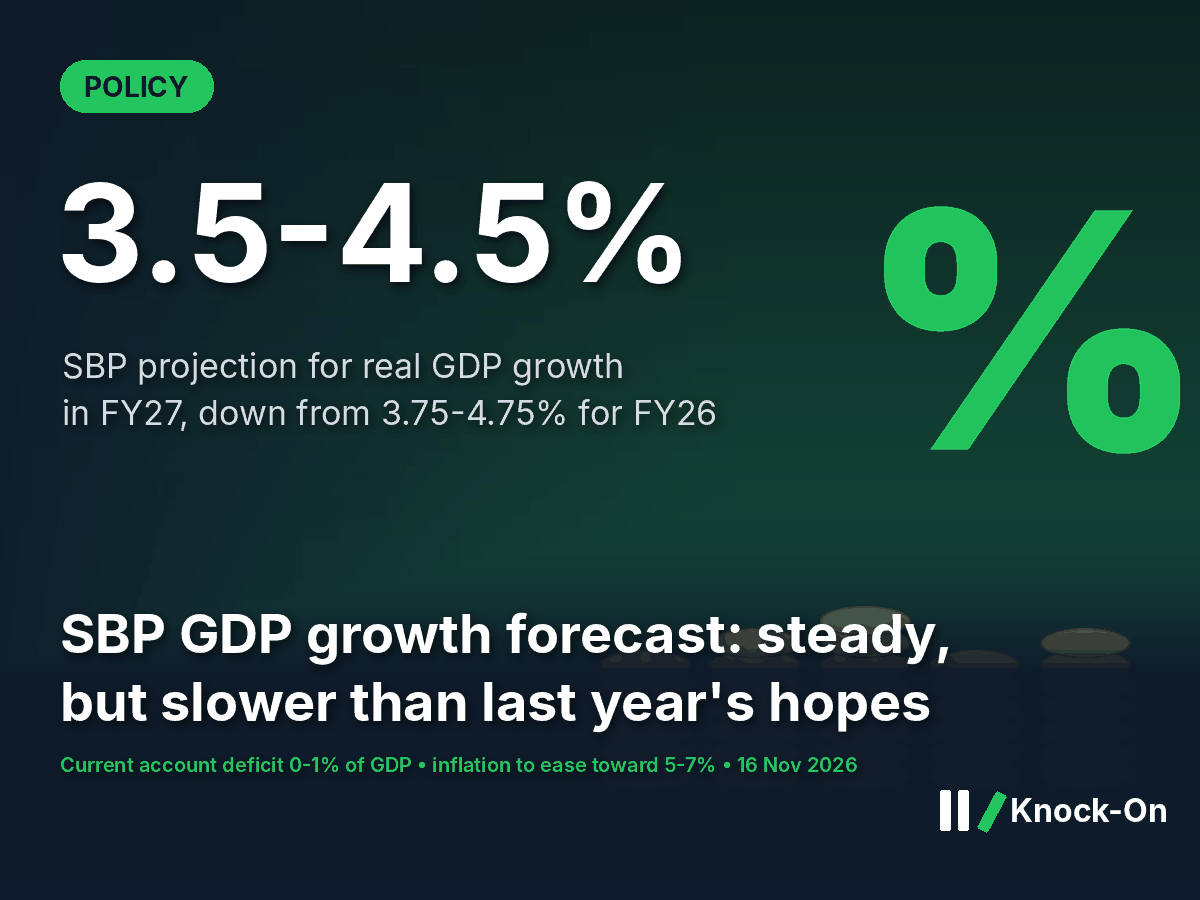
The SBP GDP growth forecast for the current fiscal year, FY27, is 3.5% to 4.5%, the State Bank of Pakistan said on Monday in its annual report on the State of Pakistan’s Economy for 2025-26. That is a quarter of a percentage point lower at both ends than the 3.75-4.75% range it had set for FY26. For businesses, the message is steady but modest demand, an economy still leaning on remittances, and inflation that the central bank expects to ease only gradually.
The short version
- The SBP projects real GDP growth of 3.5-4.5% in FY27, after a recovery in FY26 led by large-scale manufacturing.
- The current account deficit is expected at 0-1% of GDP, held down by remittances; it was 0.1% of GDP in FY26.
- Inflation, in double digits year-on-year since April 2026 because of the Middle East energy shock, is expected to ease gradually toward the 5-7% target range.
- The SBP names the energy price shock and a worsening El Niño as the key risks.
What happened
The State Bank released its annual report for FY26 on 16 November, according to Business Recorder. It says real GDP growth rose in FY26, led by a rebound in large-scale manufacturing, and projects the SBP GDP growth range for FY27 at 3.5-4.5%. It expects growth to come from a gradual recovery in domestic demand and better output in agriculture and industry, with services following.
In its half-year report in May, the SBP had said FY26 growth would be close to the lower end of its 3.75-4.75% range. Real GDP grew 3.8% in the first half of FY26, the same report said. The chart below sets those numbers side by side.
The SBP’s growth range has moved down a quarter point
Real GDP growth, %; projection ranges shown at their midpoints
On prices, the SBP says average inflation in FY26 stayed close to the upper bound of its 5-7% target, but year-on-year inflation went into double digits from April 2026 after the Middle East energy shock. It expects inflation to ease gradually toward the target range during FY27. Imports are expected to grow, and exports to recover moderately.
Why it matters
The SBP GDP growth forecast sets the tone for bank lending, corporate planning and the IMF conversation. A 3.5-4.5% range points to an economy that is growing, but not fast enough to change hiring or investment plans on its own. The report also shows where the stability comes from: remittances. The SBP says continued momentum in workers’ remittances is likely to keep the current account deficit within 0-1% of GDP, even as imports rise. October alone brought in $3.89bn in remittances, led by Saudi Arabia and the UAE.
The SBP also says a $3bn Eurobond raised in September, its own dollar purchases and expected official inflows should help reserves build toward four months of import cover.
The knock-on effects
First order: a modest SBP GDP growth outlook for demand
Firms selling to the domestic market, from cement to consumer goods, are being told to expect a gradual pick-up in demand, not a boom. The SBP links growth to agriculture and industry first, with services following.
Second order: inflation keeps borrowing costs in focus
With inflation easing only gradually, borrowers have little reason to expect quick relief. The State Bank raised its policy rate to 12% in October as oil and wheat prices climbed. The report’s emphasis on the energy shock suggests the oil price will remain central to its next decisions.
Third order: farm risk could spill into food prices
The SBP warns that a worsening El Niño threatens the agricultural outlook, though it says kharif output of sugarcane, rice and maize is up on last year. A weaker rabi harvest would hit rural incomes, food inflation and agri-linked industries such as fertiliser and flour milling.
Who could benefit
- Banks and remittance channels: strong inflows support deposits, fee income and the rupee.
- Manufacturers: the SBP credits large-scale manufacturing with leading the FY26 recovery.
- Importers: a contained current account deficit and rising reserves lower the risk of import curbs.
Who may face pressure
- Exporters: the SBP says exports were held back in FY26 by global conditions and expects only a moderate recovery.
- Energy-intensive firms: the global energy price shock remains the main source of inflation pressure.
- Farmers and agri-businesses: El Niño is the risk the SBP flags most directly for agriculture.
What to watch
- The next SBP monetary policy decision, and whether it cites the annual report’s inflation path.
- Monthly remittance and current account data from the SBP in December.
- Government fiscal data after a first-quarter surplus that shrank 40%.
- Rabi sowing and El Niño updates over the winter.
Sources
- Business Recorder, State of Pakistan’s Economy: SBP projects GDP growth at 3.5-4.5% in FY27, 16 November 2026
- Business Recorder, SBP projects Pakistan’s FY26 GDP growth at 3.75-4.75%, warns of Middle East war risks, 12 May 2026
This is analysis, not investment advice. Figures are as of 16 November 2026.


Leave a Reply