
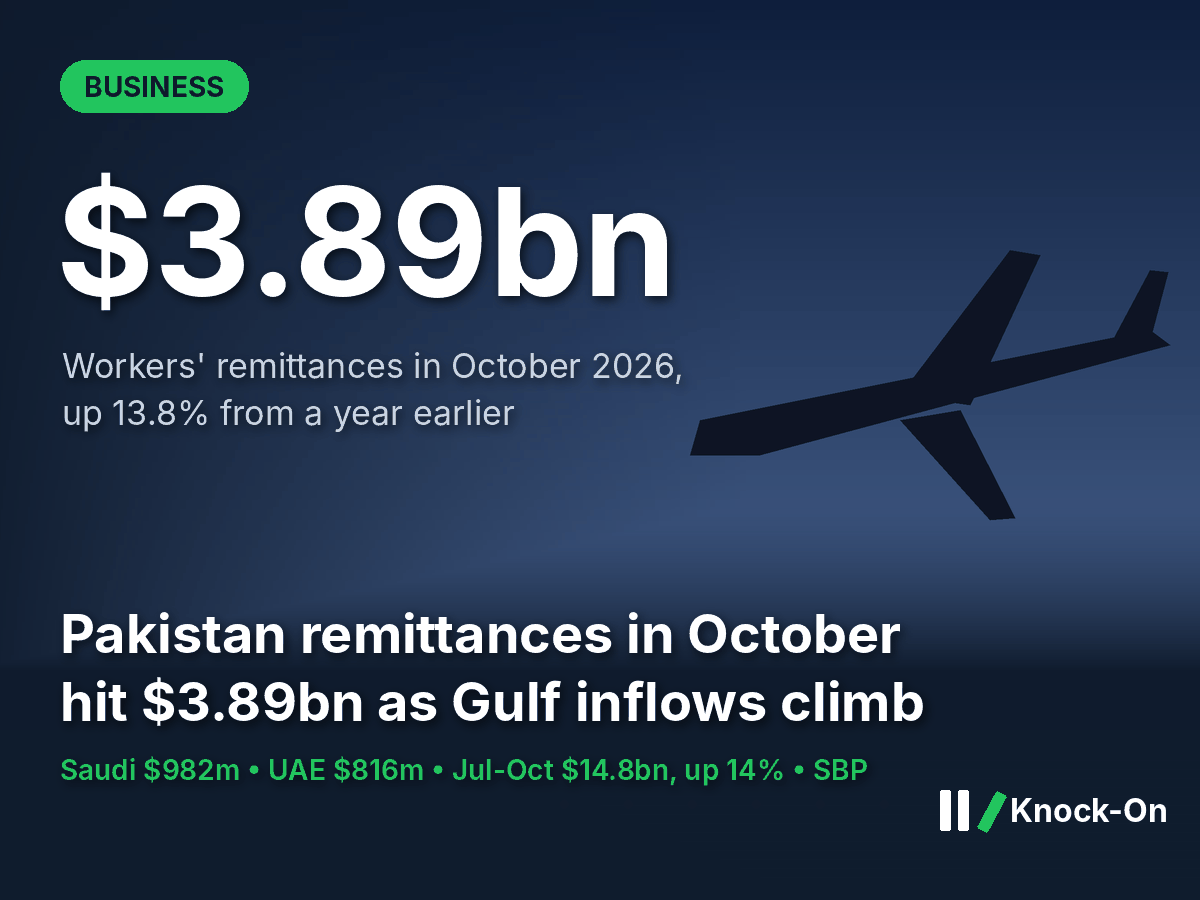
Pakistan remittances in October came in at $3.89 billion, up 13.8% from $3.42 billion a year earlier and 8.5% higher than September, according to State Bank of Pakistan data reported on Tuesday, 10 November 2026. Saudi Arabia and the UAE together sent about $1.8 billion. For businesses, the money from roughly 10 million Pakistanis abroad is one of the main reasons the rupee and the import bill have stayed manageable while oil prices swing with the US-Iran conflict.
The short version
- Workers’ remittances were $3.89bn in October 2026, up 13.8% year on year and 8.5% month on month.
- July–October inflows reached $14.8bn, up 14% from $13bn in the same period last year.
- Saudi Arabia ($982m) and the UAE ($816m) were the top two sources, with the UK third at $592m.
- The SBP has raised its full-year forecast to $45bn, from $44bn.
What happened
Business Recorder reported that inflows grew across the main corridors. Remittances from Saudi Arabia rose 17% on the year, from $838 million to $982 million. The UAE was up 16% to $816 million, and the UK up 19% to $592 million. Money from the United States rose 9% to $329 million, while inflows from the European Union were $461 million, 3% more than in September.
The Gulf still sends the most money home
Workers’ remittances to Pakistan by source, US$ million, October 2026 (change on October 2025)
Daily Pakistan’s tally of SBP monthly data puts inflows over the past 12 months at about $43.4 billion. SBP Governor Jameel Ahmed has described remittances as resilient and said the bank now expects $45 billion for the fiscal year to June 2027.
Why it matters
Remittances bring in dollars without creating a debt that must be repaid. That helps pay for fuel, machinery and raw materials, and supports the rupee. Emre Akcakmak of East Capital wrote on X that remittances, at a trailing 12-month level of $44 billion by his count, now cover all of Pakistan’s external deficits and equal about 10% of GDP, Business Recorder reported. He called them “Pakistan’s oil”. Those are his estimates; the reports did not publish a current-account figure to check them against. The trend does match the build-up in reserves covered in our story on Pakistan’s record forex reserves.
The knock-on effects
First order: more dollars for the rupee and reserves
Strong Pakistan remittances add to banks’ foreign exchange supply each month. That reduces pressure on the rupee and makes it easier for importers to open letters of credit.
Second order: a cushion against oil shocks
Because most money comes from the Gulf, inflows are tied to the region’s economies and jobs. So far, conflict in the Middle East has not dented them. That matters for planning: if oil prices rise again, as discussed in our analysis of the Iran war impact on Pakistan, remittances help pay the bigger fuel bill. Investors noticed: the market rally covered in KSE-100 today came on the same day as the data.
Third order: household spending and the policy rate
Families that receive remittances spend on food, housing, education and consumer goods, supporting retailers, builders and banks in many smaller cities. A steadier external account also gives the SBP more room when it weighs inflation against growth, though rate decisions depend on prices too.
Who could benefit
- Banks and exchange companies: higher transfer volumes and more deposits.
- Importers: better dollar availability and a steadier rupee.
- Retail, property and construction: remittance-funded household spending.
- Government finances: less need for new foreign borrowing to fund the external gap.
Who may face pressure
- Exporters, if a firmer rupee squeezes their earnings in rupee terms.
- Informal money-transfer operators, as more flows move through banks.
- Policymakers, because heavy reliance on Gulf jobs leaves the economy exposed to any downturn in the region.
What to watch
- November remittance data from the SBP, due in December.
- The October current-account balance, which will show how far remittances offset the trade gap.
- Weekly SBP reserve figures, and whether the $45bn full-year forecast holds.
- Gulf labour markets and oil prices as US-Iran talks continue.
Sources
- Business Recorder, Pakistan records $3.9bn in remittances for October 2026, 10 Nov 2026
- Business Recorder, Remittances now cover Pakistan’s entire external deficit, says analyst, 10 Nov 2026
- Daily Pakistan, Overseas Pakistanis send $3.9 Billion in October as 12-Month Remittances hit $43 Billion, 10 Nov 2026
This is analysis, not investment advice. Figures are as of 10 November 2026.

Leave a Reply