
The Iran war impact on Pakistan could intensify again within weeks. The Wall Street Journal reported on Tuesday that Washington has told several Gulf Arab countries to prepare for a possible “short, intense military campaign” against Iran after the 3 November US midterm elections. A day earlier, President Donald Trump called the Pakistan-brokered Islamabad Memorandum of Understanding “sort of a waste of time”, and on Wednesday Iran accused the US of “contempt for diplomacy”. For Pakistani businesses, the question is simple: what happens to fuel, freight and financing costs if the fighting returns?
The short version
- The US has reportedly told Gulf states to prepare for strikes on Iran after 3 November; the White House declined to comment on “sensitive military plans that may or may not exist”.
- Trump dismissed the Islamabad MoU, which Pakistan helped mediate in June; Pakistan urged both sides at the UN Security Council to honour it.
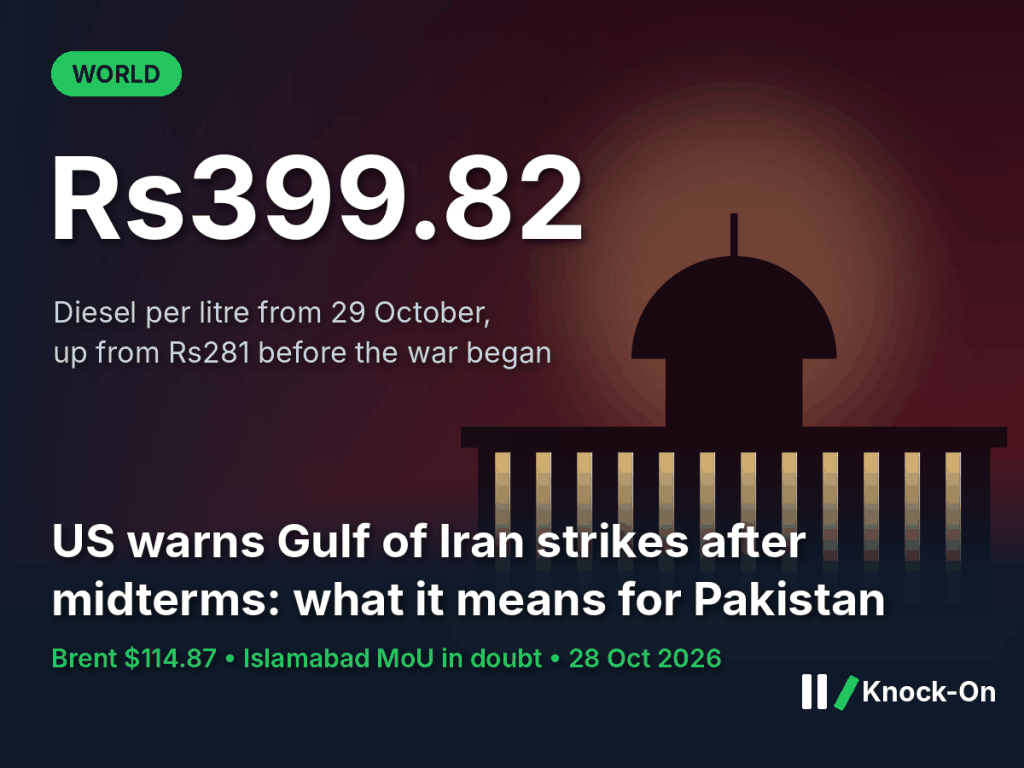
- Brent rose 0.87% to $114.87 a barrel on Wednesday. From 29 October, diesel is Rs399.82 a litre in Pakistan, about 42% above its pre-war level.
- Daily fuel pricing means any oil spike would reach Pakistani pumps within days.
What happened
According to the Wall Street Journal report, carried by Anadolu Agency and The Express Tribune, the messages were passed through diplomatic and military channels. Officials cited by the newspaper said an extra aircraft carrier strike group is expected to join about 20 US warships in the region next month. The report said Trump has not made a final decision. The White House said he “keeps all options on the table to ensure that Iran can never have a nuclear weapon.” Asked on Tuesday about strikes after the midterms, Trump said: “anything’s possible.”
At a rally on Monday, Trump said the Islamabad MoU was “sort of a waste of time. But, you know, you like to listen to professionals,” the Sunday Guardian reported. Iranian Foreign Ministry spokesperson Esmaeil Baghaei replied on X that the remark exposed “the hollowness of their diplomatic commitments.” At the UN Security Council on 27 October, Pakistan’s acting permanent representative Usman Jadoon said a diplomatic settlement “has become more critical than ever” and urged both sides to honour their MoU commitments and return to talks. Separately, Qatari mediators have given Iran a new draft deal, and Tehran is expected to respond by the end of the week, an official told Reuters. Knock-On has followed the Pakistan-brokered Iran deal and the Hormuz talks since last week.
Fuel is down from its April peak but still about 42% above pre-war prices
Pump prices in Pakistan, rupees per litre: before the war, at the 3 April peak, and from 29 October 2026
Why it matters
The first months of the war showed how the Iran war impact on Pakistan travels: through oil. After the US and Israel attacked Iran on 28 February and Tehran effectively closed the Strait of Hormuz, diesel in Pakistan rose from Rs281 a litre to a peak of Rs520.35 on 3 April, Dawn reports. Prices have eased since, but the government still collects about Rs114 a litre in taxes and duties on petrol and Rs100 on diesel. A renewed campaign that disrupted Gulf shipping again would hit a country that now resets diesel and petrol prices every day. UBS already expects Brent to stay near $110 until the end of the year, as Knock-On noted in its oil price forecast for Pakistan.
The knock-on effects
First order: a risk premium on oil and freight
Oil markets are already pricing the threat; Brent was up more than 2% at one point on Wednesday. Higher crude would lift Pakistan’s import bill and, through daily pricing, transport and farm costs almost immediately.
Second order: Gulf jobs, remittances and shipping
Houthi missiles and drones are again being aimed at Saudi Arabia, according to the Saudi-led coalition. Wider fighting in the Gulf would raise insurance and freight costs on Pakistan’s main trade routes and put pressure on the economies that employ millions of Pakistani workers.
Third order: inflation, rates and diplomacy
Another oil shock would make it harder for the State Bank to reverse its recent rate rise. Pakistan’s role as a mediator also gives it a stake in whether talks survive, and the Islamabad MoU is now under open challenge from Washington.
Who could benefit
- Local oil and gas producers: their prices are linked to international crude.
- Solar and storage suppliers: fuel price spikes strengthen the case for replacing diesel generators.
Who may face pressure
- Transporters and farmers: diesel is close to Rs400 a litre already.
- Importers and exporters: shipping and insurance costs rise with Gulf risk.
- Airlines: jet fuel and airspace closures raise costs.
- The government’s budget: pressure to cut the petroleum levy grows when pump prices climb.
What to watch
- By the end of this week: Iran’s response to the new Qatari draft deal.
- Sunday, 1 November: the OPEC+ meeting on December output.
- Tuesday, 3 November: the US midterm elections, after which strikes may follow, according to the WSJ report.
- Daily: Petroleum Division price notifications.
Sources
- The Express Tribune (Anadolu), US warns Gulf states of possible ‘short, intense’ Iran war after midterms: report, 28 October 2026
- The Express Tribune, Pakistan urges US, Iran to honour Islamabad MoU during UNSC debate, 28 October 2026
- The Express Tribune, Iran sees only unacceptable ideas in latest mediation to end war, 28 October 2026
- Sunday Guardian, Trump rejects Pakistan-brokered Iran peace deal, 28 October 2026
- Fox News, Trump says ‘anything’s possible’ regarding potential strikes on Iran after midterm elections, 28 October 2026
- The National, Oil prices up due to Houthi strikes and US threat to renew Iran war, 28 October 2026
- Dawn, Diesel price nears Rs400 as govt adds over a rupee to petrol, HSD rates, 28 October 2026
This is analysis, not investment advice. Figures are as of 28 October 2026. Knock-On is not affiliated with any political party.

Leave a Reply