
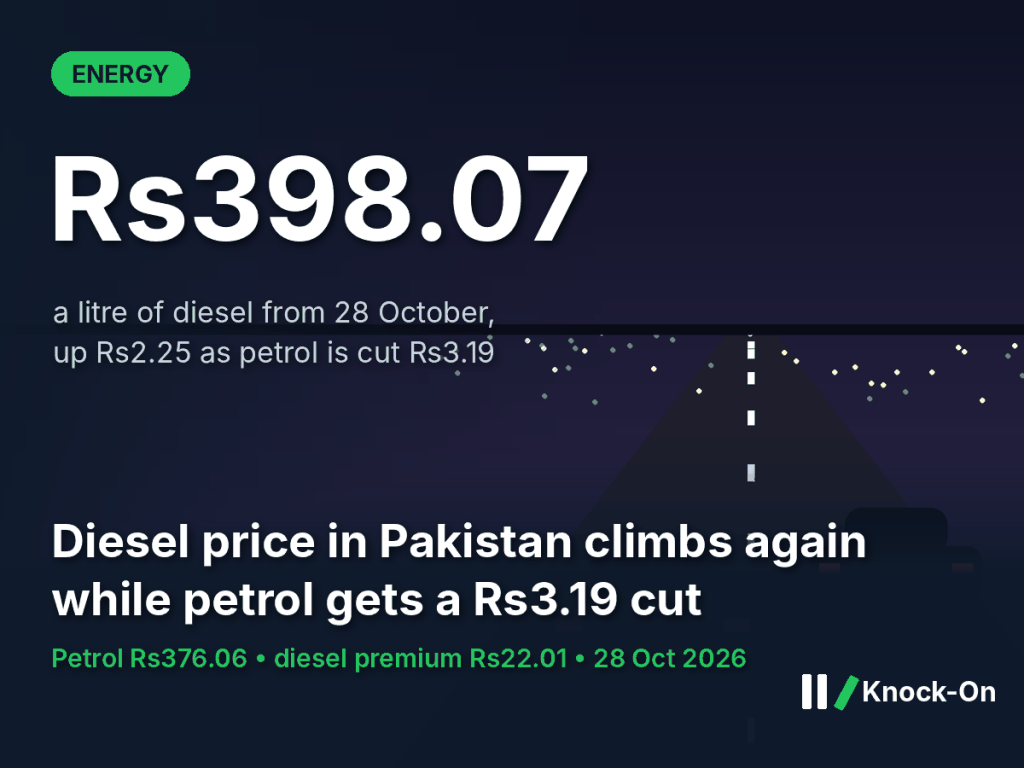
The diesel price in Pakistan rises by Rs2.25 to Rs398.07 a litre from Wednesday, 28 October, while petrol is cut by Rs3.19 to Rs376.06, the Petroleum Division said on Tuesday night. The two fuels are now moving in opposite directions under daily pricing. Commuters on motorcycles get a little relief; truckers, farmers and factories running generators pay more again.
The short version
- Diesel: Rs395.82 to Rs398.07 a litre (+Rs2.25). Petrol: Rs379.25 to Rs376.06 (−Rs3.19). Effective 28 October.
- Diesel now costs Rs22.01 a litre more than petrol, up from Rs16.57 a day earlier (Knock-On calculation).
- Diesel is still about 24% below its 3 April peak of Rs520.35, but about 42% above its early-March level of Rs281.
- Jamaat-i-Islami says it will march on Islamabad in mid-November if there is no major relief on the petroleum levy.
What happened
According to a Petroleum Division press release reported by Business Recorder, the Oil and Gas Regulatory Authority (OGRA) revised ex-depot prices under the government’s pricing mechanism, citing “global developments, including changes in Platts rates, premiums and incidentals.” The new diesel price in Pakistan is Rs398.07 a litre and petrol is Rs376.06. A day earlier, diesel had risen by Rs2.16 and petrol by Rs1.54, as covered in our report on the petrol price in Pakistan reaching Rs379.25.
Daily pricing was announced on 17 July because of swings in world oil markets after renewed US–Iran hostilities. Dawn reports that the government still collects Rs114 a litre in levies and taxes on petrol and Rs100 on diesel. Diesel peaked at Rs520.35 on 3 April, after rising from Rs281 when the war began on 28 February.
Diesel is below its April peak but 42% above pre-war
High-speed diesel pump price, rupees per litre, March–October 2026
Why it matters
Diesel is the fuel of business: Dawn notes it runs heavy transport, power plants and large generators, while petrol mainly fuels private cars, rickshaws and two-wheelers. A rising diesel price in Pakistan therefore reaches freight rates, crop costs and factory overheads, even when petrol eases. Since mid-July, diesel is up Rs74.77 a litre (23.1%) against Rs65.35 (21.0%) for petrol (Knock-On calculation). The timing is awkward: the State Bank has just made the SBP interest rate hike to 12%, citing energy prices among its inflation worries.
The knock-on effects
First order: the diesel price in Pakistan raises running costs
A truck burning 100 litres a day pays Rs225 more per day than on Tuesday. A motorcyclist using 20 litres of petrol a month saves about Rs64 (Knock-On calculations).
Second order: freight and food
Transporters usually pass diesel costs into freight charges, which feed into food and retail prices. Farmers face higher tractor and tubewell costs during wheat sowing.
Third order: pressure on the levy
Jamaat-i-Islami chief Hafiz Naeemur Rehman met the prime minister, and the two sides agreed to form a joint committee to consider widening the fuel relief scheme, Dawn reports. The party wants the levy abolished. Any cut would ease pump prices but reduce a large source of government revenue.
Who could benefit
- Motorcycle and small-car users: the petrol cut adds to the existing petrol subsidy scheme for two-wheelers and small cars.
- Ride-hailing and delivery riders: slightly lower daily fuel bills.
- CNG, EV and solar suppliers: the widening diesel gap strengthens the case for switching.
Who may face pressure
- Goods transporters on fixed-rate contracts.
- Farmers running tractors and diesel tubewells.
- Factories and telecom towers that rely on diesel generators.
- Consumers, through freight-driven food prices.
What to watch
- Next daily revision: Brent fell about 1.8% to $113.72 on Tuesday, according to The Express Tribune; product prices decide whether that reaches pumps.
- Iran diplomacy and Houthi attacks on Saudi Arabia: see our report on the Makkah pact Iran talks in Tehran.
- Mid-November: Jamaat-i-Islami’s deadline for levy relief and the joint committee’s work.
- The next weekly SPI inflation reading, for signs of fuel costs in food prices.
Sources
- Business Recorder, Govt cuts petrol price by Rs3.19, hikes diesel by Rs2.25 per litre, 27 Oct 2026
- Dawn, Govt cuts petrol price by Rs3.19 per litre, ups high-speed diesel rate by Rs2.25, 27 Oct 2026
- The Express Tribune, Govt cuts petrol by Rs3.19, increases diesel by Rs2.25 for Oct 28, 27 Oct 2026
- APP, Diesel price rises by Rs2.16, petrol by Rs1.54 per litre, 26 Oct 2026 (July comparison prices)
This is analysis, not investment advice. Figures are as of 27 October 2026.


Leave a Reply