
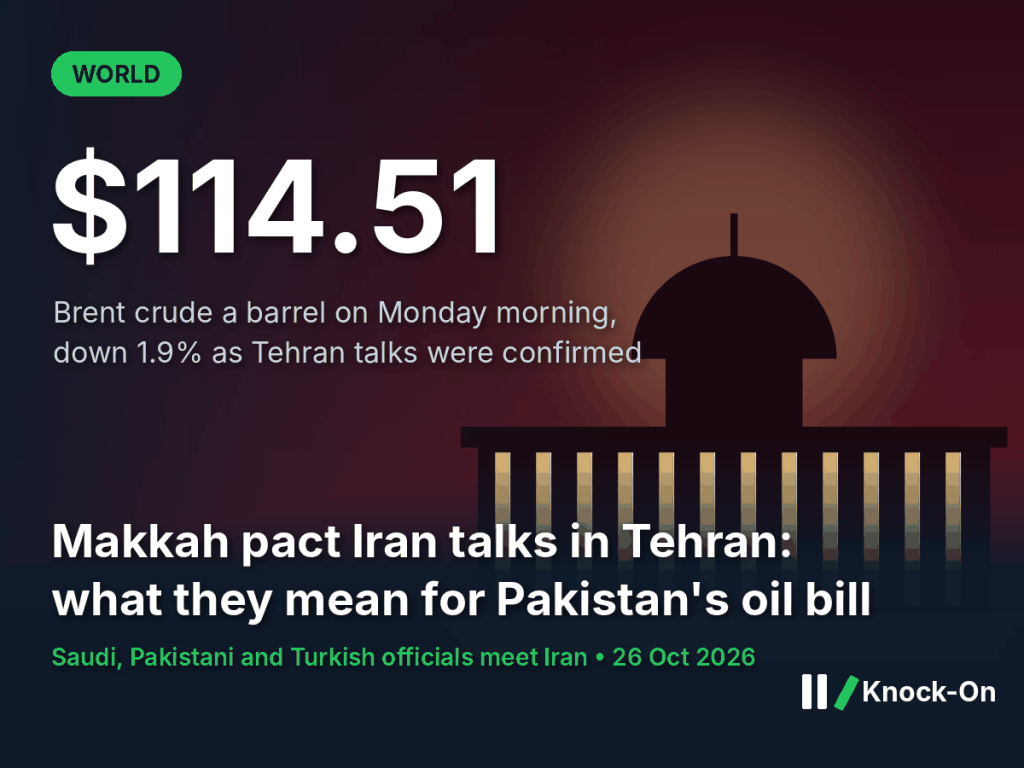
The Makkah pact Iran talks were due to open in Tehran on Monday, with Pakistan’s army chief, Field Marshal Asim Munir, joining Saudi Arabia’s defence minister and Turkey’s intelligence chief, according to Iranian officials and sources cited by Reuters. Oil markets read the meeting as a small step towards calm: Brent crude fell 1.9% to $114.51 a barrel on Monday morning. For Pakistani businesses, what matters is whether talks like these can bring oil prices down for longer than a day.
The short version
- Senior officials from Saudi Arabia, Pakistan and Turkey, the three members of the Makkah Joint Defence Agreement, were due to meet Iranian security officials in Tehran on 26 October.
- An Iranian official called the four-party meeting “an important and effective step”. It is the first high-level contact between Iran and all three countries since Houthi attacks on Saudi Arabia escalated.
- Brent fell $2.21 to $114.51 on Monday morning, after rising 6% last week. It is still far above its level at the start of October.
- The talks come on the same day the State Bank of Pakistan announces its interest rate decision, with oil a key input.
What happened
Ali Bagheri Kani, deputy secretary of Iran’s Supreme National Security Council, told state television that Saudi Defence Minister Prince Khalid bin Salman, Field Marshal Munir and Turkish intelligence chief Ibrahim Kalin would hold consultations on regional security, 24 News reported. He said the meeting was proposed during Field Marshal Munir’s visit to Tehran the previous week. A source told Arab News that the army chief “has departed for Iran”. A Saudi Foreign Ministry official told Al Arabiya the visit was part of efforts to ease regional tensions, Arab News reported.
Pakistan, Saudi Arabia and Turkey signed the Makkah pact in August. Under it, an attack on one member counts as an attack on all. Pakistan approved the pact last week, and Turkey’s parliament has begun ratification, Reuters reported. Iran’s ambassador in Islamabad said at the weekend that Tehran would study the pact and could support it “if it is good”, as covered in our report on the Pakistan-brokered Iran deal.
Oil reacted before the meeting began. Brent was down $2.21 at $114.51 and US crude down $2.23 at $101.04 at 04:26 GMT, Reuters reported, as Qatari mediators visited Tehran on Sunday in coordination with the US. Analysts quoted by Reuters were cautious: Vandana Hari of Vanda Insights said the “reprieve may prove temporary” and that risks remain “skewed to the upside”.
Monday’s dip leaves Brent far above where October began
Brent crude, US dollars per barrel, October 2026
Why it matters
Pakistan buys most of its fuel abroad, so every move in Brent reaches pump prices, freight and inflation. Diesel was raised to Rs393.66 a litre for 24 to 26 October, with petrol held at Rs377.71, Business Recorder reported, and the next price is due this week. The Makkah pact Iran talks matter because Saudi Arabia, a major oil supplier and Pakistan’s largest source of remittances, is now under attack from the Houthis, as set out in our analysis of the Saudi attacks impact on Pakistan. Any channel that lowers the risk to Gulf oil facilities and shipping is a channel that could ease Pakistan’s import bill.
The knock-on effects
First order: fuel prices and the PSX
A lasting fall in crude would ease pressure on the next fuel price reviews. Equities are watching too: the KSE-100 was down about 830 points on Monday morning, with oil and rate worries cited, Business Recorder reported.
Second order: interest rates
Most analysts polled by Topline expect the State Bank to raise its 11.5% policy rate on Monday, partly because of oil. Our SBP interest rate decision preview sets out the case on each side. Calmer oil would not change today’s decision, but it would shape the next one.
Third order: Pakistan’s diplomatic and financial standing
Pakistan is now both a mediator between Washington and Tehran and a defence partner of Riyadh. If that role helps reduce the conflict, it could strengthen ties with Gulf financing partners. If talks fail and the pact is tested, Pakistan’s security commitments would grow.
Who could benefit
- Transporters, airlines and factories if lower crude feeds into diesel, jet fuel and furnace oil prices.
- Importers if shipping and insurance costs through the Gulf ease.
- Families of Gulf workers if a calmer region protects jobs and remittances.
Who may face pressure
- Diesel users, from truckers to farmers, if the talks produce nothing and oil climbs again.
- Borrowers, if oil keeps inflation and interest rates high.
- Oil and gas producers, whose revenue is linked to international prices, if crude falls sharply.
What to watch
- 26 October: any statement from the Tehran meeting, and the State Bank’s policy rate decision.
- This week: the next petrol and diesel price notification.
- 3 November: US midterm elections; analysts note President Trump has not ruled out strikes on Iran after them.
Sources
- Arab News Pakistan, Field Marshal Asim Munir due in Tehran to attend Iran’s talks with Makkah pact members, 26 October 2026
- Arab News, Saudi defense minister leads delegation attending Makkah pact countries’ meeting with Iran, 26 October 2026
- 24 News, Iran confirms Saudi, Turkey, Pakistan officials to visit Tehran for security talks, 26 October 2026
- The Standard / Reuters, Officials from Mecca pact countries to meet Iranian officials on Monday, two sources say, 25 October 2026
- Business Recorder / Reuters, Oil drops from near six-month highs on hopes Iran war hostilities to ease, 26 October 2026
- Express Tribune, PSX down 4,045 points amid ME wars, 25 October 2026
- Business Recorder, PSX: selling at bourse, KSE-100 down over 800 points, 26 October 2026
- Business Recorder, Hike or hold: SBP to announce policy rate today, 26 October 2026
- Business Recorder, Govt raises diesel price by Rs1.91 per litre, keeps petrol unchanged, 23 October 2026
- CBS News, Live Updates: Iran war, oil and gas prices, 23–24 October 2026
This is analysis, not investment advice. Figures are as of 26 October 2026. Knock-On is not affiliated with any political party.

Leave a Reply