
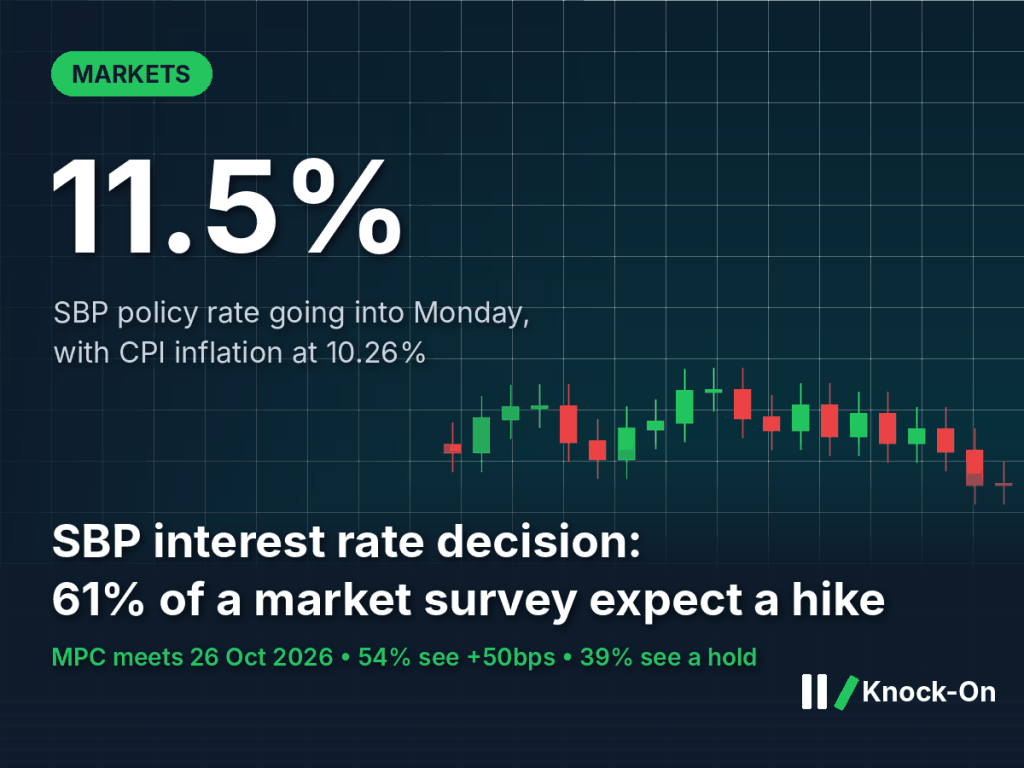
The SBP interest rate decision is due on Monday, 26 October, and most of the market expects the State Bank of Pakistan to raise its policy rate from 11.5%. In a market survey reported last week, 61% of participants expected a hike. Industry associations in Karachi are asking for the opposite: cuts to single digits. For any business that borrows, holds cash or owns shares, Monday’s number sets the cost of money for at least the next seven weeks.
The short version
- The SBP’s Monetary Policy Committee meets on 26 October. The policy rate has been 11.5% since at least the 14 September meeting, when it was held.
- In a market survey, 54% expect a 0.50 percentage point hike, 7% expect a full 1 point, and 39% expect no change.
- CPI inflation was 10.26% in September and averaged 10.2% in the first quarter, up from 4.3% a year earlier.
- Bankers say the market needs a hike; Karachi’s industrial associations want rates cut to single digits.
What happened
The SBP’s published calendar confirms the Monetary Policy Committee meets on 26 October, with the policy statement and a press conference the same day and an analyst briefing on 27 October. Governor Jameel Ahmad chairs the committee. At its last meeting on 14 September it kept the rate at 11.5%, with seven of its 10 members voting to hold, according to Bloom Pakistan.
A market survey reported by MM News and Bloom Pakistan on 21 October found that 61% of participants expect the SBP interest rate to rise on Monday. Most of them expect a modest move.
Most of the market expects a 50bps hike on Monday
Share of market survey participants by expected SBP decision, % (survey reported 21 Oct 2026)
Dawn reported on Sunday that stakeholders were calling for a 50 to 100 basis point increase, and that most financial experts expect 50bps. “I am sure of a 50bps increase in the interest rate, but the market requires a 100bps hike to tame rising inflation,” senior banker Rashid Masood Alam told the paper. Faisal Mamsa, chief executive of Tresmark, called 50bps “the sensible middle ground”. On the other side, the Korangi Association of Trade and Industry and the SITE Association of Industry demanded single-digit rates, and Saleem Mukati of the Pakistan Chemicals and Dyes Merchants Association said hikes “would not prove effective in any way”.
Why it matters
The case for a hike rests on how thin the gap between the policy rate and inflation has become. Headline CPI inflation was 10.26% in September, according to Pakistan Bureau of Statistics data reported by ProPakistani, after 11.15% in August. That leaves the 11.5% policy rate only about 1.2 percentage points above inflation. Weekly SPI inflation has already climbed to 11.85%, as Knock-On reported in our look at how LPG, electricity and fuel are driving SPI inflation, and oil above $110 a barrel threatens to push prices higher still.
The policy rate is only 1.2 points above inflation
SBP policy rate vs CPI inflation, % a year (as of 25 Oct 2026)
The case against is growth. Dawn’s report notes that the central bank is caught between a hike and the economic growth the government wants, and the industrial lobbies argue that dearer loans would hurt output without fixing supply-driven price rises in fuel and food.
The knock-on effects
First order: the cost of borrowing
A 50bps hike would take the policy rate to 12%, and KIBOR-linked loans would reprice upwards at their next reset. Working-capital borrowers in textiles, chemicals and trading would feel it first.
Second order: banks, savers and the PSX
Banks typically earn more on their large holdings of government paper when rates rise, extending the strong run in bank profits that topped Rs200bn at four big lenders. Savers would get better returns. Equities usually face pressure: rate-hike fears were one reason the KSE-100 ended last week 2.4% lower.
Third order: the government’s interest bill
Higher rates raise the cost of new domestic government borrowing, which leaves less room in the budget for development spending. A hold, by contrast, would signal that the SBP sees the oil-driven price rise as temporary.
Who could benefit
- Banks: wider margins on government securities if rates rise.
- Savers and money-market funds: higher returns on deposits and T-bills.
- Importers paying in dollars: tighter policy can support the rupee.
Who may face pressure
- Leveraged manufacturers: higher KIBOR-linked finance costs.
- Car, property and consumer-finance buyers: dearer instalments.
- Equity investors: rate-sensitive sectors such as cement, steel and autos.
What to watch
- 26 October: the Monetary Policy Statement and the governor’s press conference.
- 27 October: the SBP analyst briefing, and the PSX’s first full reaction.
- Early November: October CPI inflation from the Pakistan Bureau of Statistics.
- Week ending 20 November: minutes of Monday’s meeting. The next decision is due on 14 December.
Sources
- Dawn, Stakeholders see monetary tightening tomorrow, 25 Oct 2026
- State Bank of Pakistan, Monetary Policy Committee calendar, accessed 25 Oct 2026
- MM News, SBP to Decide on Interest Rates on October 26 as Survey Signals Possible Hike, 21 Oct 2026
- Bloom Pakistan, SBP Interest Rate Decision October 26: 61% Expect Hike, 21 Oct 2026
- ProPakistani, Inflation remains high after 3 months, 1 Oct 2026
This is analysis, not investment advice. Figures are as of 25 October 2026.

Leave a Reply