
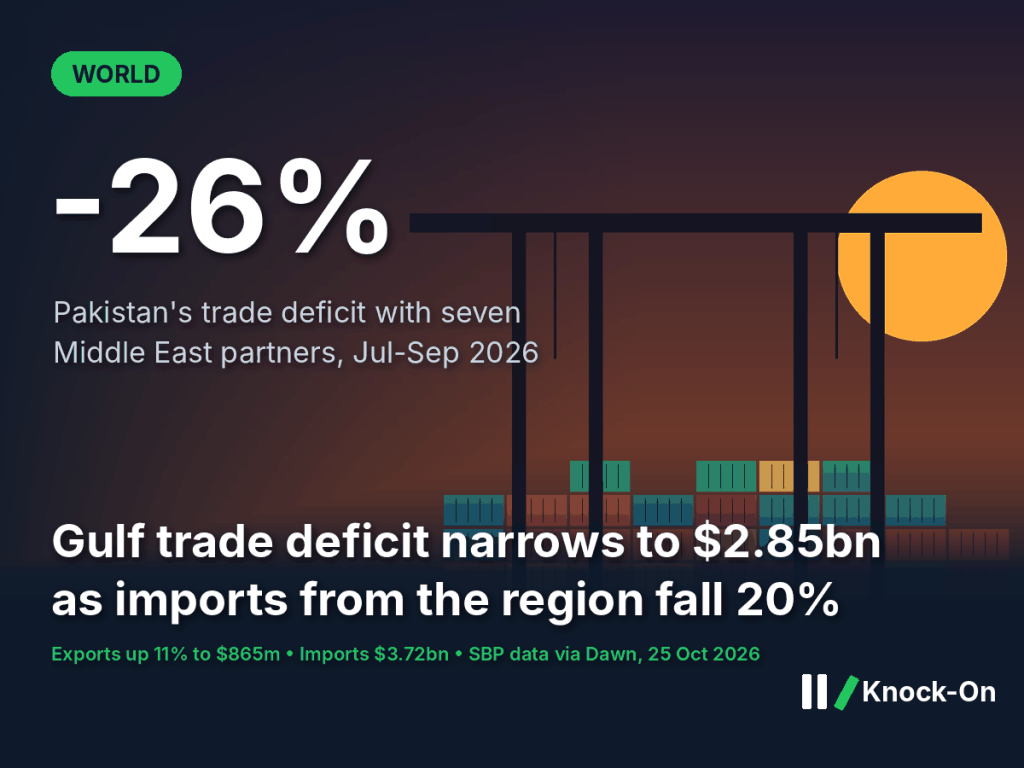
The Pakistan Gulf trade deficit shrank by about a quarter in the first three months of the fiscal year, according to State Bank of Pakistan data compiled by Dawn. The gap with seven Middle East partners fell to $2.85bn in July-September 2026, from $3.87bn a year earlier. On paper that is good news for the balance of payments. In practice, almost all of the improvement came from Pakistan buying less from the region, at a time when the Middle East conflict has disrupted trade routes since March.
The short version
- The trade deficit with Saudi Arabia, the UAE, Qatar, Kuwait, Bahrain, Oman and Jordan narrowed 26.35% to $2.85bn in July-September.
- Imports from the region fell 20.02% to $3.72bn; exports rose 10.96% to $864.9m.
- Lower imports explain roughly nine-tenths of the improvement (Knock-On calculation).
- Imports from Qatar fell 72.5% and from Kuwait 97.5%, a sign of disrupted supply rather than lower demand.
What happened
Dawn reported on 25 October that Pakistan’s imports from its seven Middle East trading partners fell to $3.717bn in the first quarter of FY27, from $4.648bn a year earlier. Exports to the same countries rose to $864.878m, from $779.425m. The UAE took 66.21% of those exports and Saudi Arabia 19.45%, leaving 14.34% for the other five.
Imports fell by $931m; exports rose by only $85m
Pakistan’s trade with seven Middle East partners, July-September, US$ billion
The country picture is uneven. Imports from Saudi Arabia fell 18.52% and from the UAE 6.15%, which Dawn links to lower oil, petroleum and commodity inflows. Imports from Qatar fell 72.51% and from Kuwait 97.46%; together the two accounted for $947.9m of the gross drop in import payments. Imports from Oman went the other way, up 97.40%. On exports, the UAE rose 16.35%, Oman 10.73%, Saudi Arabia 4.92% and Jordan 4.70%, while shipments to Qatar fell 22.79%, Bahrain 23.07% and Kuwait 2.24%.
Why it matters
The Gulf is where Pakistan buys most of its fuel, and the UAE and Saudi Arabia alone account for about 90% of its energy imports from the region, Dawn says. A narrower Pakistan Gulf trade deficit therefore eases pressure on dollars in the short run. But the cause matters. With the region at war and Brent crude settling at $116.72 a barrel on 23 October, its highest since April, a fall in the import bill from Qatar and Kuwait points to supply that did not arrive, not to fuel Pakistan no longer needs. Dawn describes Pakistan’s import flows as highly sensitive to developments in the region’s energy corridors, which is why the Pakistan-brokered Iran deal matters so much to the fuel bill.
The knock-on effects
First order: a smaller Gulf trade gap helps the current account
About $1bn less spent in the region in one quarter is $1bn less demand for dollars, which supports the rupee and reserves while oil prices stay high.
Second order: supply is shifting, not shrinking
When one supplier drops out, cargoes have to come from somewhere else, often at higher cost or longer shipping routes. Refiners already stocked up on crude in the first quarter as Gulf supply looked at risk, so part of the bill may simply move to other origins.
Third order: exporters face a narrow market
Export growth to the Gulf rests mostly on the UAE. With two-thirds of sales going to one market, a slowdown there would hit food, textile and construction-material exporters quickly. That fits the government’s push for export-led growth, which needs a wider set of buyers.
Who could benefit
- Exporters to the UAE and Oman: sales rose 16% and 11% in the quarter.
- The rupee and reserves: a smaller regional import bill means fewer dollars leaving.
- Suppliers outside the Gulf: traders able to source fuel and raw materials from other regions.
Who may face pressure
- Gas- and fuel-dependent industry: sharp falls from Qatar and Kuwait signal tighter supply.
- Exporters to Qatar and Bahrain: shipments fell by more than a fifth.
- Households relying on Gulf jobs: the region is also Pakistan’s main source of remittances, now exposed to the same conflict.
What to watch
- 26 October: the SBP’s monetary policy decision, which will reflect oil and import costs.
- Early November: October trade data, to show whether imports from Qatar and Kuwait recover.
- US-Iran talks: any deal that reopens Gulf shipping would change the import mix quickly.
Sources
- Dawn, Pakistan’s trade gap with Gulf partners narrows, 25 October 2026
- Business Recorder, Oil hits USD116 mark as ME conflict rages on, 24 October 2026
- Business Recorder (Reuters), Iran’s Pezeshkian blames US for interim deal failure, urges new try, 24 October 2026
This is analysis, not investment advice. Figures are as of 25 October 2026. Knock-On is not affiliated with any political party.

Leave a Reply