
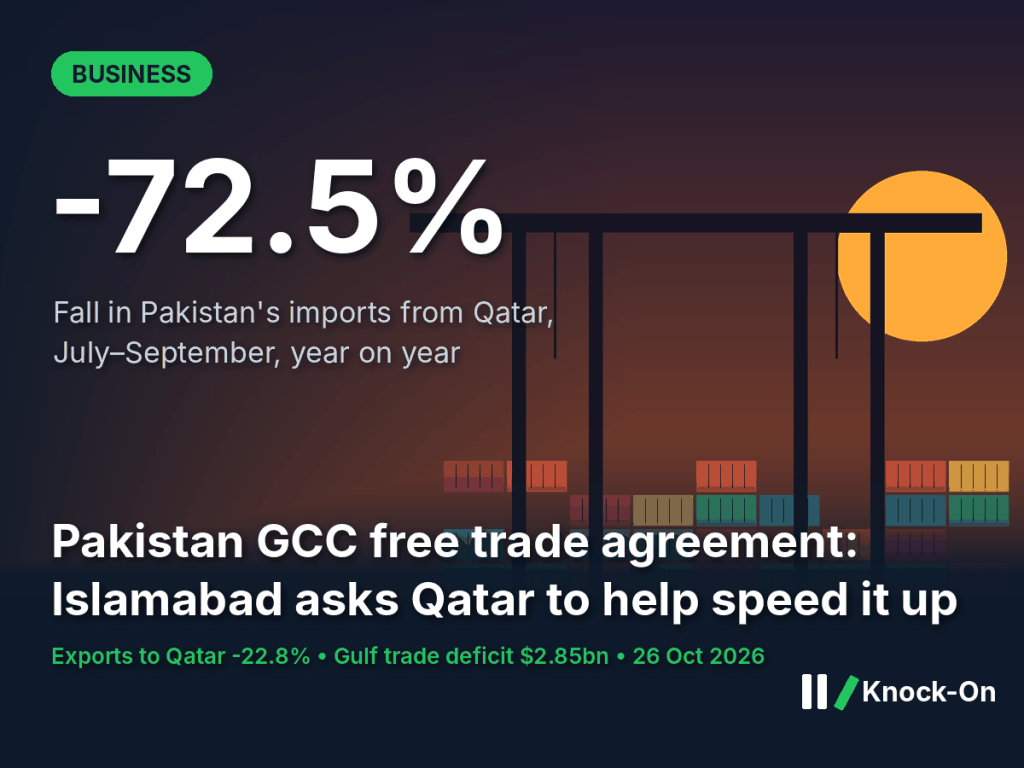
Pakistan has asked Qatar to help get the Pakistan GCC free trade agreement signed early, at a joint task force meeting in Doha co-chaired by Commerce Minister Jam Kamal Khan. Pakistan finished its own approvals and sent the agreement text to the Gulf Cooperation Council Secretariat on 31 December 2025, Dawn reported, but the deal has not yet been signed. The request comes as trade with Qatar shrank sharply: in July to September, Pakistan’s imports from Qatar fell 72.51% and its exports there fell 22.79%.
The short version
- At the second Pakistan-Qatar Joint Task Force on Trade and Investment, held in Doha on 24 October, Pakistan asked for early signing of the Pakistan-GCC free trade agreement.
- Pakistan also raised Qatar’s restrictions on bone-in meat imports, and said a rice supply MoU between the Trading Corporation of Pakistan and Qatar’s Hassad Food has gone to the federal cabinet.
- Qatari investors were invited into grain storage, cold chains, electric vehicles, IT, shipping and the Karachi-Hyderabad Motorway.
- No trade or investment amounts were announced.
What happened
Mr Khan and Qatar’s Minister of State for Foreign Trade Affairs, Dr Ahmad bin Mohammed Al-Sayed, co-chaired the meeting, with Pakistani ministries joining online and the Special Investment Facilitation Council coordinating from Islamabad, Dawn reported. Pakistan asked for the 11 technical working groups set up at the first meeting in April to start work soon, ProPakistani reported. The two ministers signed the minutes of the first meeting, and Pakistan will host the third.
On the sidelines of the World Investment Forum in Doha, Mr Khan also met Hassad Food’s chief executive, Ali Hilal Al-Kuwari, to discuss agriculture and food supply chains, and invited the company to the FoodAg 2026 exhibition in Karachi on 23–26 November, Business Recorder reported. He met the Qatar Businessmen Association’s chairman to discuss IT, logistics and food security.
Trade with Qatar fell much faster than trade with the wider Gulf
Year-on-year change in Pakistan’s goods trade, July–September 2026 (1QFY27), %
Why it matters
The Gulf is Pakistan’s closest large export market and a key source of energy, jobs and investment. A Pakistan GCC free trade agreement would cut tariffs on goods sold to Saudi Arabia, the UAE, Qatar, Kuwait, Oman and Bahrain in one deal. In the first quarter, exports to seven Middle Eastern countries rose 10.96% to $864.9m while imports from them fell 20.02% to $3.717bn, Dawn reported. As our analysis of the Pakistan Gulf trade deficit showed, lower imports rather than stronger exports did most of the work. Qatar is the weak spot: exports there fell even as sales to the UAE rose 16.35%.
The knock-on effects
First order: food exporters
The most concrete items are food: a government rice supply deal with Hassad Food awaiting cabinet approval, and a request to lift curbs on bone-in meat. Both could reopen sales quickly if agreed, without waiting for the wider agreement.
Second order: export competitiveness
Lower Gulf tariffs would help Pakistani textiles, food and building materials compete with suppliers that already have trade deals in the region. That fits the government’s push for export-led growth in Pakistan.
Third order: investment and security of supply
Qatari money in silos, cold chains and logistics would help Pakistan sell food to a region focused on food security, especially while the Iran war disrupts Gulf shipping. Gulf diplomacy is moving on several fronts this week, including the Makkah pact Iran talks in Tehran. Any investment, though, remains a proposal until deals are signed.
Who could benefit
- Rice exporters, if the Hassad Food MoU is approved.
- Meat processors, if Qatar lifts bone-in meat restrictions.
- Cold-chain, storage and logistics firms, if Qatari investment follows.
- Textile and food exporters more broadly, if the GCC agreement is signed.
Who may face pressure
- Local industries that compete with Gulf goods such as petrochemicals and plastics, if tariffs on GCC imports come down.
- Exporters to Qatar, while sales there keep falling.
What to watch
- Federal cabinet decision on the TCP–Hassad Food rice MoU (date not set).
- Start of the 11 Pakistan-Qatar technical working groups.
- 23–26 November: FoodAg 2026 in Karachi.
- Any GCC signing date for the free trade agreement.
Sources
- Dawn, Pakistan, Qatar explore new avenues for trade, investment cooperation, 26 October 2026
- ProPakistani, Pakistan Asks Qatar to Help Fast-Track Free Trade Agreement with GCC, 26 October 2026
- Business Recorder, Pakistan offers Qatar long-term food security partnership, 26 October 2026
- Dawn, Pakistan’s trade gap with Gulf partners narrows, 25 October 2026
This is analysis, not investment advice. Figures are as of 26 October 2026. Knock-On is not affiliated with any political party.

Leave a Reply