
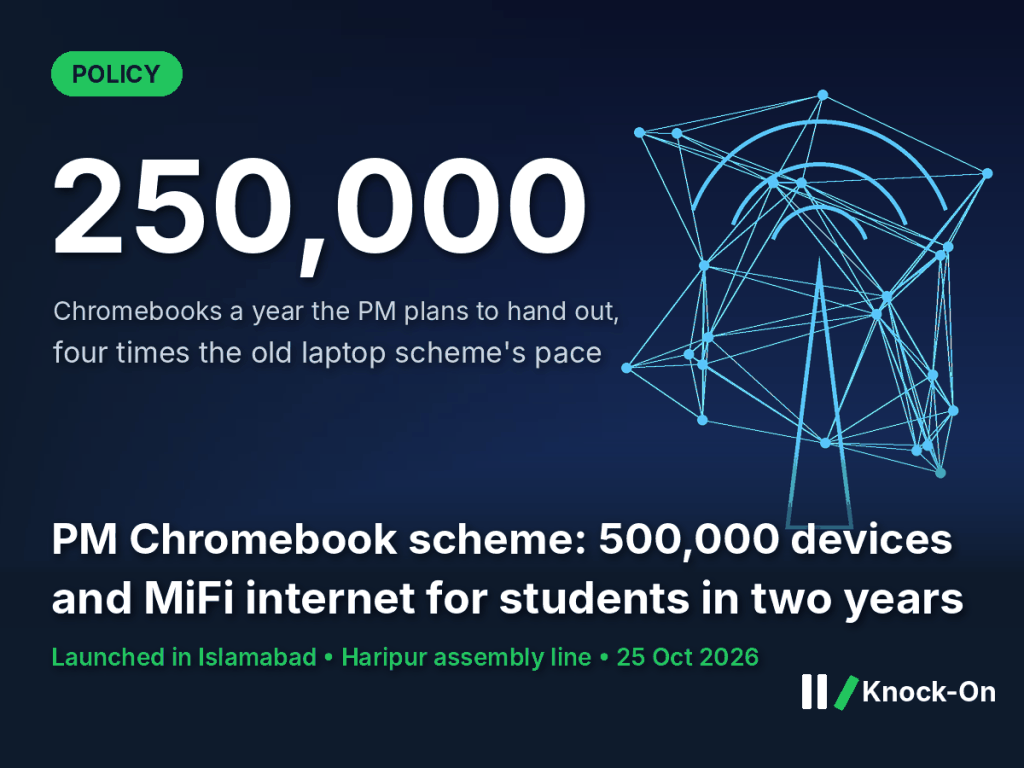
The PM Chromebook scheme was launched in Islamabad on Sunday, with Prime Minister Shehbaz Sharif saying the government will give 500,000 Chromebooks to students within two years, along with a bag and a MiFi internet device each. Selection will be on merit and will include students from religious seminaries, the government says. For Pakistan’s device makers, telecom operators and IT employers, the bigger story is the pace: the government says the previous laptop programme handed out about 600,000 laptops over roughly ten years.
The short version
- 500,000 Chromebooks over two years works out at about 250,000 a year, roughly four times the average pace of the old laptop scheme (Knock-On calculation).
- Each student also gets a MiFi device; the PM’s Youth Programme says each connection could serve up to five people, or 2.5 million in total.
- No cost, supplier or data allowance has been published.
- Google has been assembling Chromebooks in Haripur since November 2025, a likely beneficiary if the scheme sources locally.
What happened
At a ceremony under the Prime Minister’s Youth Programme on 25 October, the Prime Minister distributed the first Chromebooks and MiFi devices to students, Business Recorder and The Express Tribune reported. “Only your hard work and ability will be the criteria,” he told students, according to the Tribune. Rana Mashhood Ahmad Khan, chairman of the Youth Programme, said high-speed internet connections would go to 500,000 students and that each could benefit up to five people. Rashid Minhas, chairman of the Tokyo Technology Care Foundation, said the foundation had signed an MoU with the government to help students in schools and seminaries expand their digital reach.
The Tribune notes that about 100,000 laptops were distributed in 2024 and another 100,000 were announced for 2025. Neither report gives the PM Chromebook scheme’s budget, its provincial quotas, the supplier of the devices or the monthly data included with the MiFi connections.
The Chromebook scheme runs at four times the old laptop pace
Devices per year, government student schemes and planned local assembly
Why it matters
A quarter of a million devices a year is a sizeable order in a market where imported electronics carry heavy taxes; Knock-On recently looked at how the mobile phone tax in Pakistan shapes what buyers can afford. A government order on this scale could give the Haripur assembly line, run by the National Radio and Telecommunication Corporation with Google, steady volume. The Tribune reports plans for about 600,000 devices a year there; the information ministry said in 2025 the line was expected to produce 500,000 by 2026. The government has not said where this scheme’s devices come from.
The knock-on effects
First order: a large, predictable device order
If the Chromebooks are assembled locally, the PM Chromebook scheme could take up a large share of Haripur’s planned output, supporting jobs and parts suppliers. If they are imported, the order adds to the import bill at a time of high oil costs.
Second order: new mobile data users
500,000 MiFi connections mean new data subscriptions for whichever operators supply them. That fits the network build-out described in our story on 5G in Pakistan, where Jazz has built most of the sites so far.
Third order: a bigger pool of digital workers
The Prime Minister said the devices could become a source of livelihood once students join the workforce. If that happens, freelancers and IT exporters gain a larger trained pool, the kind of productivity gain the World Bank says Pakistan needs to raise average incomes faster. That is a long-term hope, not a measured result.
Who could benefit
- Local assemblers: the Haripur line and its partners, if devices are sourced locally.
- Telecom operators: 500,000 new data connections to supply.
- IT and freelancing firms: more students with their own devices and internet.
Who may face pressure
- The federal budget: the cost has not been disclosed, and spending is tight under the IMF programme.
- Laptop retailers: free devices may reduce demand for entry-level laptops among students.
- Administrators: merit-based selection across schools and seminaries will need a clear process.
What to watch
- Eligibility rules: how students apply and how merit is judged.
- Supplier and cost: whether devices come from Haripur, and the total budget.
- Data packages: which operators provide the MiFi connections, and on what terms.
- Late 2027: whether the two-year target of 500,000 devices is met.
Sources
- Business Recorder, Govt to distribute 500,000 Chromebooks, MiFi devices to students in two years: PM Shehbaz, 25 October 2026
- The Express Tribune, PM kicks off distribution of 500,000 Chromebooks, internet devices to students, 25 October 2026
- Arab News Pakistan, Pakistan says new assembly line to produce 500,000 Chromebooks by 2026, 5 November 2025
This is analysis, not investment advice. Figures are as of 26 October 2026.

Leave a Reply