
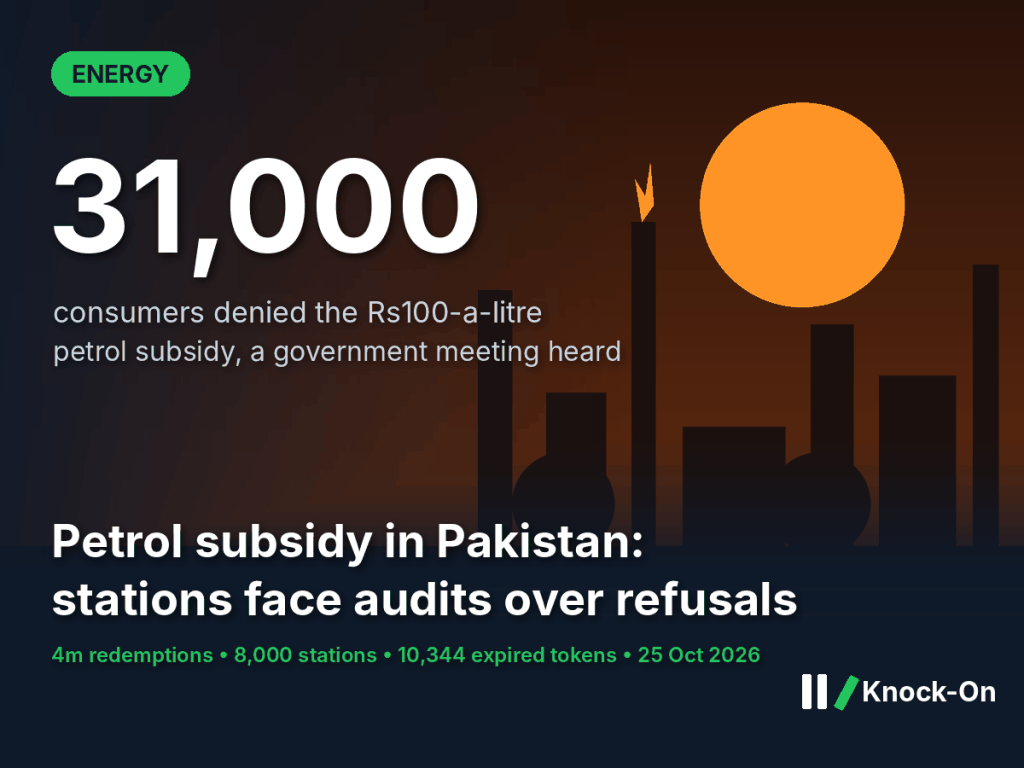
The petrol subsidy in Pakistan has reached millions of motorcyclists, but not everyone it was meant for. A high-level government meeting was told that 31,000 consumers had been denied the Rs100-a-litre relief, the Express Tribune reported on 25 October. The meeting ordered audits of petrol stations with unusually few subsidised sales and fixes to registration errors. For fuel retailers, the scheme is now a compliance issue as well as a source of footfall.
The short version
- About 31,000 consumers did not receive the petrol subsidy; 10,344 tokens had expired unused.
- The scheme has logged about 4 million redemptions across roughly 8,000 stations, close to 500 per station.
- Any station with fewer than 50 redemptions will be audited by provincial and district officials.
- Eligible riders pay Rs100 a litre less, up to 20 litres a month for two- and three-wheelers and 30 litres for cars up to 800cc.
What happened
The relief scheme opened in mid-September. Registered users send an SMS to 9771 to receive a token, which they show at the pump; each token covers five litres for motorcycles and rickshaws and 10 litres for cars, Business Recorder explained at launch. With petrol at Rs377.71 a litre, the price kept unchanged on 23 October, an eligible rider pays about Rs277.71 (Knock-On calculation).
According to the Tribune, a survey message went to about 31,000 people whose tokens expired. About 11,000 said they had not had time to use them. Roughly 13,000 who cited a station refusal or a technical fault will be asked to rebook. The 9771 helpline took 3,000 calls, about 400 resolved at first contact, with Punjab (1,700) and Sindh (618) the largest sources. Complaints included about 972 on registration, 414 on province mismatch and 250 on duplicate registration attempts. Refusals were described as negligible in Punjab, below 1% in Sindh and nil in Gilgit-Baltistan; in Khyber Pakhtunkhwa, four of 200 complainants contacted cited refusal, each traced to a temporary internet outage.
Why it matters
Fuel is where the Middle East war reaches household budgets fastest. When the Petroleum Division proposed the scheme to the ECC, it estimated about 11.8 million users and a cost of roughly Rs24.6bn a month, according to PakWheels, which reported the proposal. Motorcycles account for most of that money, so whether riders can actually redeem tokens decides whether the subsidy does its job. Levies already take a large share of the pump price, as our petrol price levy breakdown shows.
Motorcycles take about four-fifths of the subsidy bill
Estimated monthly cost of the Rs100-a-litre petrol relief, Rs billion, as proposed to the ECC in September 2026
The knock-on effects
First order: petrol stations face scrutiny
Stations below the 50-redemption benchmark will be audited, and the highest-volume stations in each city will be monitored. Deputy commissioners can now download city-wise station lists from the scheme dashboard, and extra devices will go where queues form.
Second order: registration rules decide who benefits
The minister of state for finance said visits to 40 to 45 stations found staff and riders wrongly believing a motorcycle must be registered in the applicant’s own name. The IT ministry is to correct this publicly, and assistant commissioners will list Qingqi rickshaw drivers with valid papers to help them register.
Third order: a test for digital targeted subsidies
The token system is an early test of whether relief can be targeted by ID card, SIM and vehicle record rather than given to everyone through a lower pump price. Its record here will shape how future fuel relief is designed, at a time when diesel prices are also squeezing transport.
Who could benefit
- Riders and rickshaw drivers: fixes to registration and token expiry could let more claim up to Rs2,000 a month.
- Compliant petrol stations: subsidised customers bring regular traffic.
- Delivery and ride-hailing workers: lower fuel costs on high-mileage motorcycles.
Who may face pressure
- Low-redemption stations: audits follow anything under 50 redemptions.
- The federal budget: every successful fix raises take-up, and so the monthly cost.
- Riders with second-hand bikes: vehicles not matched to their ID cards still risk rejection.
What to watch
- Within two days of the meeting: the IT ministry’s report on how many registered motorcyclists’ ID cards match their vehicle title.
- Next fuel price notification: any change to the pump price changes what eligible riders pay after the Rs100 relief.
- Mid-December: whether the scheme, proposed for three months from mid-September, is extended.
Sources
- The Express Tribune, 31,000 consumers denied petrol subsidy, 25 October 2026
- Business Recorder, Fuel relief scheme: How to get Rs100/litre petrol subsidy?, 13 September 2026
- PakWheels, Petroleum Division seeks Rs. 75 billion for fuel subsidy scheme, 14 September 2026
- Dawn, Govt raises high-speed diesel rate by Rs1.91 per litre; petrol price unchanged at Rs377.71, 23 October 2026
This is analysis, not investment advice. Figures are as of 25 October 2026.

Leave a Reply