
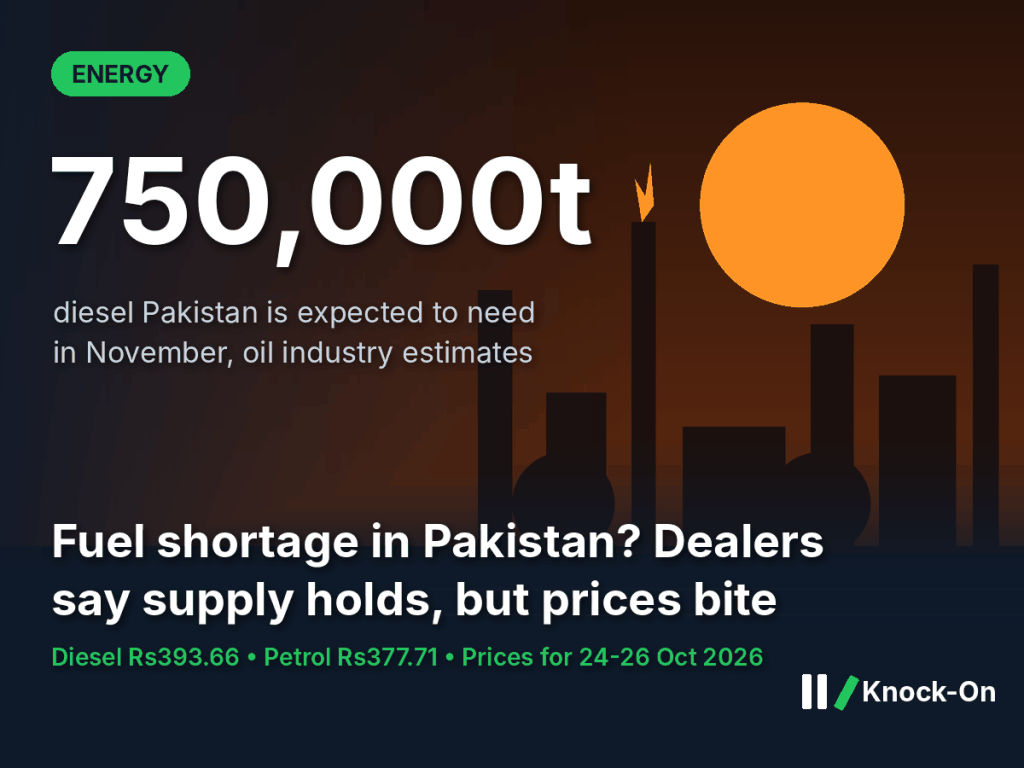
Talk of a fuel shortage in Pakistan reached the Senate this week, as the Middle East conflict pushed Brent crude to a five-month high. Petrol dealers have now urged consumers not to panic buy, and the government told senators there is no fuel supply problem. For businesses, the more pressing issue is cost: diesel was raised again to Rs393.66 a litre for 24 to 26 October, while petrol stays at Rs377.71.
The short version
- The Pakistan Petroleum Dealers Association (PPDA) urged consumers to avoid panic buying, saying supply and demand are being kept in balance.
- In the Senate, the PPP asked whether petrol would be available until December; the government said there is no supply problem.
- Oil industry estimates put November demand at about 750,000 tonnes of diesel and 630,000 tonnes of petrol.
- Local refineries cover about 70% of diesel needs but only about 30% of petrol, so petrol relies much more on imports.
What happened
PPDA chairman Malik Khuda Baksh told Dawn that excessive buying could distort the market, and that the supply-demand balance had been “maintained efficiently” by the government, industry and consumers. He said refineries were operating and that crude and fuel were being imported from Gulf countries, including Saudi Arabia and Oman. “Price remains an issue, but that is a different matter,” he said. He added that the Iran border closure had put the LPG market under stress.
In the Senate on 23 October, PPP parliamentary leader Sherry Rehman asked whether petrol would be available until December and whether rationing was planned, and asked the petroleum and energy ministers to brief parliament on contingency plans, The Nation reported. Opposition leader Raja Nasir Abbas warned that the conflict could worsen energy and food pressures as shipping routes come under threat. Minister of State for Finance Bilal Azhar Kayani told the House there was no fuel supply problem, and said targeted fuel subsidies reach more than 10 million people.
The Petroleum Division raised diesel by Rs1.91 to Rs393.66 a litre and kept petrol unchanged at Rs377.71. Prices are now set daily by OGRA based on international trends. According to Dawn, taxes and duties make up Rs114 a litre on petrol and Rs100 on diesel. Brent rose to about $114.57 a barrel on Friday, after touching $115, Daily Pakistan reported.
Petrol leans far more on imports than diesel does
Estimated November 2026 demand, tonnes, split by local refining and imports (imports in green)
Why it matters
A fuel shortage in Pakistan would hit transport, farming and factories at once, so even rumours change behaviour: firms and motorists fill up early, which can empty pumps temporarily. The chart shows where the real exposure lies. On Knock-On’s calculation, roughly 441,000 tonnes of November petrol would need to arrive as imported product, against about 225,000 tonnes of diesel. Even locally refined fuel depends on imported crude, as Knock-On’s report on crude oil imports and refiners’ stockpiling showed. Any disruption to Gulf shipping, the risk set out in our analysis of the Saudi attacks’ impact on Pakistan, would therefore test petrol supply first.
The knock-on effects
First order: fuel shortage fears meet high diesel prices
Supply appears stable for now, according to dealers and the government, but diesel at Rs393.66 a litre is about 40% above the Rs281 it cost before the conflict began on 28 February, according to Dawn (Knock-On calculation). Diesel peaked at Rs520.35 on 3 April. More detail on freight is in our diesel price and freight costs report.
Second order: farming season and freight
The industry links November diesel demand to seasonal agricultural needs. Higher diesel costs feed into tractor use, crop transport and wholesale food prices just as the wheat sowing season begins.
Third order: subdued demand and fiscal pressure
Industry sources expect high prices and the off-peak travel season to keep consumption subdued, Dawn reported. Lower volumes mean less petroleum levy revenue, while fuel subsidies and the Jamaat-e-Islami’s demand for levy cuts add pressure on the budget.
Who could benefit
- Local refineries, whose output becomes more valuable when imported product is uncertain.
- Oil marketing companies with storage, which can supply steadily if panic buying returns.
- Subsidy recipients: motorcyclists, rickshaw and loader operators and small-car users, according to the government.
Who may face pressure
- Truckers, transporters and logistics firms paying more for diesel.
- Farmers buying diesel for the sowing season.
- Retailers and markets operating under the 9pm closing rule, which Dawn says was reintroduced as an austerity measure.
- Households and businesses already facing the LPG shortage.
What to watch
- 26 October: the next fuel price revision, as the current prices run until Monday.
- Senate session from Monday: whether ministers brief parliament on fuel and LPG contingency plans.
- The technical committee on the petroleum levy with Jamaat-e-Islami, due to meet within days.
- Brent crude and Gulf shipping security.
Sources
- Dawn, Fuel dealers urge consumers to avoid ‘panic buying’, 24 October 2026
- The Nation, PPP in Senate seeks govt briefing over petrol availability till December, 24 October 2026
- Dawn, Govt raises high-speed diesel rate by Rs1.91 per litre; petrol price unchanged at Rs377.71, 23 October 2026
- Daily Pakistan, Petrol price stays at Rs377, diesel crosses Rs393 for weekend, 23 October 2026
This is analysis, not investment advice. Figures are as of 24 October 2026.


Leave a Reply