
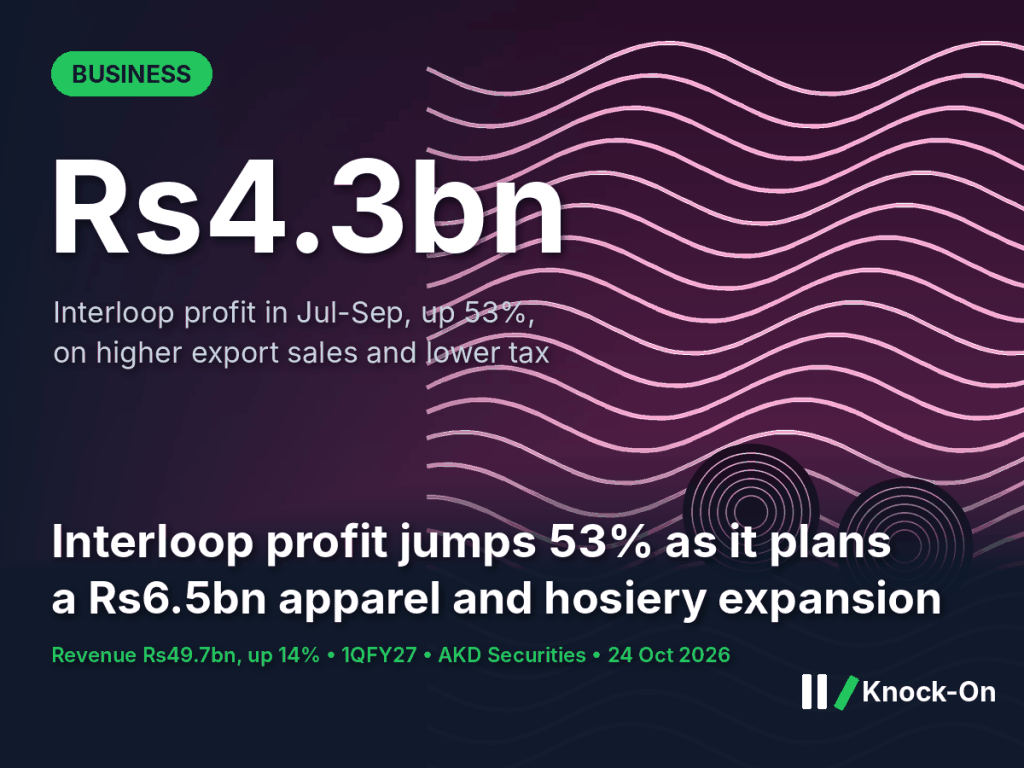
Interloop profit rose 53% to Rs4.3bn in July to September, the first quarter of the 2026-27 financial year, as one of Pakistan’s largest textile exporters sold more abroad and paid less tax. Its board has also approved a Rs6.5bn (about $23.5m) budget to expand and modernise its apparel and hosiery plants. Together, the two announcements signal an exporter adding capacity even as dearer oil and a possible interest-rate rise cloud the outlook for industry.
The short version
- Net profit rose to Rs4.3bn from Rs2.8bn; earnings per share rose to Rs3.05 from Rs2.00.
- Revenue rose 14% to Rs49.7bn on higher export volumes, but the gross margin slipped to 22.8% from 23.3%.
- A lower effective tax rate (29% against 38%), doubled other income and cheaper export finance did much of the lifting.
- The board approved Rs6.5bn of capital spending to expand and modernise apparel and hosiery.
What happened
Interloop’s results for the quarter ended September, summarised by AKD Securities and reported by Business Recorder, show revenue of Rs49.7bn, up from Rs43.8bn a year earlier. AKD linked the growth to higher export volumes, helped by added capacity and better utilisation across hosiery, denim and apparel. The gross margin narrowed to 22.8%, which AKD attributed mainly to lower prices outside yarn and to the rupee’s appreciation.
Below the gross profit line, the picture improved. Other income roughly doubled to Rs1.7bn, likely from gains on derivative instruments, according to AKD. Finance costs fell 8% to Rs1.6bn despite higher borrowings, reflecting lower rates under the Export Finance Scheme. The effective tax rate dropped to 29% from 38% after the removal of super tax. Operating expenses rose 15% to Rs4.7bn, mainly on distribution costs.
Separately, Interloop told the PSX on Friday that its board, meeting in Faisalabad on 22 October, had approved an additional capital expenditure and balancing, modernisation and replacement budget of Rs6.5bn across its apparel and hosiery segments. The company did not disclose the added capacity, timeline or funding source.
Profit grew almost four times faster than sales
Interloop, change from Jul–Sep 2025 to Jul–Sep 2026, %
Why it matters
The Interloop profit jump shows how much of a Pakistani exporter’s bottom line now depends on policy rather than on selling prices. Margins on the factory floor actually narrowed. What lifted profit was a lower tax rate, cheaper export finance and financial gains. That matters because two of those three can change with a budget or an SBP interest rate decision, which is due on 26 October.
The expansion is the more forward-looking signal. A large exporter committing Rs6.5bn to new and modernised capacity suggests it expects export orders to hold. For the wider picture, see Knock-On’s earlier look at textile industry profits in Pakistan.
The knock-on effects
First order: more export volume from Punjab plants
All of Interloop’s plants are in Punjab. New capacity there would add export volume in hosiery and apparel, and more demand for yarn, machinery and workers, though the company has not said how much or when.
Second order: margins exposed to the rupee and rates
The rupee’s strength already squeezed margins this quarter. If interest rates rise, the benefit from cheaper Export Finance Scheme borrowing could narrow, especially with borrowings higher than a year ago.
Third order: market access becomes the deciding factor
Extra capacity pays off only if buyers in Europe and the US keep ordering. That puts weight on Pakistan keeping its GSP+ access to the EU as India’s trade deal with the bloc moves ahead.
Who could benefit
- Interloop shareholders, with earnings per share up to Rs3.05 from Rs2.00.
- Machinery and construction suppliers, if the Rs6.5bn budget is spent in Pakistan.
- Factory workers in Punjab, if new lines need more staff.
Who may face pressure
- Exporters without scale, who face the same rupee and margin pressure without the same financing advantages.
- Interloop’s own margins, if the rupee strengthens further or export finance becomes dearer.
What to watch
- 26 October: the SBP monetary policy decision, which affects borrowing costs.
- Any disclosure of the capacity, timeline and funding of the Rs6.5bn plan.
- Monthly textile export data from PBS and APTMA.
- Whether other exporters report similar gains from the removal of super tax.
Sources
- Business Recorder, Interloop profit rises 53pc to Rs4.3bn in 1QFY27, 24 Oct 2026
- Business Recorder, Pakistan’s Interloop to expand production with $23.5mn investment, 23 Oct 2026
This is analysis, not investment advice. Figures are as of 24 Oct 2026.

Leave a Reply