
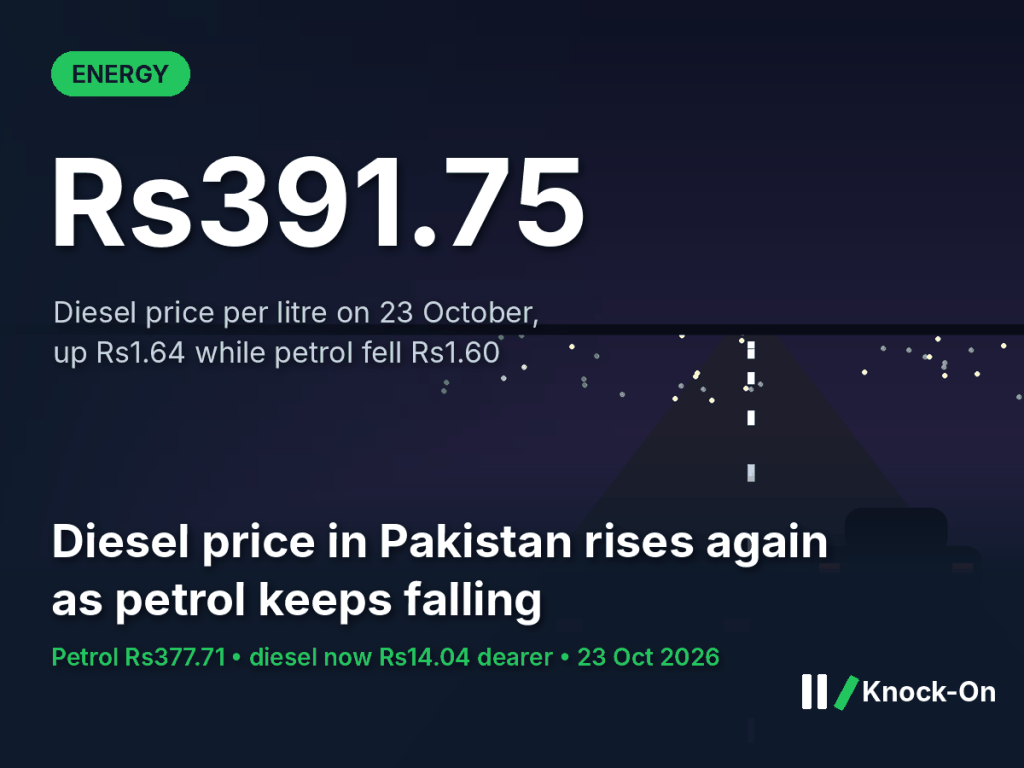
The diesel price in Pakistan rose for a second day running on Friday, by Rs1.64 to Rs391.75 a litre, while petrol fell Rs1.60 to Rs377.71. Under daily fuel pricing the two fuels are now moving in opposite directions, and that matters more to business than the headline petrol cut. Petrol mainly powers cars, rickshaws and motorcycles. High-speed diesel moves trucks, runs power plants and drives large generators, so its price feeds into the cost of almost everything that is transported or manufactured.
The short version
- High-speed diesel rose Rs1.64 to Rs391.75 a litre for 23 October, after a 31-paisa rise the day before.
- Petrol fell Rs1.60 to Rs377.71, its second cut in two days, so diesel now costs Rs14.04 a litre more than petrol.
- Diesel is still Rs33.17 below its 17 September level, but 39% above its pre-war price of about Rs281.
- Freight, farming and factory generators feel diesel first; motorists feel petrol.
What happened
The Petroleum Division notified new prices late on Thursday, 22 October, applicable for Friday, Dawn reported. Petrol fell from Rs379.31 to Rs377.71 a litre and high-speed diesel rose from Rs390.11 to Rs391.75. A day earlier, the government had cut petrol by Rs2.71 and raised diesel by 31 paisas. Across the two revisions, petrol is down Rs4.31 a litre and diesel is up Rs1.95 (Knock-On calculation). Our earlier analysis of how levies make up the petrol price in Pakistan explains why crude oil sets most of the daily moves.
Prices have been set daily since 17 July, when Petroleum Minister Ali Pervaiz Malik said OGRA would revise them each day in line with international markets. Taxes and duties are about Rs114 a litre on petrol and Rs100 a litre on diesel, according to Dawn. Brent crude traded above $111 a barrel on Thursday as attacks in the Gulf raised supply fears, the same shock that pushed the KSE-100 down 2,006 points that day.
Diesel is well off its April peak, but still 39% above its pre-war price
High-speed diesel price in Pakistan, rupees per litre, 2026
Why it matters
A falling petrol price can make fuel look cheaper overall, but the diesel price in Pakistan is the one that sits inside business costs. Goods transporters raised freight charges by 7% in September after a run of diesel increases, The Express Tribune reported. This week the Karachi Chamber of Commerce and Industry said higher diesel and freight costs were adding pressure on businesses already facing high operating costs, PakWheels reported. Diesel is lower than it was then, but the direction has turned up again.
The knock-on effects
First order: diesel users pay more each day
Truck and bus operators, factories running generators and farmers using diesel pumps and tractors pay the higher price immediately. Rs1.95 a litre over two days is small on its own, but daily pricing means small rises can add up quickly while crude stays above $110.
Second order: freight rates are unlikely to fall
Transporters raised freight charges twice in a short period during September’s diesel increases. A renewed rise in diesel makes cuts to those rates less likely, so wholesalers, retailers and exporters that pay per trip should expect freight costs to hold or edge up rather than fall.
Third order: pressure on prices and rates
Transport costs pass into food and goods prices. With inflation already close to 10%, a sustained diesel rise would add to the case that analysts weigh ahead of the SBP interest rate decision on 26 October.
Who could benefit
- Motorists and motorcyclists: petrol is Rs4.31 a litre cheaper than two days ago.
- Ride-hailing and rickshaw operators: petrol-based fleets gain a small cost edge over diesel vehicles.
- Fuel retailers: petrol and diesel together sell about 700,000 to 800,000 tonnes a month, Dawn reports, so volumes stay large either way.
Who may face pressure
- Goods transporters: diesel is a core running cost, and they are already seeking relief from high diesel prices.
- Farmers: diesel for tractors and pumps costs more.
- Factories and shops on generators: back-up power gets dearer.
- Retailers and wholesalers: freight costs are unlikely to fall.
What to watch
- Daily OGRA prices: whether diesel keeps rising while Brent stays above $110.
- Petroleum levy talks: any change to the levy would move both fuels at once.
- 26 October: the SBP monetary policy decision.
- Transporters: any new freight-rate announcement.
Sources
- Dawn, Govt reduces petrol price by Rs1.60 per litre, raises high-speed diesel rate by Rs1.64, 22 October 2026
- Dawn, Govt reduces petrol price by Rs2.71 per litre, ups high-speed diesel rate by Re0.31, 21 October 2026
- The Express Tribune, Transporters raise freight charges by 7%, 19 September 2026
- PakWheels, Karachi transporters say bad roads and diesel are raising freight costs, 22 October 2026
- Pakistan Observer, Pakistan slashes petrol price further, raises diesel rate for October 23, 22 October 2026
This is analysis, not investment advice. Figures are as of 23 October 2026.



Leave a Reply