
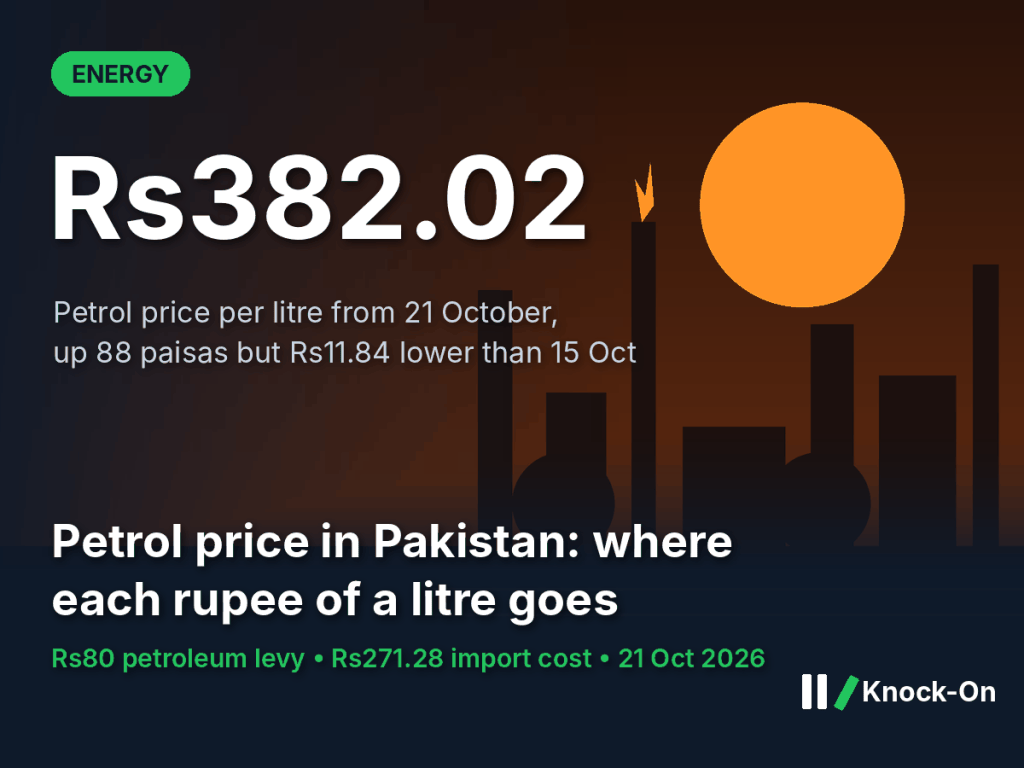
The petrol price in Pakistan rose 88 paisas to Rs382.02 a litre from Wednesday 21 October, and high-speed diesel rose 53 paisas to Rs389.80, under the government’s daily fuel pricing. The rise is small and follows four cuts in a row that brought petrol down from Rs393.86 on 15 October. But the official price build-up shows how the system now works: Rs85 of every litre is government levy that does not move, and almost everything else follows the cost of imported fuel, with Brent crude hovering around $110 a barrel.
The short version
- Petrol is Rs382.02 a litre (up Rs0.88) and diesel Rs389.80 (up Rs0.53) from 21 October.
- Petrol is still Rs11.84 cheaper than on 15 October, and diesel Rs6.85 cheaper (Knock-On calculation).
- The import cost is Rs271.28 of the petrol price, about 71%; the petroleum and climate levies add Rs85, about 22%.
- Levies and margins were unchanged, so the whole increase came from a higher import cost.
What happened
According to the Petroleum Division notification reported by Business Recorder, the import cost of petrol rose from Rs270.40 to Rs271.28 a litre and that of diesel from Rs281.71 to Rs282.24. Every other part of the price stayed the same: a petroleum levy of Rs80, a climate support levy of Rs5, a dealer margin of Rs9.98, an oil marketing company margin of Rs7.87 and a freight equalisation margin of Rs7.89 for petrol (Rs4.71 for diesel). OGRA put the change down to movements in Platts prices, premiums and incidentals. The government replaced weekly price reviews with daily ones on 17 July, the Express Tribune reports.
The daily system has moved the petrol price in Pakistan quickly this month. Petrol was Rs393.86 on 15 October, Rs390.23 on 16 October, Rs386.30 from 17 to 19 October and Rs381.14 on 20 October, before today’s small rise, according to Pakistan Observer’s price record. That Rs5.16 cut on 20 October, which Knock-On flagged as at risk if crude stayed above $110, has now been partly reversed.
Imported fuel is 71% of a litre of petrol; levies take another 22%
Build-up of the Rs382.02 petrol price, rupees per litre, 21 October 2026
Why it matters
With levies and margins fixed, the petrol price now tracks world fuel markets almost rupee for rupee. Brent fell 83 cents to $108.72 on 20 October after touching a five-month high of $111.99, the Express Tribune reported, then rose $1.59 to $110.38 on Wednesday morning on Middle East supply fears and falling US stocks, Business Recorder reported. DBS analyst Suvro Sarkar described “a bit of wild ride in the last couple of sessions” and linked part of the earlier dip to hopes of “a Qatar- or Pakistan-brokered deal”. Each swing feeds into Pakistan’s fuel bill, which, as Knock-On has reported, could rise by up to $1.2bn a quarter if crude stays high.
The knock-on effects
First order: petrol price Pakistan changes daily, and so do running costs
Delivery fleets, ride-hailing drivers, bus operators and motorcycle couriers now face a price that can change every day. A week of cuts has lowered their costs, but today shows the direction can turn within 24 hours, which makes fixed-price contracts and fares harder to set.
Second order: fuel keeps pressure on inflation and rates
Fuel is one of the items that has kept weekly inflation in double digits. Diesel matters most here, because it moves goods and powers farm machinery. The State Bank’s next interest rate decision is due on 26 October, and fuel costs are one of the inflation risks it will weigh.
Third order: refiners carry part of the diesel bill
The cap on the diesel refining margin, the crack spread, fell from $41.89 to $38 a barrel and will apply for three more months, Business Recorder reported. Industry calculations put refineries’ contribution to holding down diesel prices since 20 August at about Rs22bn. That support is not unlimited, and the notification says the mechanism could be reconsidered sooner if prices fall quickly.
Who could benefit
- Motorists and transporters: petrol is still Rs11.84 a litre cheaper than a week ago.
- Fuel retailers and marketers: dealer and OMC margins are fixed per litre, so their income per litre does not fall when prices are cut.
- Small-vehicle owners: the Rs100-a-litre relief scheme for motorcycles, three-wheelers and cars up to 800cc, announced on 13 September, cushions part of any rise for those who qualify.
Who may face pressure
- Refiners: a lower diesel margin cap for another three months.
- Freight and farming: diesel at Rs389.80 remains above petrol, and any rise in crude passes straight through.
- Businesses with fuel-heavy budgets: daily pricing makes monthly cost planning less certain.
What to watch
- Daily notifications: whether petrol stays near Rs382 or resumes rising with crude.
- Brent crude: attacks on Gulf shipping and Saudi oil sites, and any mediation effort.
- 26 October: the State Bank of Pakistan’s interest rate decision.
- Diesel crack spread: the $38 cap runs for three months unless reviewed earlier.
Sources
- Business Recorder, Petrol price hiked by 88 paise, HSD’s by 53 paise, 21 October 2026
- Express Tribune, Govt increases petrol by 88 paisas, diesel by 53 paisas per litre for Oct 21, 20 October 2026
- Express Tribune, Govt hikes petrol by Rs1.2, cuts diesel by 17 paisas for Oct 15, 14 October 2026
- Pakistan Observer, New Petrol, Diesel Price in Pakistan for October 21, 2026, 21 October 2026
- Business Recorder, Oil rises on Middle East supply fears, US inventory drawdowns, 21 October 2026
- Business Recorder, HSD crack spread drops to USD38 per barrel, 21 October 2026
This is analysis, not investment advice. Figures are as of 21 October 2026.

Leave a Reply