
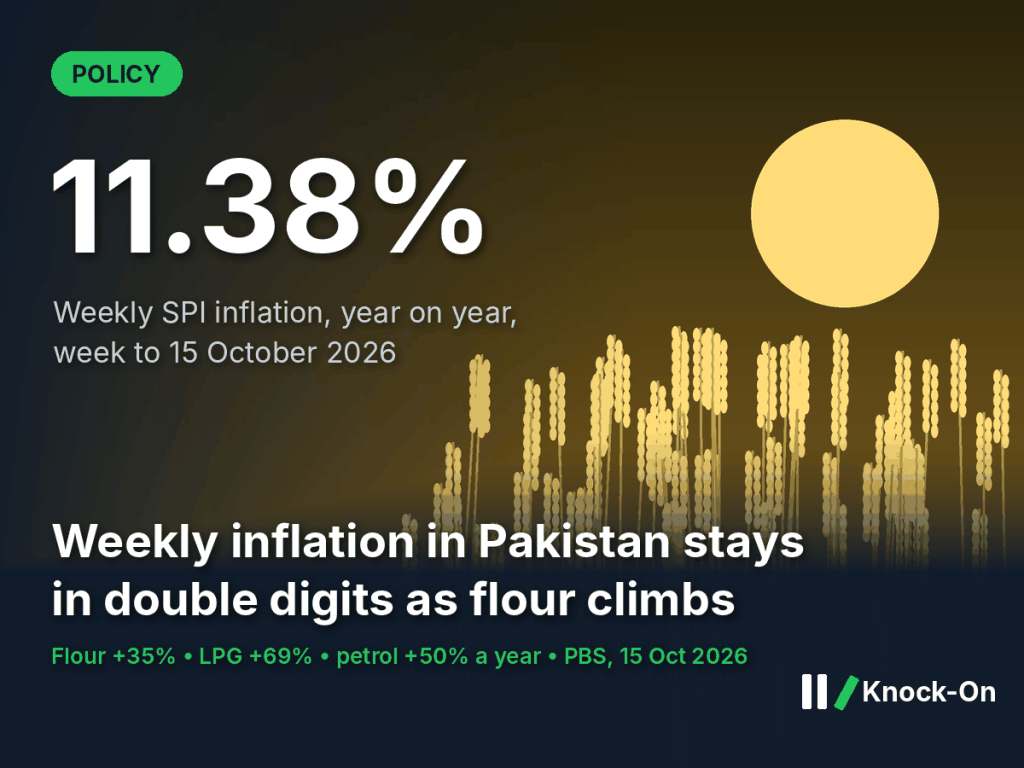
Weekly inflation in Pakistan was 11.38% year on year in the week to 15 October 2026, the Pakistan Bureau of Statistics (PBS) reported on Friday. The Sensitive Price Indicator (SPI), which tracks 51 essential items in 17 cities, slipped 0.04% from the week before as tomatoes and onions got cheaper. But wheat flour, chicken and pulses rose again, and the yearly rate has now been above 10% for five weeks running. For businesses, that means wage pressure, weaker household spending and a longer wait for cheaper loans.
The short version
- The SPI was 11.38% higher than a year earlier in the week to 15 October, down from 11.97% a week before.
- Week on week, prices dipped 0.04%, mainly because tomatoes fell 23.05% and onions 4.90%.
- Over the year, LPG is up 68.95%, petrol 49.60%, diesel 43.98% and a 20kg flour bag 35.13%.
- The highest-spending households face the fastest rise, 12.09%, against 8.19% for the lowest.
What happened
The combined SPI index fell to 372.43 from 372.58 the previous week, PBS data show. Of the 51 items tracked, 23 became more expensive, 7 became cheaper and 21 did not change. The biggest weekly increases were in gram pulse (4.97%), wheat flour (3.36%) and chicken (3.31%). Diesel rose 0.47% and LPG 0.42%, while petrol fell 0.70%.
Average prices tell the story more plainly. A 20kg bag of wheat flour cost Rs2,946.72, up from Rs2,851.04 a week earlier and Rs2,180.64 a year ago. An 11.67kg LPG cylinder averaged Rs5,154.16, against Rs3,050.70 a year ago. Live broiler chicken was Rs395.98 a kilo. Sugar, potatoes, eggs and tomatoes are all cheaper than last year, which is why the headline rate is not higher.
Weekly inflation jumped into double digits in mid-September and has stayed there
SPI, year-on-year change (%), by week ending, August to October 2026
Why it matters
The weekly inflation figure is the earliest signal of where monthly consumer prices are heading. Dawn described the pattern as cost-push inflation: energy prices rise first and food follows, as transport, milling and poultry feed costs pass through. Fuel has been repriced daily since July, and the government has kept a levy of about Rs114 a litre on petrol and Rs100 on diesel, Dawn reports. That keeps inflation sticky even when global oil eases. It also matters for interest rates: Knock-On has reported that the IMF inflation forecast for Pakistan is now 9.9%, and double-digit weekly readings make an early cut in the SBP policy rate harder to justify.
The knock-on effects
First order: food and fuel bills
Bakeries, restaurants, caterers and food processors pay more for flour, chicken and LPG. A 35% yearly rise in flour is hard to absorb, and the flour price in Pakistan has kept climbing despite provincial subsidies. Transporters face diesel up 44% on the year.
Second order: wages and spending
When staples cost more, workers press for higher pay and households cut discretionary spending. Retailers of clothing, electronics and eating out may see slower footfall, while firms with large low-wage workforces face pressure on salaries.
Third order: the cost of credit
Persistent double-digit weekly inflation in Pakistan argues against cheaper money. Businesses hoping for lower borrowing costs to fund stock or expansion may have to wait longer, and banks may keep favouring government paper over private lending.
Who could benefit
- Vegetable buyers: tomatoes are 63.65% and potatoes 39.93% cheaper than a year ago, easing costs for restaurants and processors.
- Sugar users: confectioners and beverage makers pay 23.20% less for refined sugar than last year.
- Savers and lenders: sticky inflation tends to keep deposit and bill yields higher for longer.
Who may face pressure
- Bakeries, flour mills’ customers and food-service businesses facing higher flour and chicken prices.
- Small restaurants and homes using LPG, up almost 69% in a year.
- Logistics firms and farmers paying for diesel.
- Borrowers waiting for a cut in interest rates.
What to watch
- 17–19 October: petrol was cut by Rs3.93 to Rs386.30 a litre for this period, Dawn reports, which could ease next week’s reading. Our petrol price in Pakistan tracker follows each change.
- Next weekly SPI: the PBS release for the week ending 22 October.
- Early November: PBS’s October consumer price index, which will show whether the weekly surge feeds into monthly inflation.
- Wheat and flour: any further government wheat releases or subsidy changes.
Sources
- Pakistan Bureau of Statistics, Executive Summary SPI Report, week ended 15.10.2026, 16 Oct 2026
- Pakistan Bureau of Statistics, Executive Summary SPI Report, week ended 08.10.2026, October 2026
- Dawn, Short-term inflation surges to 11.38pc due to costly food, 16 Oct 2026
- Express Tribune, SPI stays in double digits on costly fuel, 17 Oct 2026
- Dawn, Govt cuts petrol price by Rs3.93 per litre, 16 Oct 2026
This is analysis, not investment advice. Figures are as of 17 Oct 2026.

Leave a Reply