
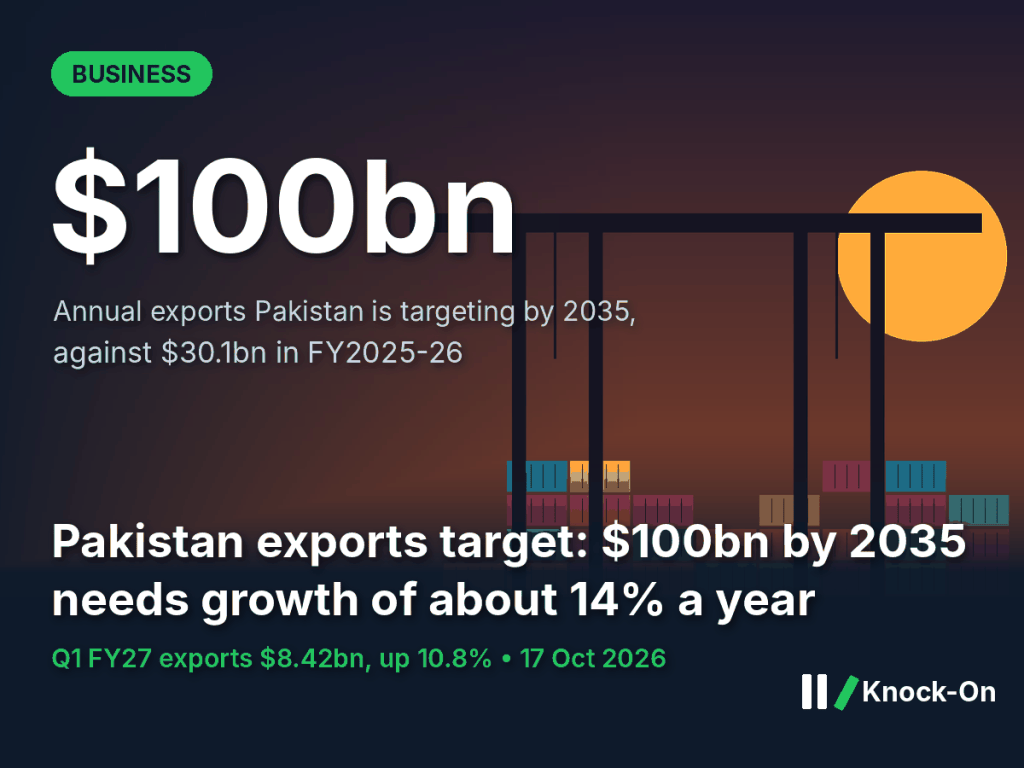
The Pakistan exports target is now $100bn a year by 2035, with $60bn as a medium-term goal, the prime minister’s coordinator on commerce told an economists’ conference in Islamabad, The Nation reported on Saturday. Pakistan exported $30.1bn of goods in the year to June 2026, so the target means more than tripling sales abroad in about nine years. A strong first quarter helps, but exporters say their costs are moving the other way.
The short version
- Rana Ihsaan Afzal Khan set out a $100bn exports goal for 2035 and $60bn for the medium term.
- Goods exports fell 5.93% to $30.1bn in FY2025-26 but rose 10.8% to $8.42bn in July to September.
- Reaching $100bn from $30.1bn needs growth of about 14.3% a year for nine years (Knock-On calculation).
- The plan leans on lower tariffs, fewer regulations, cheaper export finance and new trade deals.
What happened
Rana Ihsaan Afzal Khan, Coordinator to the Prime Minister on Commerce and Industries, spoke at the closing session of the Pakistan Society of Development Economists’ annual meeting at PIDE, held under the theme “Mission $100 Billion”, The Nation reported. He said the National Tariff Policy 2025-30 will rationalise duties on about 7,500 tariff lines, gradually remove regulatory and additional customs duties, and cap customs duty at 15%. About 500 regulatory requirements are under review, and the prime minister has approved a Trade Facilitation Board to cut port and logistics costs.
He also pointed to the cut in the tax on export proceeds from 2% to 1.25% in the 2026-27 budget, plans to lift SME financing from Rs1trn to Rs2trn, the Pakistan Single Window, which links more than 108,000 traders with 32 agencies, and trade talks with Vietnam, South Korea, Cambodia, Bangladesh and African countries. The new figures start from a low base. Provisional PBS data show exports of $30.139bn in FY2025-26, down from $32.040bn the year before, while imports rose 8.14% to $69.761bn, Profit reported.
The 2035 goal is more than three times today’s exports
Pakistan goods exports, US$ billion a year: actual vs government targets
Why it matters
The Pakistan exports target matters because exports are the only lasting way to pay for imports without new borrowing. In September the current account deficit reached $356m as imports outgrew exports. The latest quarter is the right direction: exports rose 17.6% year on year in September to $2.94bn, with agriculture and food up 23% and textiles up 6% for the quarter, according to figures shared by adviser Khurram Shehzad and reported by ProPakistani. But growth of 10.8% is still below the roughly 14% a year the 2035 goal implies, and services are moving too, with IT exports at their second-best month in September.
The knock-on effects
First order: input costs and tariffs
A 15% cap on customs duty would make imported machinery, yarn and chemicals cheaper for exporters. It would also expose local makers of those inputs to more competition, and cut duty income the government relies on.
Second order: finance and refunds
Exporters say policy promises have not reached their costs. The Towel Manufacturers’ Association said in a statement this week that members pay 5.5% to 8.5% under the Export Finance Scheme against an announced 4.5% rate, and asked for faster tax refunds and a review of industrial power tariffs, Business Recorder reported. Doubling SME credit, already a target raised twice since July, would help smaller exporters most.
Third order: the rupee and jobs
If exports grew fast enough to close the trade gap, pressure on the rupee would ease and the economy could grow without running into a dollar shortage. That is a forecast that depends on costs, not targets.
Who could benefit
- Food and agriculture exporters, with 16 plant and animal health protocols agreed with China.
- IT and services firms, named among the sectors for diversification.
- Manufacturers that import inputs, if duties fall towards the 15% cap.
Who may face pressure
- Protected local industries that rely on high regulatory duties.
- Textile exporters, the largest sector, growing only 6% while energy and finance stay costly.
- The FBR, which loses customs revenue as duties fall.
What to watch
- Early November: PBS trade data for October, the next test of the 10.8% pace.
- Whether the Export Finance Scheme rate actually falls to 4.5% for borrowers.
- The first meetings and decisions of the new Trade Facilitation Board.
- FoodAg 2026 in Karachi, highlighted by the government as a platform for food exports.
Sources
- The Nation, Pakistan targets $100b in annual exports by 2035 through trade reforms, 17 Oct 2026
- Profit, Pakistan’s trade deficit widens to $39.62 billion in FY2025-26, 16 Jul 2026
- ProPakistani, Pakistan exports record sharp increase in September, 5 Oct 2026
- Business Recorder, TMA for reforms to restore export competitiveness, 16 Oct 2026
This is analysis, not investment advice. Figures are as of 17 Oct 2026.

Leave a Reply