
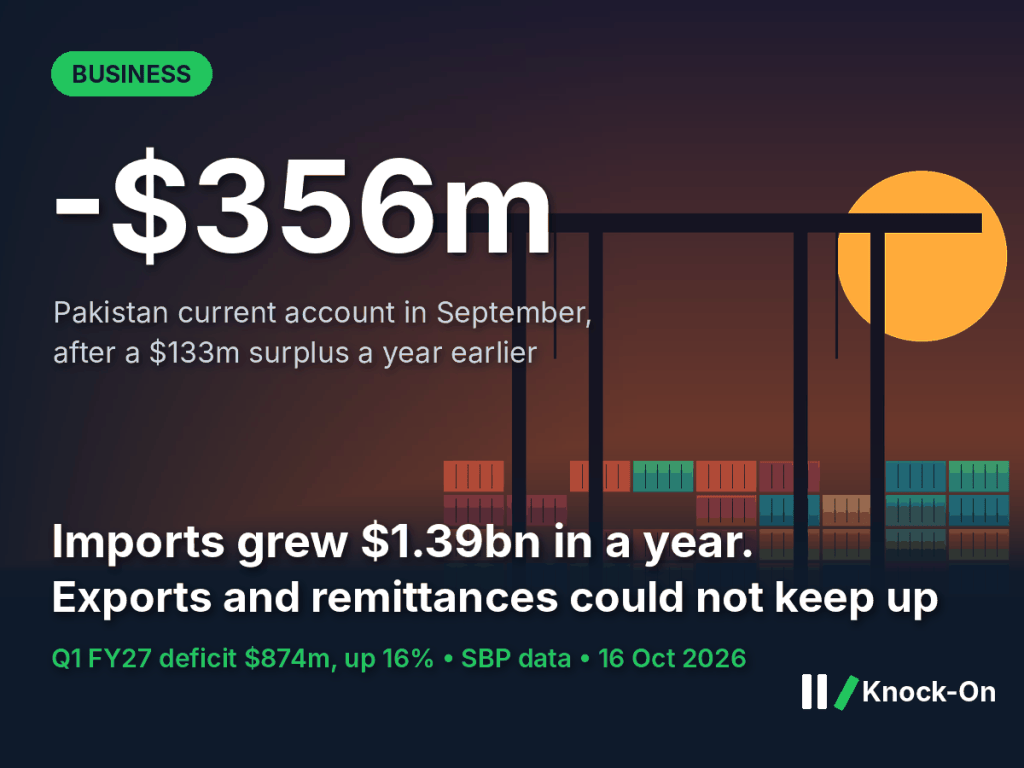
Pakistan’s current account deficit widened to $356 million in September 2026, from $73 million in August, the State Bank of Pakistan (SBP) reported on Friday. A year earlier, September showed a $133 million surplus. The cause is plain in the numbers: imports of goods and services grew by $1.39 billion in a year, while exports and workers’ remittances together added about $0.94 billion. For businesses that buy dollars, borrow in rupees or price imports, the current account deficit is the number that shapes the rupee and interest rates in the months ahead.
The short version
- The current account deficit was $356 million in September, against a $133 million surplus in September 2025.
- The July–September deficit reached $874 million, up 16% from $755 million a year earlier.
- Imports rose 23% to $7.38 billion; exports rose 15% to $3.95 billion and remittances rose 13% to $3.59 billion.
- Topline Securities forecasts a full-year deficit of $2–3 billion, or 0.4–0.6% of GDP.
What happened
The SBP said the current account balance “recorded a deficit of $356 million in Sep 2026 compared to a deficit of $73 million in Aug 2026”, according to Arab News. August’s figure was revised down from $98 million, Business Recorder reported. Over the first quarter of the 2026-27 fiscal year, the current account deficit in Pakistan came to $874 million.
Business Recorder’s breakdown shows exports of goods and services at $3.95 billion in September, up from $3.42 billion a year earlier. Imports of goods and services were $7.38 billion, up from $5.99 billion. Workers’ remittances, the main cushion, rose to $3.59 billion from $3.18 billion. ProPakistani, citing Topline Securities, said the goods trade deficit alone was $3.2 billion in September, $148 million wider than in August, with goods imports up 13% month on month to about $6.2 billion.
Imports grew faster than exports and remittances combined
Increase from September 2025 to September 2026, US$ billion
Why it matters
A current account deficit means Pakistan is spending more foreign currency than it earns, and the gap has to be filled by loans, investment or reserves. The country is running a $7 billion IMF programme in which the external balance is a key test, Arab News noted. September’s swing also comes before the full effect of higher oil prices: our analysis of how Brent above $105 could add up to $1.2bn a quarter to the oil import bill suggests more pressure on imports, not less. The real effective exchange rate also rose 0.98% to 108.93 in September, Business Recorder reported, which points to a rupee that is getting more expensive in real terms for exporters.
The knock-on effects
First order: more demand for dollars
A wider current account deficit raises demand for dollars from importers. Pressure shows first in the interbank market and in how much the SBP can add to its reserves each month.
Second order: less room for rate cuts
A central bank watching its external account is slower to ease. That matters for borrowers already facing high yields, as our piece on the SBP interest rate and T-bill yields showed.
Third order: financing and ratings
Bigger external gaps raise the importance of new financing and of the credit rating that prices it. The government is courting rating agencies, as covered in our look at Pakistan’s double-B rating hopes; a widening deficit makes that case harder to argue.
Who could benefit
- Exporters could gain if dollar demand weakens the rupee, though a rising real exchange rate works against them for now.
- Remittance-linked banks and channels remain the main support for the external account and the focus of policy attention.
- Dollar earners, including IT and services exporters, gain relative bargaining power when the external gap widens.
Who may face pressure
- Importers of fuel, machinery and raw materials, who need dollars and face currency risk.
- Borrowers hoping for cheaper loans, if the SBP stays cautious.
- Consumers, if a weaker rupee feeds into prices of imported goods.
What to watch
- October trade figures and the next SBP current account release, to see whether September’s gap was a one-off or a trend.
- The SBP’s next interest-rate decision and its comments on the external account.
- Brent crude prices, which drive Pakistan’s largest import item.
- Whether the full-year deficit tracks Topline’s $2–3 billion forecast.
Sources
- Business Recorder, Pakistan posts $356mn current account deficit in Sept 2026, 16 Oct 2026
- Arab News, Pakistan’s current account deficit widens nearly fivefold in September, 16 Oct 2026
- ProPakistani, Current Account Deficit Worsens in 3 Months, 16 Oct 2026
This is analysis, not investment advice. Figures are as of 16 October 2026.



Leave a Reply