
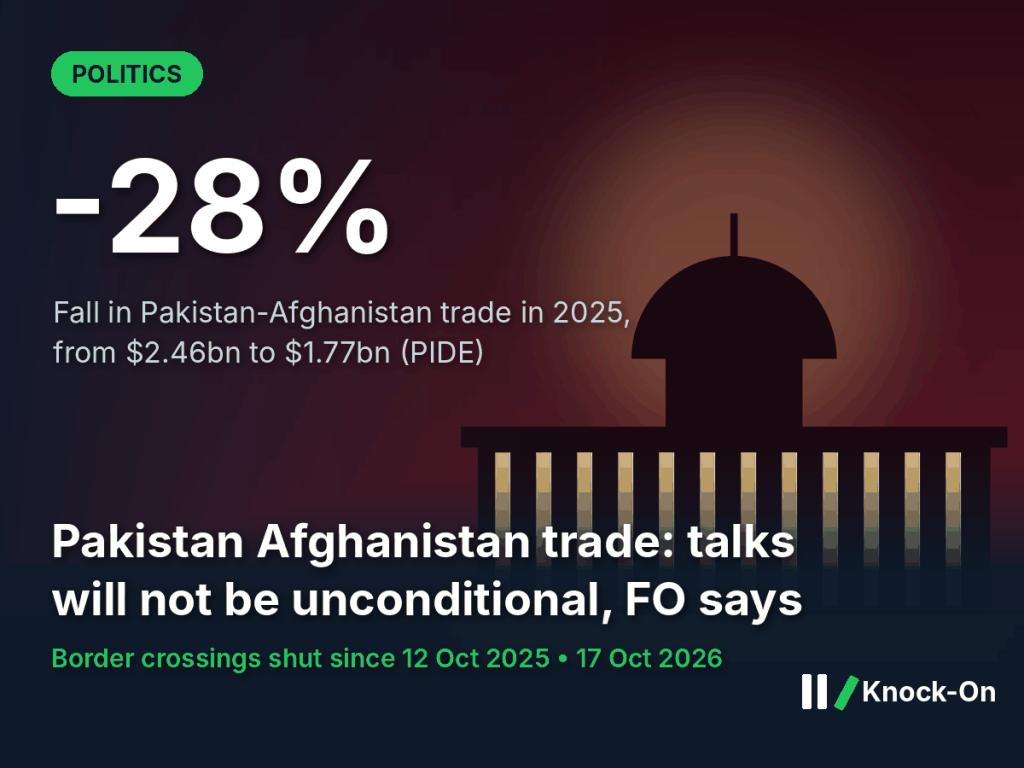
Pakistan Afghanistan trade has spent a full year without its main land routes, and the Foreign Office signalled on Friday that the way back will not be quick. Any talks with Kabul “will not be unconditional”, spokesperson Sajjad Haider Khan told his weekly briefing, Dawn reported. For exporters, truckers and traders in the border provinces, that means planning for the crossings shut since 12 October 2025 to stay closed for now.
The short version
- Pakistan wants a “verifiable mechanism” to stop attacks from Afghan soil before talks; the Afghan Taliban reject the claim that Afghanistan is a base for attacks.
- Bilateral trade fell 28% to $1.77bn in 2025, according to a PIDE report cited by Business Recorder.
- Five crossings, including Torkham and Chaman, have been closed to trade for a year, with no reopening date announced.
- Kabul says it is replacing Pakistani goods through Central Asia, led by Kazakh flour and wheat.
What happened
At Friday’s briefing, the spokesperson said Pakistan’s one demand is a “verifiable mechanism to ensure complete cessation of terrorist activities” from Afghan territory, and that the Taliban government had been taking “one step forward and one step backward”, according to Dawn. He said he was not aware of any formal Russian mediation, although Moscow’s envoy Zamir Kabulov has offered to help if both sides ask. A Moscow Format meeting on 5 October ended without a joint statement after the two delegations disagreed over wording on militant groups. Dawn notes that the Afghan Taliban have rejected Pakistan’s claims that Afghanistan is a base for attacks.
The trade cost is already visible. A Pakistan Institute of Development Economics report put Pakistan Afghanistan trade at $1.77bn in 2025, down from $2.46bn in 2024, and estimated exporters’ losses at $4.5bn since the closure, Business Recorder reported in August. The authors described that loss figure as an indication of scale rather than a verified total. The Pakistan-Afghanistan Joint Chamber of Commerce estimated a monthly loss of Rs50bn, with 10,000 to 12,000 containers stranded at the border in January and February.
Trade with Afghanistan shrank as Central Asia moved in
Bilateral trade, US$ billion
Why it matters
Afghanistan was a market Pakistani firms could reach by road in a day. In the six months before the closure, Pakistani exports to Afghanistan were worth $832m, according to World Bank data cited by Amu TV. That demand has not vanished; it has moved. Taliban spokesperson Zabihullah Mujahid said this week that Afghanistan is offsetting the loss through other routes, and Afghan firms signed $55m of wheat and flour contracts in Kazakhstan, Afghanistan International reported. The longer Pakistan Afghanistan trade stays frozen, the harder it will be to win those buyers back, at a time when the government is chasing a $100bn exports target.
The knock-on effects
First order: lost sales at the border
Fruit, vegetables and other perishables were hit hardest, the PIDE report found. Transporters faced container rent, fuel and detention charges of $150 to $200 per container per day while goods waited.
Second order: the border economy
Khyber Pakhtunkhwa and Balochistan host the main crossings, so warehouses, clearing agents and transport firms there carry most of the cost. In KP this comes on top of the uncertainty from governor’s rule, which faces a court hearing on 20 October.
Third order: transit and regional routes
Karachi’s role as Afghanistan’s main port also weakens as Afghan traders build links through Central Asia and Iran. Once new suppliers and routes are set up, they may stay in use even after the border reopens. That is a risk, not a certainty.
Who could benefit
- Central Asian exporters, especially Kazakh flour and wheat suppliers.
- Pakistani exporters with other markets, who can redirect goods to buyers elsewhere.
Who may face pressure
- Fruit and vegetable traders who relied on quick road access.
- Transporters and clearing agents in KP and Balochistan.
- Karachi port and logistics firms that handled Afghan transit cargo.
What to watch
- Any formal mediation request involving Russia, Qatar, Turkiye, Saudi Arabia or China, which have all hosted or offered talks.
- The Foreign Office’s next weekly briefing for any change in tone.
- Any announcement on reopening Torkham or Chaman to trade.
- 20 October: the Peshawar High Court hearing on governor’s rule in KP.
Sources
- Dawn, Pakistan rules out unconditional talks with Afghanistan, 17 Oct 2026
- Business Recorder, Afghan border closure inflicts USD4.5bn loss on Pak exporters: report, 22 Aug 2026
- Afghanistan International, Afghanistan replaces lost Pakistan trade through Central Asia, says Taliban, 14 Oct 2026
- Amu TV, Afghanistan’s trade with Pakistan remains stalled for over 300 days, 9 Aug 2026
- Pakera, Pakistan Afghan border closed one year: trade cost, 11 Oct 2026
This is analysis, not investment advice. Figures are as of 17 Oct 2026. Knock-On is not affiliated with any political party.

Leave a Reply