
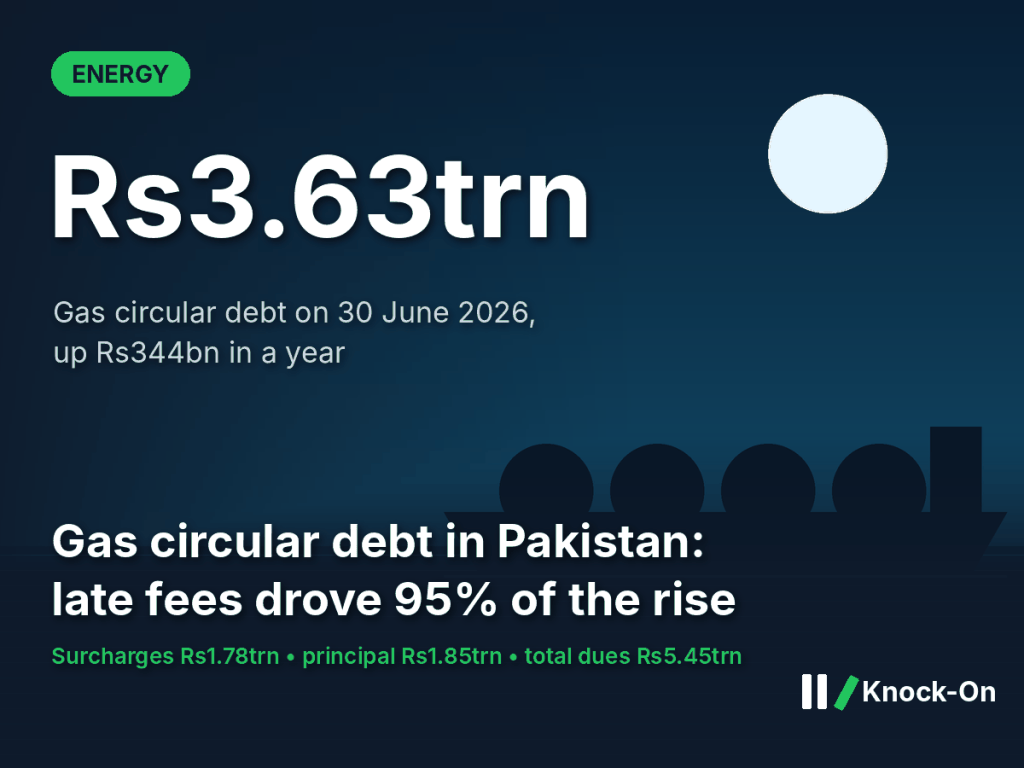
Gas circular debt in Pakistan stood at Rs3.631 trillion on 30 June 2026, up Rs344 billion from a year earlier, Business Recorder reported. Almost all of that increase came from late payment surcharges, which grew by Rs327 billion, while the underlying unpaid principal rose only Rs17 billion. Counting another Rs1.823 trillion owed to gas producers and LNG suppliers, the sector’s total debt is Rs5.454 trillion. The figures surfaced as Finance Minister Muhammad Aurangzeb reviewed a gas sector restructuring and deregulation roadmap on Monday.
The short version
- Gas circular debt rose to Rs3.631trn on 30 June 2026 from Rs3.288trn a year earlier.
- Late payment surcharges now total Rs1.783trn, almost as much as the Rs1.848trn principal.
- Including Rs1.823trn of payables to gas and LNG suppliers, total gas sector debt is Rs5.454trn.
- A reform roadmap prepared with a World Bank team now goes to the Prime Minister; a Circular Debt Management Plan will be shared with the IMF once approved.
What happened
Business Recorder set out the gas circular debt breakdown as of 30 June. Of the Rs1.848 trillion principal, Rs1.448 trillion is tariff differential, the gap between what gas costs utilities and what regulated consumers are charged. A further Rs131 billion is owed by power companies, Rs210 billion is tied up in sales and income tax receivables, and Rs59 billion is stuck in litigation. Payables to indigenous gas suppliers stand at Rs1.479 trillion and to LNG suppliers at Rs344 billion, including RLNG price actualisation and diversion costs.
Surcharges, not new shortfalls, drove the Rs344bn rise
Increase in gas circular debt, June 2025 to June 2026, Rs billion
The roadmap reviewed on Monday proposes a phased shift towards competition, efficiency benchmarks to cut system losses, more sustainable pricing and competitively priced gas for exporters, drawing on reforms in Türkiye and the UK. Participants stressed careful sequencing to protect supply and regulated consumers. No dates were given.
Why it matters
When surcharges grow almost twenty times faster than principal, the gas circular debt is compounding on itself: the longer bills go unpaid, the bigger the stock becomes, even if no new shortfall is added. That is our reading of the figures. The core of the problem is the Rs1.448 trillion tariff differential, meaning regulated users have long paid less than gas costs. Any lasting fix therefore involves some mix of higher prices for those users, budget money, or deals to write off surcharges between state-owned companies. The same pattern of unpaid dues runs through power, where CPEC power dues have reportedly reached Rs498bn.
Under-priced gas is most of the principal
Principal of gas circular debt by component, Rs billion, 30 June 2026
The knock-on effects
First order: cash-starved gas producers
The Rs1.479 trillion owed to indigenous gas suppliers is money exploration and production companies cannot spend on drilling. Payables to LNG suppliers add pressure on import arrangements, already under review in Pakistan’s Qatar gas deal.
Second order: pressure on gas tariffs
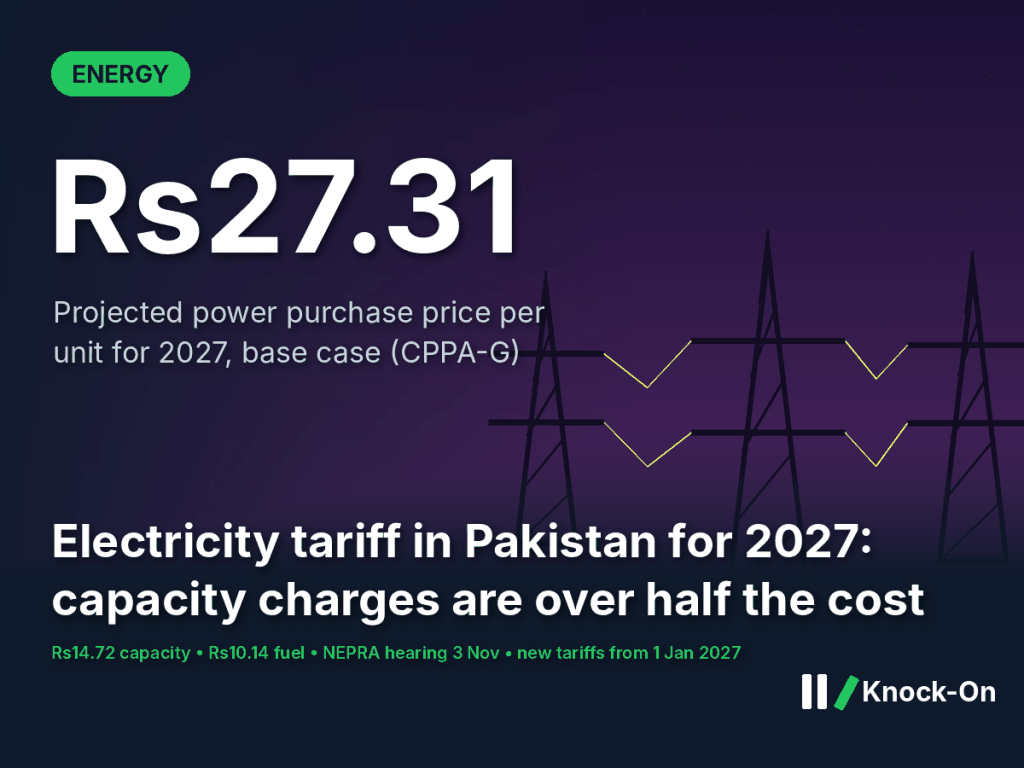
Because the tariff differential is the largest component, reform is likely to mean closer-to-cost pricing for regulated users. For industry and exporters, the roadmap promises competitively priced gas, but the path there is not yet set. Energy costs are already high, as shown by the Rs27.31 power purchase price behind next year’s electricity tariff.
Third order: fiscal and IMF talks
The Circular Debt Management Plan is being finalised with stakeholders and will be shared with the IMF after approval, Business Recorder reported. Any settlement that uses budget money competes with other spending.
Who could benefit
- Gas producers: would gain most if a plan clears long-unpaid receivables.
- Exporters: the roadmap explicitly targets competitively priced gas for them.
- Private gas traders: deregulation would open more business-to-business sales.
Who may face pressure
- Regulated gas users: households and businesses on below-cost tariffs.
- Gas utilities: face efficiency benchmarks and loss targets.
- The federal budget: if part of the debt is settled with public money.
What to watch
- The Prime Minister’s decision on the gas sector roadmap (no date given).
- Approval of the Circular Debt Management Plan and its submission to the IMF.
- Any OGRA gas price determination that narrows the tariff differential.
Sources
- Business Recorder, Total gas sector’s circular debt hits Rs5.454trn, 20 October 2026
- Business Recorder, Restructuring, deregulation: Proposed gas sector roadmap reviewed, 20 October 2026
This is analysis, not investment advice. Figures are as of 30 June 2026, reported 20 Oct 2026.

Leave a Reply