
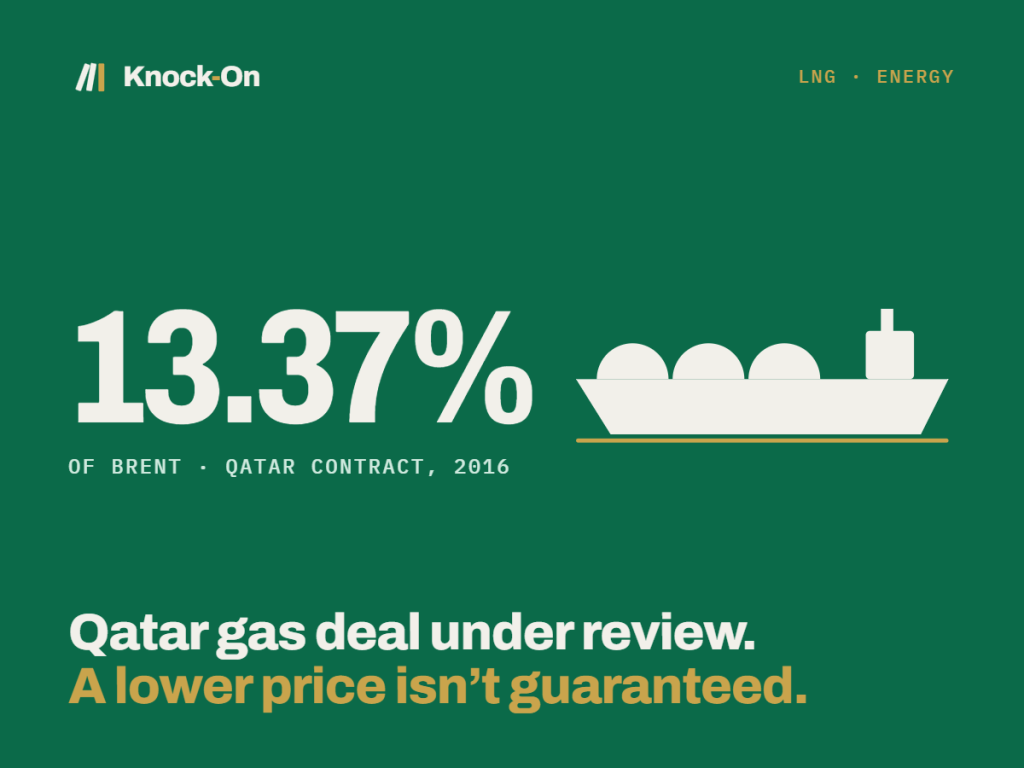
Ten years ago, Pakistan signed a long-term deal with Qatar to keep its power plants and industry supplied with gas. Both sides now want to revisit the price. The common assumption is that Pakistan will secure cheaper gas. The terms of the contracts, and the current state of the energy market, suggest the result could go either way.
The short version
- Pakistan State Oil (PSO) and QatarEnergy have served price-review notices on each other and agreed to review the LNG supply contracts, according to The Express Tribune.
- Qatar moved first, serving notice on the second contract on 7 March 2026. PSO followed on the first contract on 19 March.
- The 2016 contract prices gas at 13.37% of the Brent oil price. By our estimate, each percentage point of that “slope” is worth roughly $190–200 million a year at $100 oil.
- The outcome affects electricity tariffs, industrial gas costs and circular debt.
What happened
According to The Express Tribune’s 8 October report, which cites unnamed sources, both sides have served notices under the price-review clauses of their two government-to-government agreements:
- The first agreement (SPA-I) is a 15-year contract running from 2016 to 2031. PSO served its review notice on 19 March 2026, after the clause became available on the contract’s tenth anniversary.
- The second agreement (SPA-II) is a 10-year contract running from 2021 to 2031. QatarEnergy served its notice on 7 March 2026.
PSO receives about 6.75 million tonnes of LNG a year (108 cargoes) under the two contracts. With power-sector demand falling, Pakistan’s system has been running a surplus, and 24 cargoes have been removed from this year’s delivery plan. Both contracts are take-or-pay. The report says that when surplus cargoes are sold elsewhere, profits go to QatarEnergy while losses fall on PSO. PSO is seeking federal government consent to proceed with the review.
Why it matters
The price formula is the single largest driver of what Pakistan pays for imported gas. SPA-I prices LNG at 13.37% of Brent, a level analysts have long described as expensive relative to more recent contracts in the region.
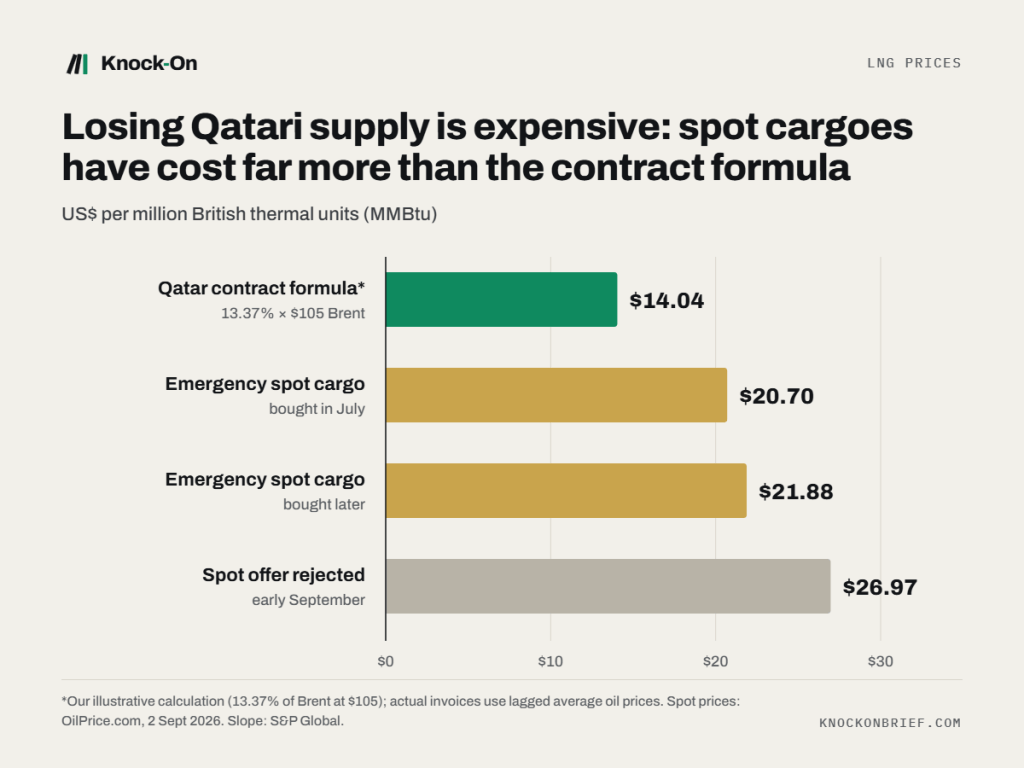
Our own estimate: at $100 oil, each percentage point of slope is worth about $1 per million British thermal units. SPA-I covers about 3.75 million tonnes a year, or roughly 195 million MMBtu. Each point of slope is therefore worth around $190–200 million a year. This is an approximation, but it shows the scale of what is being negotiated.
The contrarian view
Most coverage will frame this as Pakistan seeking a discount. Three factors complicate that.
Qatar served the first notice. SPA-II’s clause allows the price to be adjusted to reflect comparable contracts, which can mean an increase as well as a decrease.
Leverage has shifted. With Brent above $100 and Gulf shipping disrupted, sellers of reliable LNG are in a stronger position than they were a year ago. When QatarEnergy declared force majeure on exports this summer because of disruption in the Strait of Hormuz, Pakistan paid $20.70 and $21.88 per MMBtu for emergency spot cargoes. In early September it rejected a spot offer at about $27, according to OilPrice.com.
The clock may already have run. As The Express Tribune describes SPA-I, if the parties do not agree within six months of a notice, either side may terminate at the end of that contract year. PSO’s notice on SPA-I was dated 19 March, so the six-month mark passed on 19 September. Termination would carry serious supply risk for Pakistan. The real prize may therefore be flexibility, meaning fewer take-or-pay obligations and better diversion terms, rather than a lower headline price. This is our analysis, not a reported development.
The knock-on effects
First order: the cost of imported gas
Any change to the slope feeds directly into the price of re-gasified LNG supplied to power plants and industry.
Second order: power tariffs and industrial competitiveness
LNG-fired power plants pass fuel costs into electricity tariffs. Export industries that run on gas compare their energy costs with competitors in Bangladesh, India and Vietnam.
Third order: circular debt and the IMF
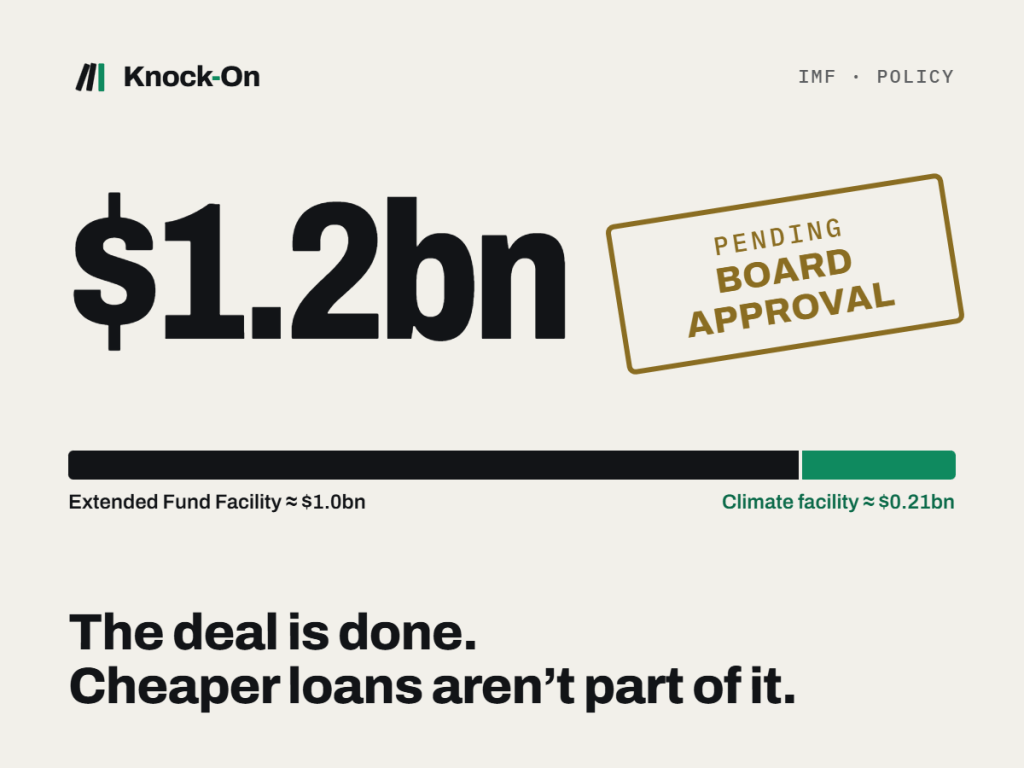
Gas-sector circular debt is a recurring issue in Pakistan’s IMF programme. A better contract would ease pressure on the fiscal accounts. A worse one, or a disruptive termination, would add to it.
Who could benefit
- Power consumers and gas-using export industries, if the review lowers the slope or adds flexibility.
- The fiscal position, through lower subsidy and circular-debt pressure.
Who may face pressure
- Industries dependent on LNG, if the review raises costs or supply becomes less certain.
- PSO and the gas utilities, which carry the cash-flow risk of surplus cargoes.
What to watch
- Federal government consent for PSO to proceed, and the stated scope of the review.
- Any official statement from the Petroleum Division or PSO on timelines.
- Brent prices, which determine what each point of slope is worth.
Our forecast
We do not expect a final pricing outcome to be announced in October. Reasoning: the negotiation is complex, requires federal consent and involves two contracts with different review mechanics. Confidence: moderate.
Sources
- The Express Tribune, “Pakistan, Qatar agree to review LNG deal”, 8 October 2026 (single outlet, based on unnamed sources)
- S&P Global Commodity Insights, Pakistan plans to renegotiate LNG prices with QatarEnergy, February 2025 (slope and volume)
- IEEFA, Pakistan’s LNG surplus crisis
- OilPrice.com, Pakistan rejects costly LNG cargo, 2 September 2026 (spot prices and Qatari force majeure)
This is analysis, not investment advice. The cost estimate is our own approximation and is labelled as such. Figures are as of 9 October 2026.


Leave a comment