
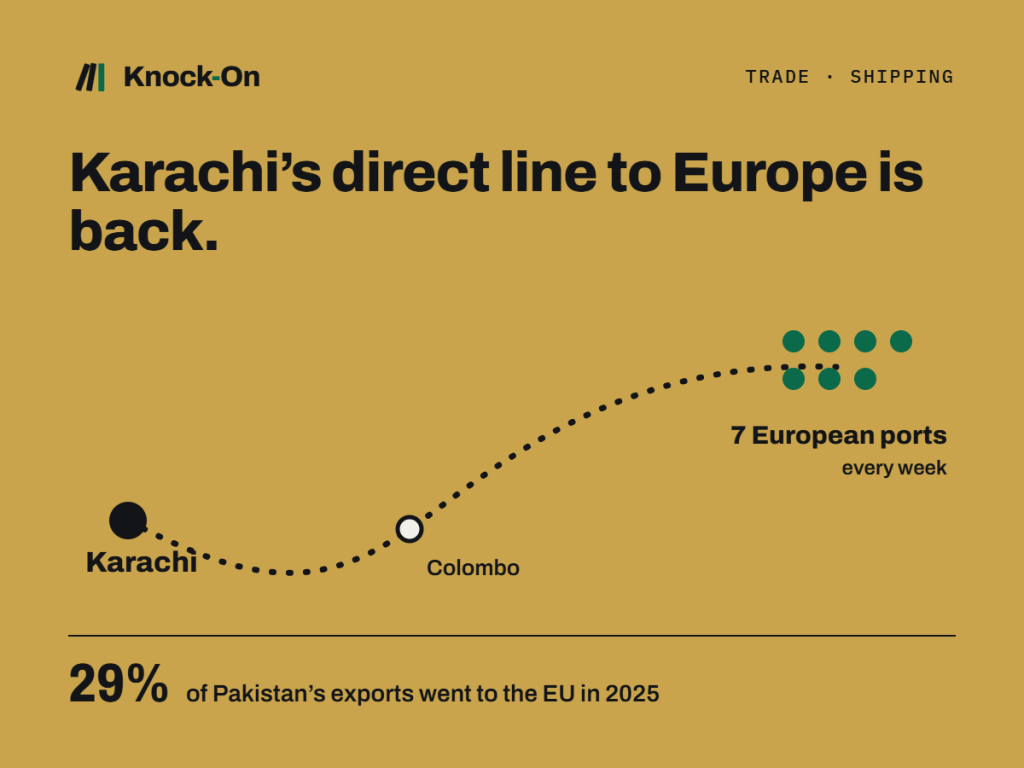
Pakistan has regained a weekly container service connecting Karachi with major European ports. For an export base that relies heavily on European buyers, that is welcome news. The minister who announced it was careful to add a caveat, and the caveat is the part businesses should weigh most.
The short version
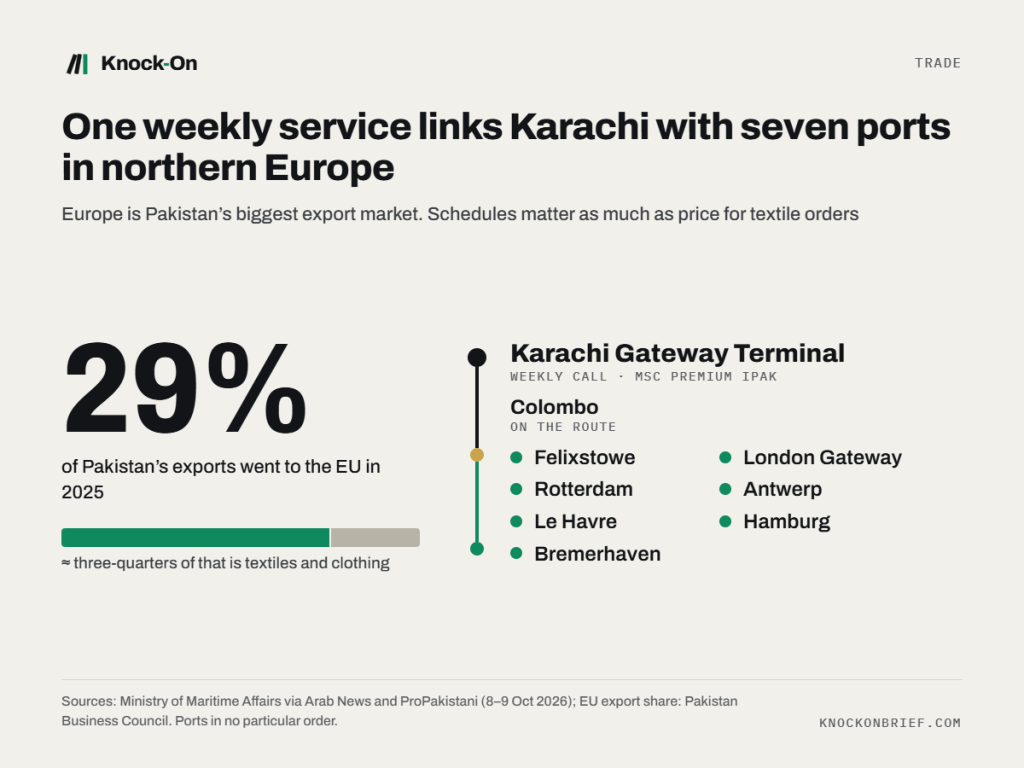
- Mediterranean Shipping Company (MSC) has reinstated its weekly Premium IPAK service, calling at Karachi Gateway Terminal.
- The service connects Karachi with Felixstowe, Rotterdam, Hamburg, Bremerhaven, Antwerp, Le Havre and London Gateway, with Colombo also on the route.
- The EU accounted for about 29% of Pakistan’s exports in 2025, and textiles and clothing make up roughly three-quarters of that trade.
- The gain is mainly in schedule reliability. The minister himself said the service will not resolve wider disruption on global shipping routes.
What happened
Federal Minister for Maritime Affairs Muhammad Junaid Anwar Chaudhry announced on 8 October that MSC had reinstated the Premium IPAK service with weekly calls at Karachi Gateway Terminal. The ministry said the service would give exporters, particularly in textiles, better options at a time when disruption around the Red Sea has forced longer and more expensive voyages to Europe and the United States.
Karachi Port Trust’s chairman said work was continuing to improve Karachi’s connectivity with European markets. He proposed measures including electronic delivery orders available around the clock, risk-based and non-intrusive inspections, and joint sampling.
The announcement did not include transit times, freight rates or a first sailing date.
Why it matters
Europe is Pakistan’s most important export market. According to Pakistan Business Council figures cited by Arab News, the EU took about 29% of Pakistan’s exports in 2025, most of them textiles and garments that enter at reduced or zero tariffs under the EU’s GSP+ scheme.
For apparel and home-textile exporters, the timing of delivery matters almost as much as the price. European retailers plan seasonal ranges months in advance. A missed shipping window can mean a cancelled order or a discount. A fixed weekly direct service reduces the risk of containers missing connections at intermediate hubs.
The knock-on effects
First order: more predictable schedules
Exporters gain a fixed weekly departure to seven northern European ports, which simplifies production planning and reduces the risk of delays at transshipment hubs.
Second order: working capital and order retention
More reliable transit can shorten the time between shipment and payment, easing working-capital needs for exporters who are paid on delivery. It also strengthens Pakistan’s case with buyers who weigh reliability alongside price when allocating orders among Pakistan, Bangladesh, India and Vietnam.
Third order: port competitiveness
If more lines follow, Karachi’s position as a direct-call port, rather than a feeder port, would strengthen. That depends on port efficiency, which is why the port-clearance reforms proposed alongside the announcement matter.
The caveat
The service does not lower the cost of getting to Europe. Vessels still face the same route disruptions, war-risk insurance premiums and fuel costs as every other carrier, and bunker fuel is expensive with Brent above $100 a barrel. Exporters should not assume freight rates will fall because of this announcement.
Who could benefit
- Textile and apparel exporters selling to northern Europe, especially those on tight delivery schedules.
- Freight forwarders and logistics companies that can build services around a fixed weekly departure.
- Karachi Gateway Terminal, through additional volumes.
Who may face pressure
- Competing routings via transshipment hubs, which may lose some Pakistan–Europe volume.
- Exporters on thin margins, if freight and surcharges stay high despite the better schedule.
What to watch
- First sailing date and published transit times.
- Freight rates and surcharges quoted on the service compared with transshipment alternatives.
- Whether other major lines add direct Pakistan–Europe calls.
- Monthly export data from PBS, especially textile exports to the EU.
Sources
- Arab News Pakistan, Pakistan restores direct shipping service to seven European ports, 8 October 2026
- ProPakistani, Direct shipping to Europe returns as Pakistan restores Karachi link, 9 October 2026
- Associated Press of Pakistan, Direct Europe shipping service restored to facilitate exporters
This is analysis, not investment advice. Figures are as of 9 October 2026.


Leave a comment