
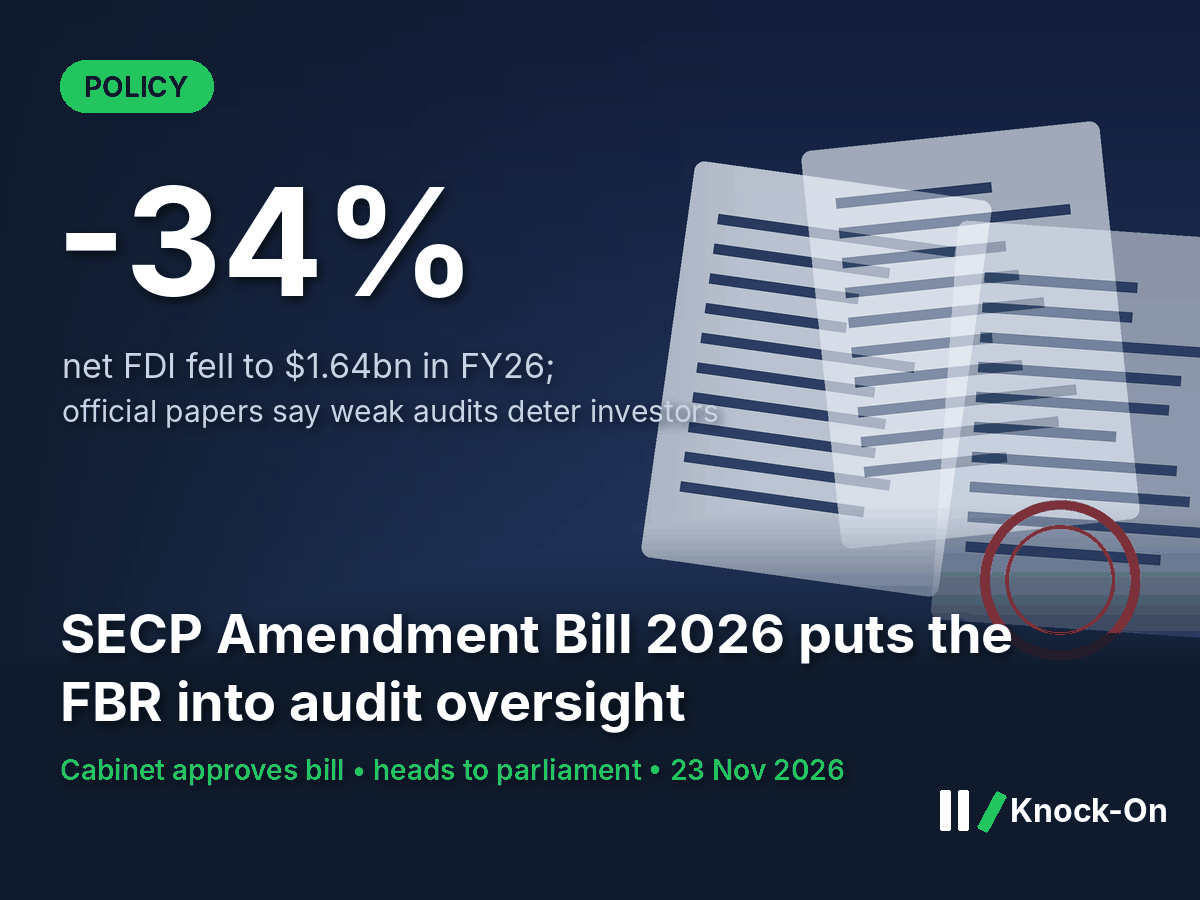
The federal cabinet has approved the SECP Amendment Bill 2026, a plan to overhaul how Pakistan supervises the auditors of listed and other public interest companies, Dawn reported on 23 November. The bill follows a finding by the Prime Minister’s FBR Task Force that the existing framework is weak, and it will now go to parliament. For businesses, the change is about trust in financial statements: official documents cited by Dawn say weak audits discourage local and foreign investment and limit access to capital markets, at a time when net foreign direct investment fell 34% in FY26.
The short version
- The cabinet approved the SECP (Amendment) Bill 2026 after reviews by three ministerial-level committees; it will be introduced in parliament.
- The FBR chairman would replace the ICAP president on the committee that nominates Audit Oversight Board (AOB) members, and board members could not be linked to audit firms.
- The AOB would run regular, risk-based inspections of the auditors of public interest companies.
- Officials say IOSCO found Pakistan non-compliant on independent audit oversight and the EU withdrew its equivalence status.
What happened
According to documents seen by Dawn, the government decided to overhaul the audit system after the FBR Task Force described the existing review framework as weak. The task force also recommended changes to the law governing the Audit Oversight Board to help tax collection. The draft SECP Amendment Bill was reviewed by the task force, the International Forum of Independent Audit Regulators (IFIAR), the Securities and Exchange Commission of Pakistan (SECP) and the AOB, alongside stakeholder consultations, before the cabinet approved it.
The official briefing cited by Dawn says the current AOB law does not meet international standards. It says IOSCO, the global body of securities regulators, declared Pakistan non-compliant on independent audit oversight, and that the European Union withdrew Pakistan’s equivalence status in this area. It points to Unity Foods and SE Foods as cases affected by weak audits and prospectus disclosures, and raises concerns about Hascol’s audited accounts. It names Sri Lanka, Mauritius and Botswana as compliant IFIAR members. A similar bill passed the National Assembly in 2021 but was withdrawn from the Senate in 2022 for resubmission. Dawn’s report carried no response from audit firms or the Institute of Chartered Accountants of Pakistan (ICAP).
Why it matters
Investors rely on audited accounts to price shares, lend money and judge partners. The government’s own case for the SECP Amendment Bill is that weak audits are one of the things holding investment back. That argument lands as foreign investment is falling: net FDI dropped 34% to $1.637 billion in FY26, according to State Bank of Pakistan data reported by Profit, while Pakistani investment abroad jumped to $342m. Audit quality is only one factor; a Dawn commentary on 23 November also pointed to costly energy, high taxes and shifting rules.
Net FDI fell by a third in FY26
Net foreign direct investment into Pakistan, $ million, FY25 vs FY26
The knock-on effects
First order: a new referee for audit firms under the SECP Amendment Bill
If parliament passes the bill, the AOB would directly inspect the auditors of public interest companies on a risk basis, while accountancy bodies would keep quality reviews of other audits under AOB oversight. The AOB could investigate complaints and references from the SECP, the State Bank and the FBR, act against people who refuse to provide information, and file complaints over criminal falsification. Dawn reports the system is meant to end the dominance of private auditors.
Second order: higher compliance costs, stronger accounts
Tougher inspections usually mean more audit work, which listed companies may pay for through higher fees. In return, cleaner accounts could reduce the risk premium investors charge and help with listings and bank lending.
Third order: international recognition and the tax link
Regaining compliance with IOSCO and EU standards would matter for foreign investors and lenders. The FBR’s larger role ties audit quality to tax collection, part of a wider push that also includes the corruption risk assessment of the FBR and other federal bodies. Some auditors and companies may question the tax authority’s influence over an audit regulator; no such reaction has been reported yet.
Who could benefit
- Minority shareholders: stronger checks on audited accounts reduce the risk of hidden problems.
- Lenders and foreign investors: regulators meeting international standards make Pakistani accounts easier to rely on.
- Well-run listed companies: firms with clean books could stand out more clearly to investors.
Who may face pressure
- Audit firms serving listed companies: regular, risk-based AOB inspections and possible enforcement.
- ICAP: it would lose its seat on the AOB nominating committee to the FBR chairman.
- Companies with weak disclosures: closer scrutiny of accounts and prospectuses, with FBR and SECP able to send references.
What to watch
- When the bill is tabled in the National Assembly and Senate; no date has been given.
- Responses from ICAP, audit firms and business chambers to the FBR’s new role.
- Whether IOSCO and the EU reassess Pakistan’s status once the law is in force.
- Monthly FDI data from the State Bank for signs of a turnaround in FY27.
Sources
- Dawn, Govt moves to overhaul ‘weak’ audit system, 23 November 2026
- Profit by Pakistan Today, Foreign direct investment in Pakistan falls 34% to $1.64 billion in FY26, 18 July 2026
- Investify (summary of Dawn commentary), Why foreign investment continues to elude Pakistan, 23 November 2026
This is analysis, not investment advice. Figures are as of 23 November 2026.



Leave a Reply