
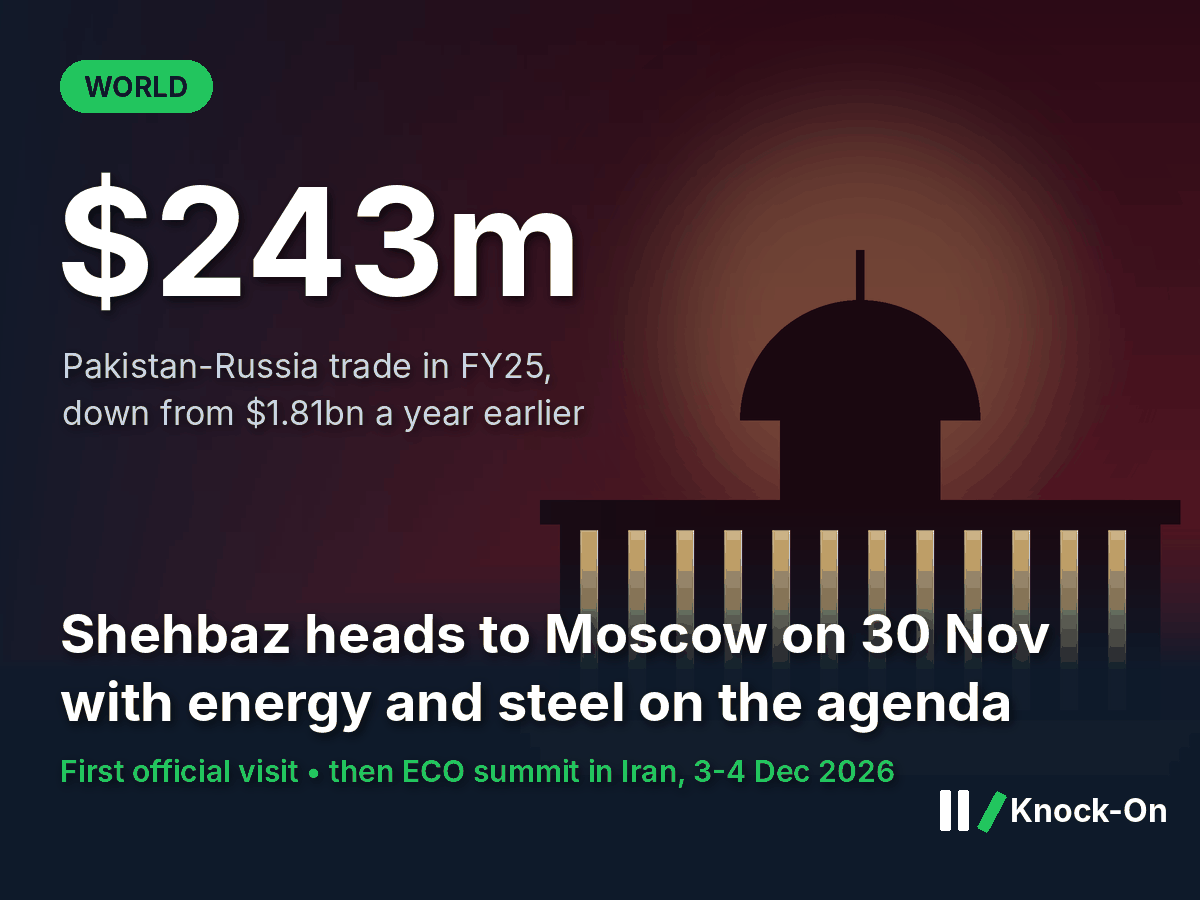
Pakistan Russia trade is far below where it stood two years ago, and Prime Minister Shehbaz Sharif’s first official visit to Moscow, starting on 30 November, is meant to change that. Dawn reported on Monday, citing a source in the Prime Minister’s Office, that talks with President Vladimir Putin are expected to cover energy, defence, trade, regional security and investment, with the revival of Pakistan Steel Mills likely to feature prominently. From Russia, the prime minister goes to Iran for the Economic Cooperation Organization (ECO) summit on 3–4 December.
The short version
- PM Shehbaz Sharif makes a three-day official visit to Russia from 30 November, then attends the 18th ECO summit in Iran on 3–4 December.
- Agenda items reported by Dawn: energy cooperation, Russian investment in oil and gas, and help reviving Pakistan Steel Mills.
- Bilateral trade fell from $1.81 billion in FY24 to $243.4 million in FY25, a drop of about 87% (Knock-On calculation).
- Officials blame payment mechanisms, banking channels, financing and shipping for the fall.
What happened
Dawn reported that the visit aims to strengthen bilateral ties and secure energy and investment agreements. Both sides are expected to examine Russian cooperation in restoring Pakistan Steel Mills, which was originally set up with Russian help, and potential Russian investment in Pakistan’s oil and gas sectors. The report gave no values for any planned agreements, and no Russian statement has been published on the agenda.
The trade numbers explain why business ties are on the list. Pakistan Russia trade rose more than 100% to $1.81 billion in the year to June 2024, Arab News reported, citing central bank data. In FY2025 it fell to $243.412 million, Energy Minister Awais Leghari said in July, “significantly below the potential”. He linked the fall to problems with payment mechanisms, banking channels, financing arrangements and shipping.
Pakistan–Russia trade lost about 87% in one year
Bilateral trade in goods and services, US$ million, fiscal years to June
Why it matters
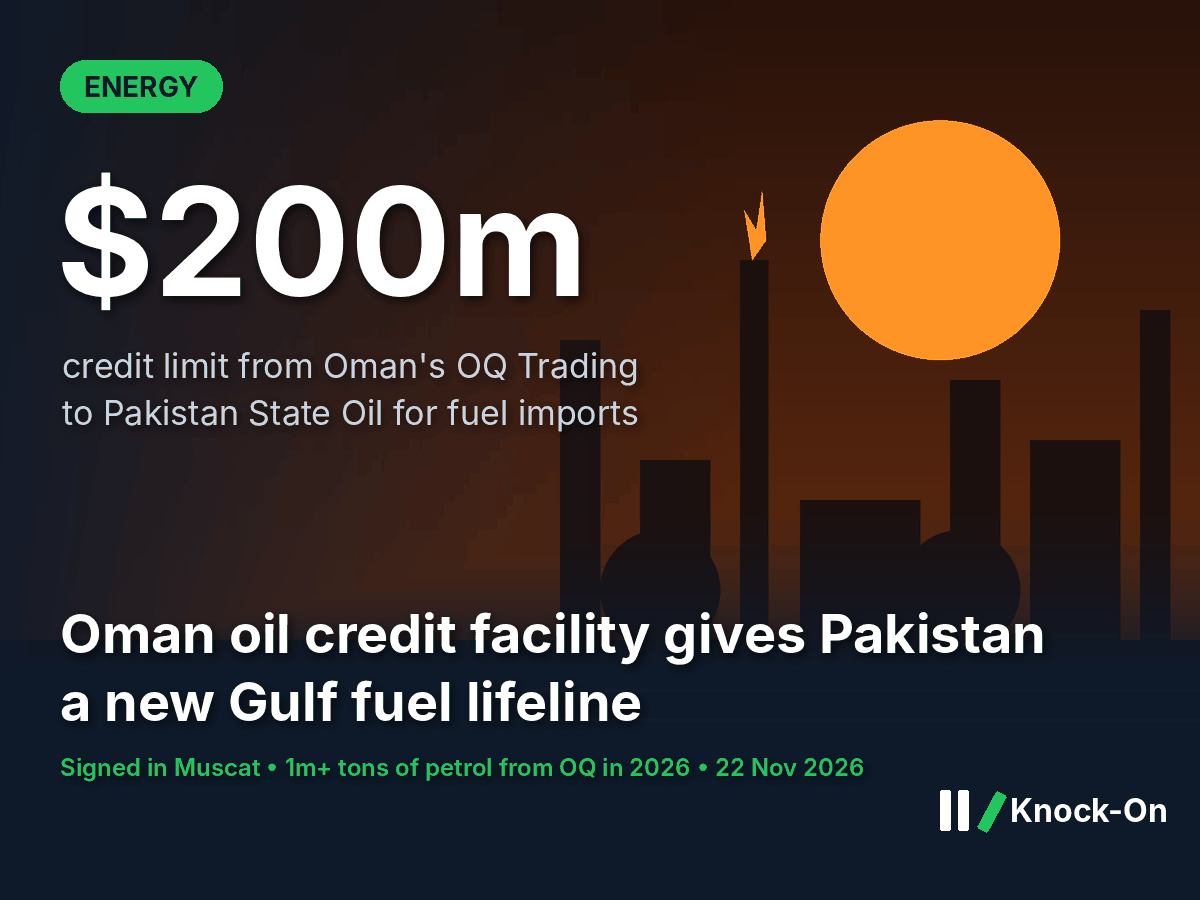
For Pakistani business, the visit is about supply options at a time when Gulf energy routes are under strain. Attacks on shipping around Hormuz have raised freight and insurance costs, as we covered in the Hormuz shipping attacks story, and Pakistan has been widening its fuel sources, most recently through an Oman oil credit facility for PSO. Pakistan began buying discounted Russian crude in 2023, according to Arab News. Whether that becomes a regular supply line depends far more on payments and shipping than on diplomacy.
The knock-on effects
First order: deals on energy and steel
Any signed agreements on oil and gas investment or Pakistan Steel Mills would be the first test. Memoranda are common on such visits; binding contracts with financing and timelines would matter more to companies.
Second order: whether Pakistan Russia trade can recover
Leghari has pointed to banking and payment channels as the main barrier. Exporters of textiles, surgical goods, sports goods and kinnows, which Russia’s consul-general in Karachi listed in 2025 as possible Pakistani supplies, need a reliable way to be paid before volumes return.
Third order: balancing partners
Pakistan relies on Gulf states for oil, financing and remittances and on the IMF for its programme. Deeper Russian ties have to fit around those relationships, and around Western sanctions on Russia that affect banks and shippers. How the government manages this will shape how much business follows the visit.
Who could benefit
- Refiners and oil marketers, if a regular Russian crude or product supply is agreed on workable payment terms.
- Steel and engineering firms, if a Pakistan Steel Mills revival brings contracts and local supply orders.
- Exporters of food and textiles, if a payment channel is set up.
Who may face pressure
- Banks, which must handle any new payment channel while staying within international sanctions rules.
- Private steel producers, which could face a revived state competitor.
What to watch
- 30 November to 2 December: agreements signed in Moscow, and whether any include values, payment arrangements or a trade agreement with Russia or the Eurasian Economic Union.
- 3–4 December: the ECO summit in Iran, as Pakistan prepares to chair the organisation for 2026-27.
- Monthly central bank trade data for any recovery in Russia flows.
Sources
- Dawn, PM to attend ECO moot in Iran after Russia trip, 23 Nov 2026
- Express Tribune (APP), Trade with Russia to cross $1b, 10 Jul 2026
- Arab News Pakistan, Pakistan to sign preferential trade agreement with Russia during Sharif’s upcoming visit — envoy, 28 Feb 2026
- Arab News Pakistan, ‘Business must cooperate’: Russia seeks to double $1.8 billion trade with Pakistan, 2 Jul 2025
This is analysis, not investment advice. Figures are as of 23 November 2026. Knock-On is not affiliated with any political party.
Leave a Reply