
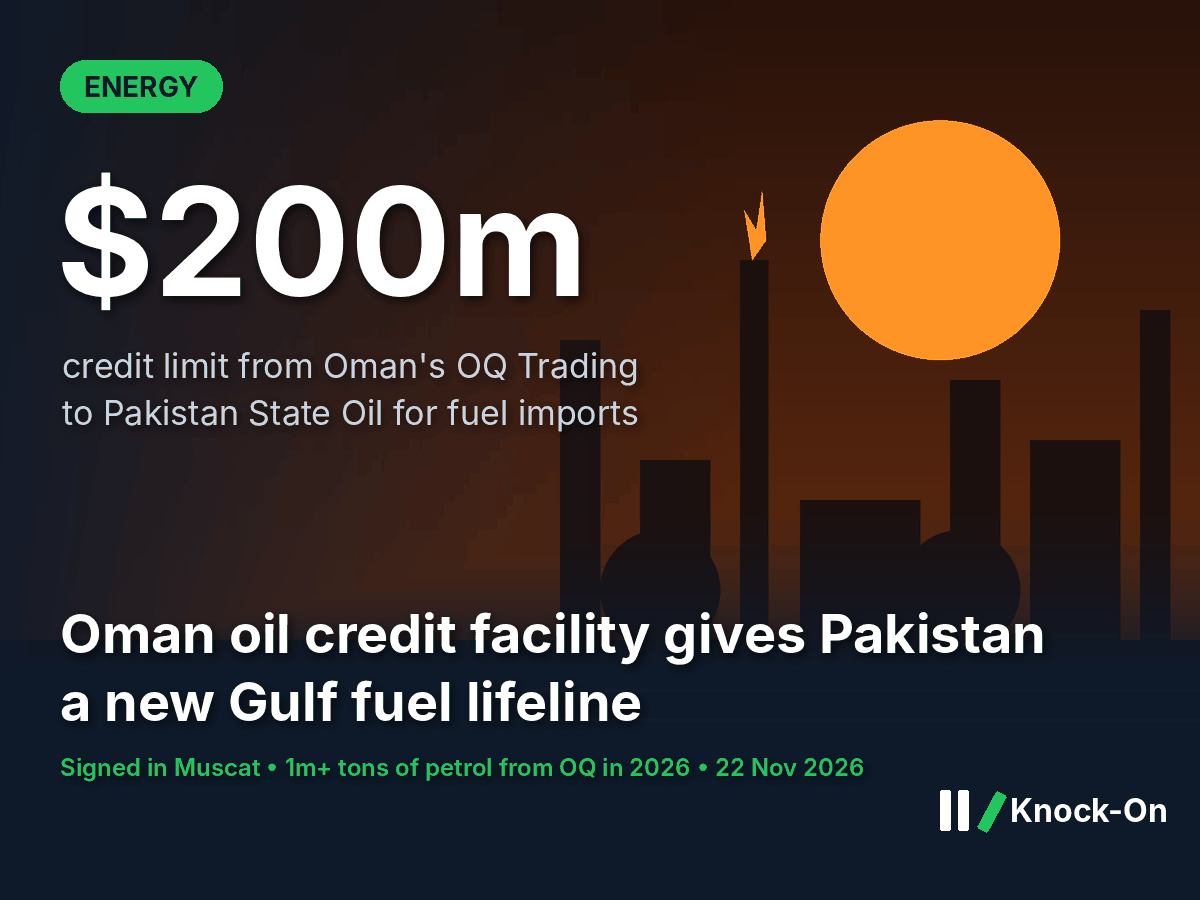
Pakistan has a new Oman oil credit facility. On Sunday, 22 November 2026, the Petroleum Division said Oman’s OQ Trading has agreed to give Pakistan State Oil (PSO) a $200 million credit limit to buy petroleum products. The deal was signed in Muscat as attacks on ships around the Strait of Hormuz keep Gulf fuel supply uncertain. For businesses that depend on steady diesel, petrol and LPG supply, the question is how much this changes.
The short version
- OQ Trading will extend a $200 million credit limit to PSO under a petroleum supply agreement, the Petroleum Division said.
- OQ has already supplied more than one million tons of gasoline (petrol) to PSO in 2026, and its LPG shipments to Pakistan are expected to pass 120,000 tons by year-end.
- The facility is small next to Pakistan’s petroleum import bill of $16.8 billion last fiscal year, and a $1.2 billion Saudi deferred-payment facility has not been renewed since it expired in April.
- The main gain is a second, structured source of fuel on credit while Gulf shipping stays risky.
What happened
Petroleum Minister Ali Pervaiz Malik met Oman’s Minister of Energy and Minerals, Salim Al Aufi, in Muscat, where the two watched PSO and OQ Trading sign the supply arrangement, Arab News reported. The Petroleum Division said the agreement “provides a structured arrangement for petroleum product supplies from OQT to PSO, supporting supply reliability amid continued volatility in regional energy markets.” Both ministers also welcomed a new Pakistan–Oman Joint Working Group on Oil and Gas.
The supply agreement itself is not new. PSO told the Pakistan Stock Exchange in October that it signed it on 8 October, after approval from its board and the federal cabinet, under a 2018 government-to-government arrangement with Oman. What is new is the $200 million credit limit. The ministry did not publish the tenor, the interest rate or the repayment terms.
Oman’s $200m credit is a fraction of one month’s fuel imports
US$ billion; Oman credit limit (Nov 2026) vs the Saudi facility Pakistan wants revived and the average monthly petroleum import bill in FY26
Why it matters
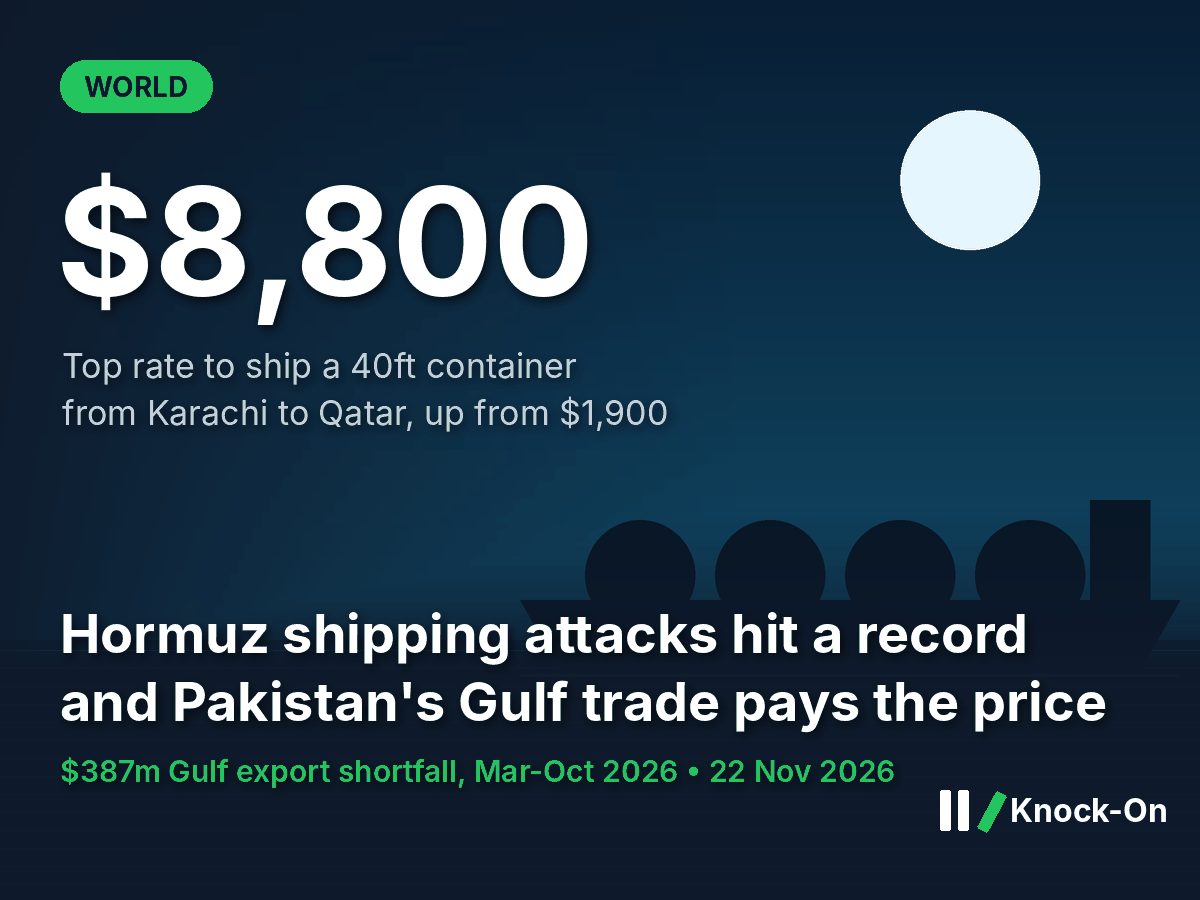
Pakistan buys most of its fuel from the Gulf, and the Iran war has made that route expensive and uncertain. As we reported this morning, Hormuz shipping attacks are at their highest level since the war began, and Qatar declared force majeure on LNG earlier this year after attacks on its facilities. Any extra supplier willing to deliver on credit reduces the risk of a dry pump or a sudden spot-market purchase at a high price.
The scale is modest. The petroleum import bill was $16.8 billion last fiscal year, the Express Tribune reported, about $1.4 billion a month on average. The Oman oil credit facility therefore covers roughly four days of imports at that pace (Knock-On calculation). The bigger prize remains the Saudi Fund for Development’s $1.2 billion annual deferred oil facility, which lapsed in April; Finance Minister Muhammad Aurangzeb raised its revival in October, and officials said Saudi Arabia was examining it.
The knock-on effects
First order: PSO gets breathing room on payments
PSO sold 693,000 tons of fuel in October, about 47% of the market, according to Topline Securities data. A credit line lets it take cargoes now and pay later, easing pressure on its cash and on the dollars it must buy through banks.
Second order: a steadier supply of petrol and LPG
OQ is already a large petrol supplier to PSO and a growing LPG supplier to both state and private buyers. A formal arrangement makes those flows more predictable, which matters after the first state LPG import showed how thin supply can push retail prices far above the official cap.
Third order: less pressure on reserves, but no price cut
Deferred payment spreads out dollar demand, which can help the rupee at the margin. It does not lower the price of fuel itself; pump prices still follow international benchmarks, which have eased in recent weeks, plus taxes and levies.
Who could benefit
- PSO: more working-capital room and a second structured supplier.
- Transporters, farmers and industry: a lower risk of supply gaps during Gulf disruption.
- LPG distributors and users: more regular cargoes from a supplier already shipping to Pakistan.
Who may face pressure
- PSO’s balance sheet: credit must be repaid, and the cost has not been disclosed.
- Private oil marketing companies: they compete with a state-owned rival that now has extra supplier credit.
- Fuel consumers: prices are still set by global oil and the petroleum levy, not by this deal.
What to watch
- Whether PSO discloses the tenor and cost of the $200 million credit to the PSX.
- Any decision by Saudi Arabia on reviving the $1.2 billion deferred oil facility.
- The government’s next fuel price announcement.
- The first meeting of the Pakistan–Oman Joint Working Group on Oil and Gas (date not announced).
Sources
- Arab News, Pakistan secures $200 million Oman oil credit facility amid Iran war disruptions, 22 November 2026
- The Express Tribune, Govt seeks 15-year Saudi oil facility, 14 October 2026
- PkRevenue (Topline Securities data), Pakistan OMC sales fall 1% year-on-year in October 2026, 2 November 2026
This is analysis, not investment advice. Figures are as of 22 November 2026. Knock-On is not affiliated with any political party.
Leave a Reply