
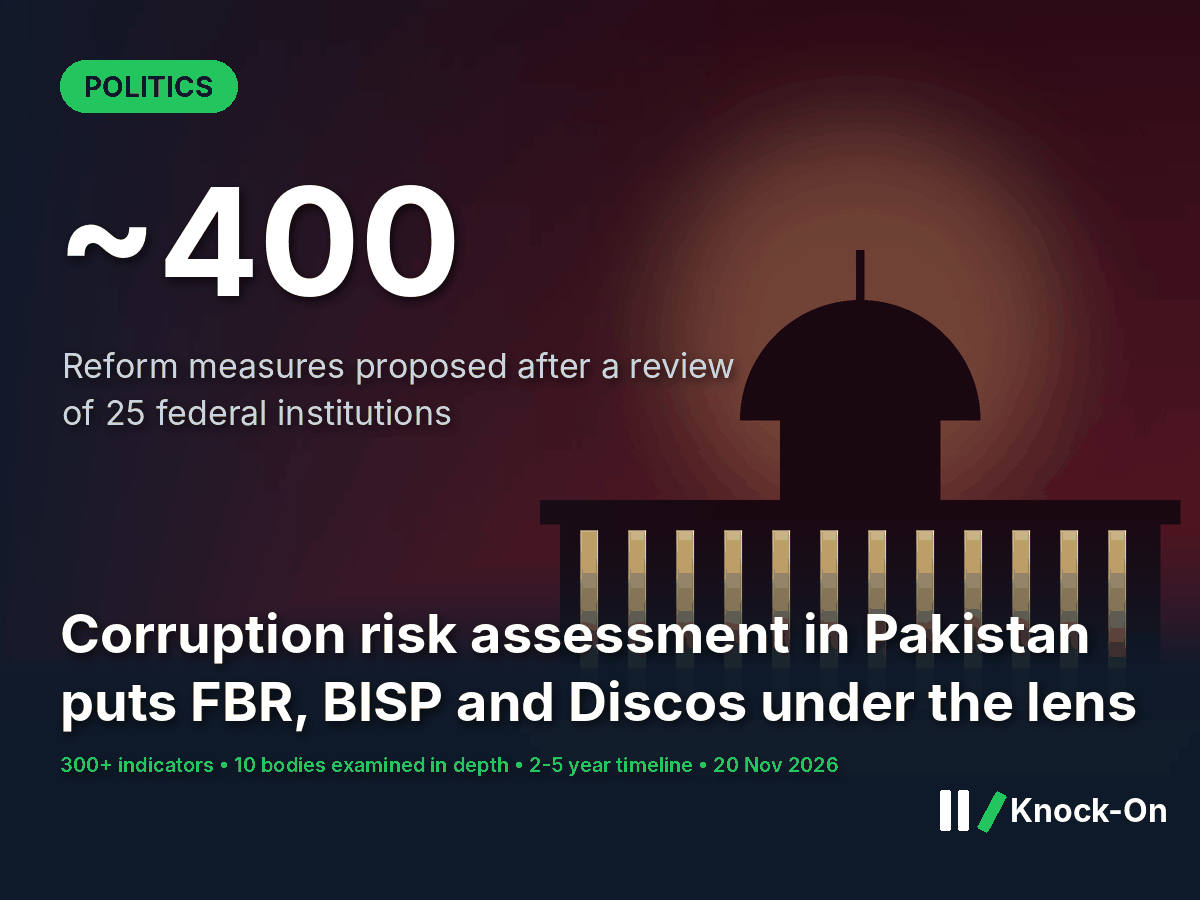
Pakistan’s federal government has published the headline findings of its first corruption risk assessment of its own institutions. Ministers said on Friday that the “National Risk Assessment of Corruption Vulnerabilities” reviewed 25 federal bodies, examined ten in depth and proposes about 400 reform measures over two to five years. For business, the list matters: it includes the tax authority, the national highways agency and the power distribution companies, the bodies companies deal with most when they pay tax, bid for contracts or buy electricity.
The short version
- The assessment covered 25 federal institutions using more than 300 indicators; ten were examined in depth.
- Named among them: the FBR, BISP, Pakistan Railways, the NHA, Sui Northern Gas and the power distribution companies (Discos).
- About 400 reform measures are proposed, grouped into 74 “reform blocks”, over two to five years.
- Law Minister Azam Nazeer Tarar said the report is “not a charge sheet” against any institution.
What happened
At a televised briefing on 20 November, Law Minister Azam Nazeer Tarar, Information Minister Attaullah Tarar and Minister of State for Finance Bilal Azhar Kayani presented the corruption risk assessment, which the Ministry of Law and Justice coordinated with other agencies. According to Dawn, 25 institutions were selected and more than 300 indicators used, with detailed indicators developed for ten chosen for their financial links. Radio Pakistan reported that of the roughly 400 proposed measures, 146 are to be completed within two years, 159 within five years, and 91 involve longer-term legal and institutional reform.
More than a third of the reforms are due within two years
Proposed reform measures by timeline, number of measures, 20 Nov 2026
Tarar said the aim was “self-accountability” and called the exercise a precautionary step. Arab News reported that the assessment and reforms would be made public after approval by the prime minister and cabinet, and linked the push to governance commitments under Pakistan’s IMF programme, which followed an IMF Governance and Corruption Diagnostic published in November 2025; it noted Tarar did not mention the IMF in the briefing. Kayani said track-and-trace and production monitoring in tobacco, sugar and tiles had added about Rs150bn in tax revenue, Radio Pakistan reported. No opposition response was reported in the sources reviewed.
Why it matters
Corruption risk is a cost for companies: discretionary tax assessments, slow refunds, contract disputes and billing problems all raise the price of doing business. A public map of weak points in the FBR, NHA and Discos gives investors and lenders a benchmark to judge whether governance is improving. It also matters for Pakistan’s lenders, who tie money to reform results, as with the ADB pension loan.
The knock-on effects
First order: tighter processes at the FBR and Discos
If the 146 near-term measures go ahead, businesses should expect more digital checks, third-party verification and audit trails at the bodies they deal with. That can mean more paperwork at first, but fewer discretionary decisions.
Second order: procurement and contracts
The NHA and Railways spend heavily through contractors. Clearer rules could change how tenders are run, alongside moves such as airport outsourcing to private operators. For power consumers, reform at the Discos ties into losses that end up in tariffs, as in the latest electricity tariff increase request.
Third order: investor confidence depends on follow-through
A diagnostic alone changes little. The effect on investment and borrowing costs will depend on whether the full report is published, whether progress is tracked, and whether measures survive the two-to-five-year timeline.
Who could benefit
- Compliant taxpayers: fewer discretionary assessments if FBR reforms hold.
- Contractors and suppliers: more predictable tenders at the NHA and Railways.
- Audit and IT firms: demand for verification, monitoring and digital systems.
Who may face pressure
- Firms relying on informal arrangements: track-and-trace and audits reduce room for evasion.
- The ten flagged bodies: they must deliver measures on a public timetable.
- Businesses during the transition: new controls can slow approvals before they speed them up.
What to watch
- Cabinet approval and publication of the full report, which ministers said would follow.
- The full list of the ten institutions examined in depth.
- Progress updates on the 146 measures due within two years.
- Any IMF comment on governance commitments in its next programme review.
Sources
- Dawn, Govt maps corruption risks in 10 key federal bodies, 21 Nov 2026
- Dawn, Corruption vulnerabilities identified in govt institutions in bid to undertake ‘self-accountability’, says law minister, 20 Nov 2026
- Radio Pakistan, Around 400 reform measures proposed for federal institutions: Azam, 20 Nov 2026
- Arab News, Pakistan flags corruption risks in tax, welfare and other federal institutions, 20 Nov 2026
This is analysis, not investment advice. Figures are as of 21 November 2026. Knock-On is not affiliated with any political party.

Leave a Reply