
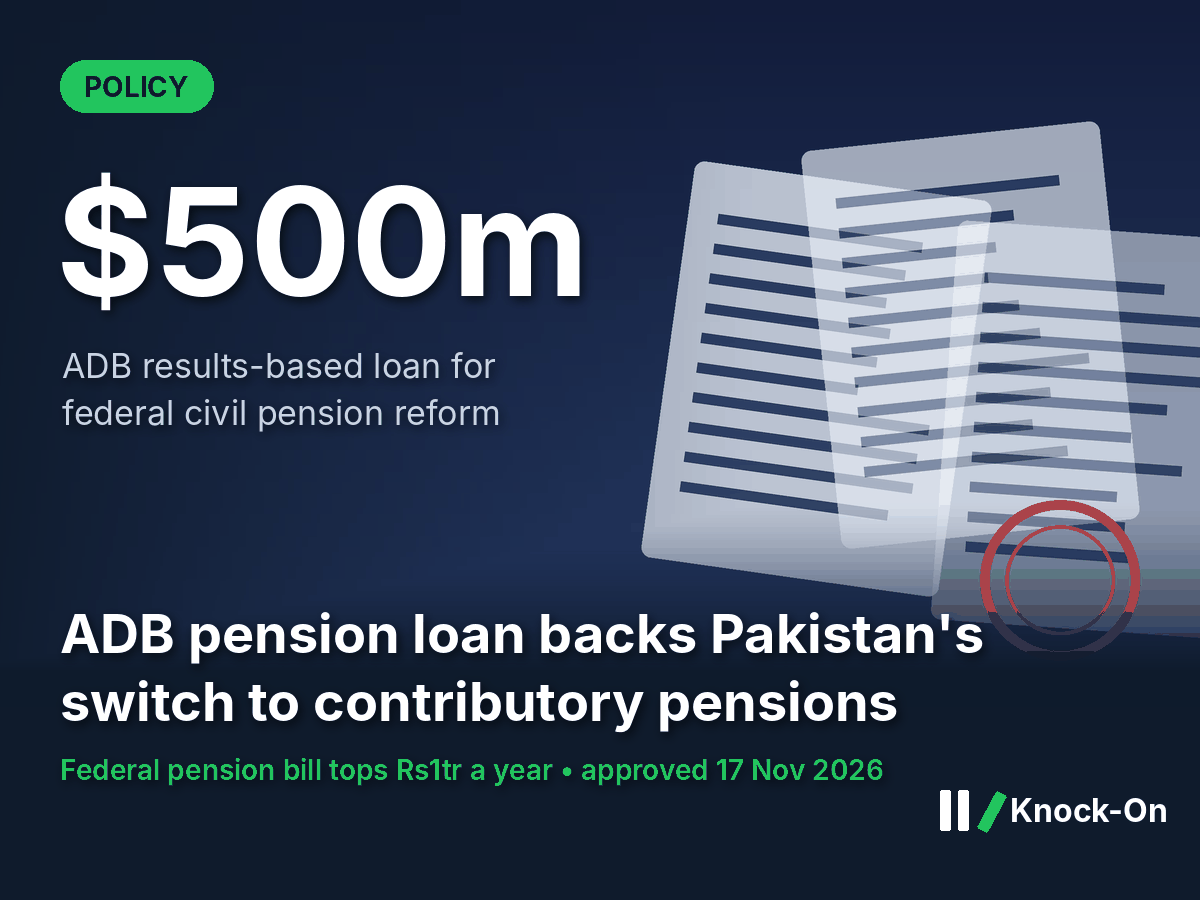
The Asian Development Bank has approved a $500 million ADB pension loan for Pakistan to help reform the federal civil pension system, Business Recorder reported on 17 November 2026. The lender describes it as a results-based loan under its Transforming Public Sector Pension Program. The issue for business is fiscal: federal pension spending now tops Rs1 trillion a year, money that competes with development spending and adds to the government’s borrowing needs.
The short version
- ADB approved a $500m results-based loan for Pakistan’s federal civil pension reform.
- It supports the first phase of the government’s Pension Reform Implementation Plan, including the defined contribution scheme for federal civil employees appointed from July 2024.
- Federal pension spending has risen almost fivefold since FY2016 and now exceeds Rs1tr a year, according to ADB.
- The Express Tribune reported in October that the loan is part of a $750m ADB package that also includes $250m for public-private partnerships.
What happened
According to Business Recorder, ADB said on Tuesday that the $500 million loan backs the first phase of Pakistan’s Pension Reform Implementation Plan. A central part is the move to a defined contribution scheme, which federal civil employees appointed from July 2024 are required to join. The existing scheme is unfunded and non-contributory, paid entirely from annual budget allocations. ADB said its support aims to contain rising pension costs, cut pension liabilities, improve transparency through digital systems and improve services and financial literacy for pensioners.
Emma Fan, ADB Country Director for Pakistan, said: “Pakistan has taken important steps to strengthen its federal pension system.” She added that the support aims to build stronger institutions, more transparency and a more sustainable system.
The Express Tribune reported on 27 October that the pension loan, worth about Rs139 billion, was being negotiated alongside a $250 million (about Rs70 billion) ADB loan for a public-private partnerships programme, and that both were taken for budget support.
Pensions take two-thirds of a $750m ADB package
ADB loans for Pakistan reported in Oct–Nov 2026, US$ million
Why it matters
Pensions are one of the fastest-growing claims on the federal budget. Every rupee paid to retirees under the old scheme comes out of current revenue, alongside interest costs that have already squeezed the budget: Pakistan’s fiscal surplus shrank 40% in July–September as interest bills rose. The ADB pension loan brings in dollars now, but the larger business effect depends on whether the reform slows the growth of the pension bill over time.
The knock-on effects
First order: budget support from the ADB pension loan
The $500 million adds to external financing that the Express Tribune said was taken for budget support. It also adds to debt: the paper reported public debt at 68.3% of GDP, with total debt and liabilities near Rs100 trillion as of June 2026, and gross financing needs of over 20% of GDP according to the finance ministry’s borrowing plan.
Second order: slower growth in a fixed cost
If the contributory scheme works as planned, future pension costs are funded during working lives rather than paid entirely from the budget. That could, over time, free fiscal space for development and social spending, as ADB says. Any savings arrive slowly, because existing retirees and older employees stay on the legacy system.
Third order: a deeper pool of long-term savings
Contributions under a defined contribution scheme have to be invested. A growing pension fund could, over years, add demand for government debt and other long-term assets, the market where the government is already cutting its domestic debt by Rs1.64tr. The size and rules of that fund have not been set out in the reports.
Who could benefit
- The federal budget: new dollar financing now, and a slower-growing pension bill later if the reform holds.
- Fund managers and pension providers: a contributory scheme creates assets that need managing.
- Development spending: ADB says the reform aims to free fiscal space for it.
Who may face pressure
- New federal employees: their retirement income will depend on contributions and returns rather than a defined benefit.
- The finance ministry: the Planning Commission has asked for outcomes from past pension reform loans, the Express Tribune reported.
- Public debt metrics: the loan adds to external borrowing.
What to watch
- Loan signing and disbursement: when the $500m reaches the treasury.
- The $250m PPP loan: whether it follows the pension loan to approval.
- FY28 budget, June 2027: the pension allocation will show whether growth is slowing.
- Past reform outcomes: whether the finance ministry reports results of earlier pension reform loans, as the Planning Commission requested.
Sources
- Business Recorder, ADB approves $500mn loan for Pakistan’s pension reforms, 17 November 2026
- The Express Tribune, $750m borrowed for pensions, PPP, 27 October 2026
- Business Recorder, Pension system reforms: Pakistan floats programme to secure USD500m ADB loan, 14 March 2026
This is analysis, not investment advice. Figures are as of 17 November 2026.


Leave a Reply