
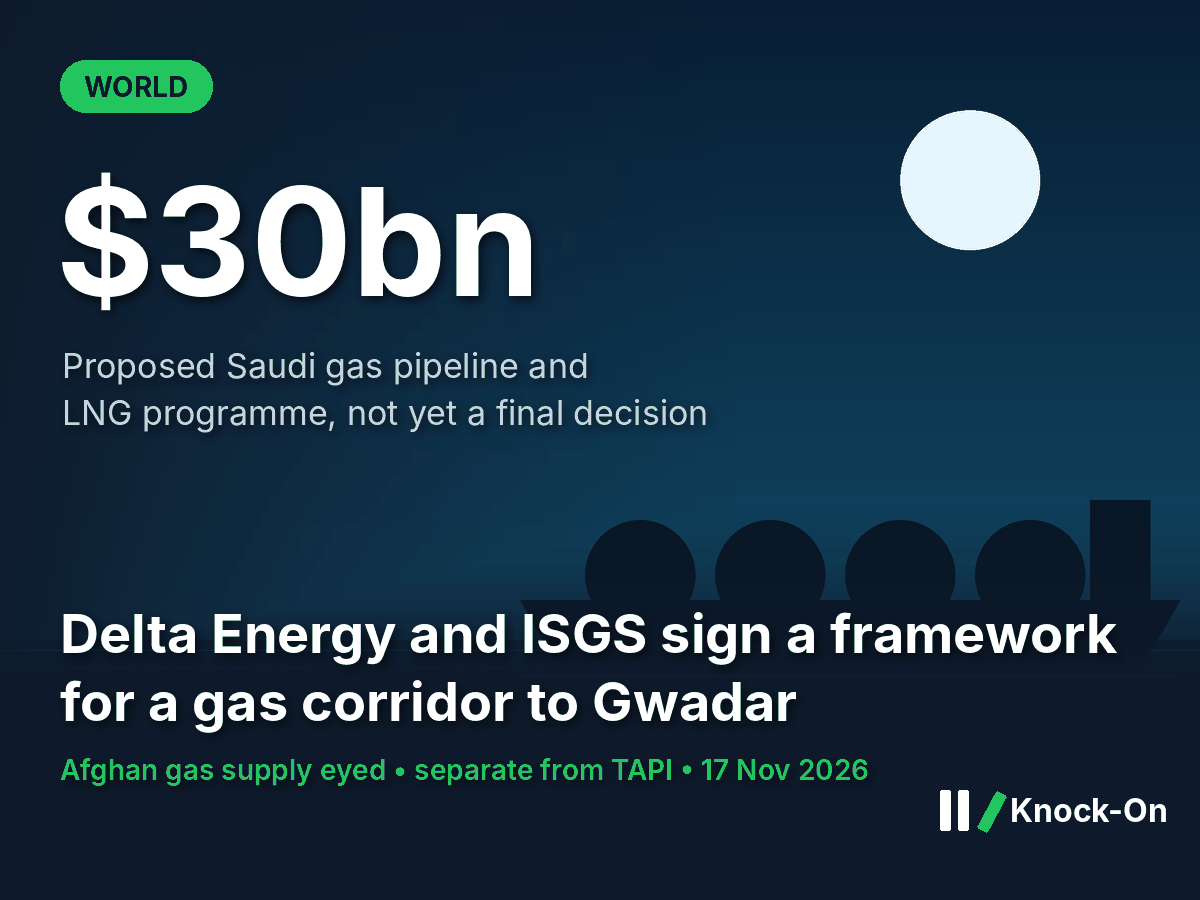
A Saudi company has put a large number on Pakistan’s search for new gas. Delta Energy Saudi signed an agreement on Tuesday with Pakistan’s Inter State Gas Systems (ISGS) to explore energy infrastructure with a proposed investment of about $30 billion, the companies said in a statement reported by Reuters. The Delta Energy Pakistan pipeline programme would assess a gas pipeline entering through the western border toward Gwadar, plus LNG, storage and export facilities. For businesses short of gas this winter, it is a long-term option, not near-term relief: the deal is a framework, not a final investment decision.
The short version
- Delta Energy Saudi and ISGS signed an agreement to evaluate gas infrastructure in Pakistan worth about $30 billion.
- The plan covers a pipeline from the western border toward Gwadar, a possible eastern extension, LNG facilities, gas processing, storage and export terminals.
- Delta named Afghanistan’s Kashk gas concession and other Afghan resources as possible supply, and said the plan does not depend on Turkmenistan or the TAPI project.
- The companies said the agreement is not a final investment decision or a commitment to finance or build.
What happened
According to the Reuters report carried by Business Recorder, the agreement “provides a framework for evaluating the projects”. It would assess a natural gas pipeline entering Pakistan through its western border and extending toward Gwadar, with a possible extension to the eastern border. Delta also described a pipeline from Chaman, on the Afghan border, across Pakistan toward the Indian border near Fazilka as a “core strategic commitment”, which it said would require formal engagement and agreements with Pakistani and Indian authorities. No statement from either government on that route was reported.
The Pakistan agreement follows Delta’s deals in Afghanistan. In September, Delta signed agreements in Kabul with Afghanistan’s Ministry of Mines and Petroleum covering exploration and a framework for a proposed 700-kilometre pipeline from near Herat to near Spin Boldak, close to the Pakistan border, reported at about $10 billion, according to Energy Update. Initial exploration investment there was put at about $200 million.
The Pakistan leg is three times the size of Delta’s Afghan pipeline plan
Proposed or reported Delta Energy investment figures, US$ billion (none yet a final investment decision)
Why it matters
Pakistan’s own gas is running down and imported LNG has become scarce and costly since the Gulf conflict. Knock-On reported that SSGC gas supply has fallen 13% in a year to about 605 mmcfd, and that December LNG cargo bids came in at $27.30 per MMBtu. A pipeline bringing Afghan gas by land would add a supply route that does not pass through the Strait of Hormuz. But Reuters notes that plans for other pipelines into Pakistan have been delayed for years, so the Delta Energy Pakistan pipeline should be read as an option, not as supply.
The knock-on effects
First order: feasibility work, not gas
The immediate result is studies and negotiations. Engineering, survey and advisory firms are the first to see work. Gas consumers will see no change this winter.
Second order: Gwadar and Balochistan back in focus
A pipeline toward Gwadar, with LNG and export terminals, would give the port a new energy role. It would also depend on security along the western border and in Balochistan, and on trade and transit relations with Afghanistan, which Pakistan raised at the ECO meeting in Islamabad.
Third order: regional agreements decide the scale
The largest version of the plan, extending to the Indian border, needs government-level agreements that Delta itself says are required. Whether those happen is a political question outside the companies’ control. Until then, financing on the $30 billion scale is unlikely to be committed.
Who could benefit
- ISGS and gas utilities, from a potential new source of pipeline gas.
- Gwadar port and logistics businesses, if LNG and export terminals proceed.
- Construction, steel pipe and engineering firms, if projects reach the build stage.
- Gas-intensive industry such as fertiliser and textiles, in the long run, if cheaper supply arrives.
Who may face pressure
- LNG importers and traders, if pipeline gas eventually replaces some cargoes.
- Gas users hoping for quick relief, since no timeline has been given.
What to watch
- Any statement from the Petroleum Division or ISGS on studies, timelines and route choices.
- Progress on Delta’s Afghan exploration and pipeline, which the Pakistan plan would draw on.
- Reactions from the governments of Afghanistan, India and Saudi Arabia to the proposed routes.
- Winter LNG cargo awards, which show how urgent new gas supply remains.
Sources
- Business Recorder (Reuters), Saudi’s Delta Energy to explore $30 billion energy investment in Pakistan, 17 November 2026
- Energy Update, Saudi Delta Energy Signs Afghanistan Gas Deals, Revives CentGas Pipeline Vision, 16 September 2026
- Dawn, Gas output halves in 10 years, says SSGC chief, 15 November 2026
This is analysis, not investment advice. Figures are as of 17 November 2026. Knock-On is not affiliated with any political party.


Leave a Reply