
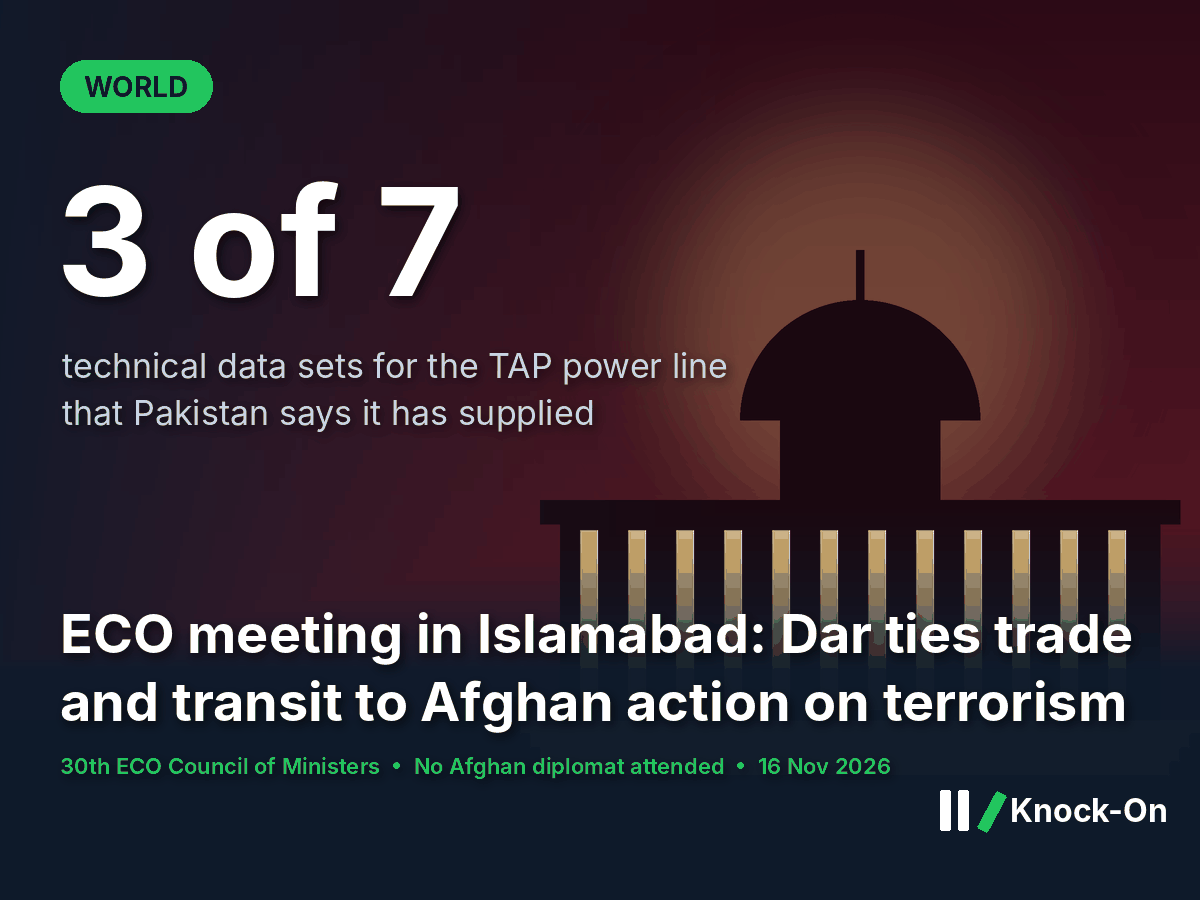
Pakistan used the ECO meeting in Islamabad on Monday, 16 November, to set out its terms for regional trade. Deputy Prime Minister and Foreign Minister Ishaq Dar told the 30th Economic Cooperation Organization (ECO) Council of Ministers that trade, transit and economic cooperation with Afghanistan depend on Kabul addressing neighbours’ security concerns, particularly terrorism, according to Business Recorder and the Associated Press. On the same day, Pakistan’s power minister pressed Turkmenistan to speed up a cross-border electricity line. For business, the message is that regional trade routes stay tied to security talks.
The short version
- Dar said meaningful progress with Afghanistan requires its authorities to address the threat of terrorism; no Afghan diplomat attended, AP reported.
- Dar said Pakistan would continue diplomatic efforts to ease US-Iran tensions.
- Pakistan invited Turkmenistan to join CASA-1000 and said it has supplied 3 of 7 technical data sets for the 1,200 MW TAP power line.
What happened
Foreign ministers and senior diplomats from ECO members, a 10-member bloc that includes Pakistan, Iran, Afghanistan, Turkey and several Central Asian states, met in Islamabad. AP reported that Iran’s Foreign Minister Abbas Araghchi attended and that no diplomat from Afghanistan did. At the ECO meeting in Islamabad, Dar said a stable Afghanistan integrated into the region would open “important avenues for trade, transit and economic cooperation”, but that Afghan authorities must address “the legitimate security concerns of neighbouring countries”, Business Recorder reported. Pakistan accuses the Afghan Taliban government of sheltering militant groups, a charge Kabul denies, according to AP.
Dar also said conflict in the region was disrupting trade routes, energy supplies and investment, and that Pakistan would continue its efforts to support dialogue between the US and Iran. Araghchi, quoted by AP from Iran’s state agency IRNA, said Iran had remained committed to diplomacy and blamed the US and Israel for insecurity around the Strait of Hormuz. Separately, Energy Minister Awais Leghari met Turkmenistan’s Energy Minister Annageldi Saparov in Islamabad. He invited Turkmenistan to join CASA-1000 and asked it to speed up its share of technical data for the Turkmenistan-Afghanistan-Pakistan (TAP) line, a 1,150 km, 500 kV link with 1,200 MW capacity running to Quetta.
Most of the TAP power line’s technical data is still outstanding
Technical data sets for the Turkmenistan-Afghanistan-Pakistan line, as stated by Pakistan’s energy minister, 16 Nov 2026
Why it matters
Pakistan’s trade with Afghanistan and its route to Central Asia have been hit by border closures. Knock-On reported last week that Afghan transit trade remains suspended and exporters have lost about $1bn in sales. Dar’s remarks indicate that reopening depends on security commitments, not only on trade talks. At the same time, energy links such as TAP and CASA-1000 would also cross Afghanistan, so the same security question affects power imports.
The knock-on effects
First order: no quick reopening for Afghan trade
With Pakistan linking progress to Kabul’s actions and no Afghan delegate at the meeting, exporters who relied on the Afghan market have no new date for normal trade. Dar called for functional transport corridors, streamlined border procedures and predictable arrangements for business, but these depend on the security track first.
Second order: energy diplomacy moves to Central Asia
Leghari said both sides agreed to convene technical working groups to set a TAP roadmap within a few weeks. He also proposed that Iran and Turkmenistan explore raising power supply to Gwadar through the Iranian grid, citing future demand there.
Third order: Gulf conflict still sets costs
AP noted that the closure of the Strait of Hormuz has raised oil prices and hurt Pakistan’s economy. Any progress on shipping security around Hormuz would matter more to fuel costs than any ECO trade measure.
Who could benefit
- Gwadar and Balochistan businesses, if extra power supply plans move forward.
- Power grid and transmission contractors, if TAP reaches a roadmap.
- Ports and logistics firms, if Central Asian transit through Pakistani ports grows.
Who may face pressure
- Exporters to Afghanistan, with no reopening timeline.
- Border-region traders in Khyber Pakhtunkhwa and Balochistan, where closed border trade is already a grievance.
- Transporters serving Afghan transit routes.
What to watch
- Any Afghan government response to Dar’s remarks.
- TAP technical working group meetings, which both sides said would set a roadmap within a few weeks.
- Whether Turkmenistan formally responds on CASA-1000.
- US-Iran contacts and the status of the Strait of Hormuz.
Sources
- Business Recorder, Afghanistan must address terrorism concerns for economic partnerships: DPM Dar, 16 November 2026
- Associated Press (via WSLS), Pakistan vows US-Iran diplomacy, urges Afghan action on terrorism at regional economic bloc meeting, 16 November 2026
- Business Recorder, Pakistan invites Turkmenistan to join CASA-1000, 16 November 2026
This is analysis, not investment advice. Figures are as of 16 November 2026. Knock-On is not affiliated with any political party.

Leave a Reply