
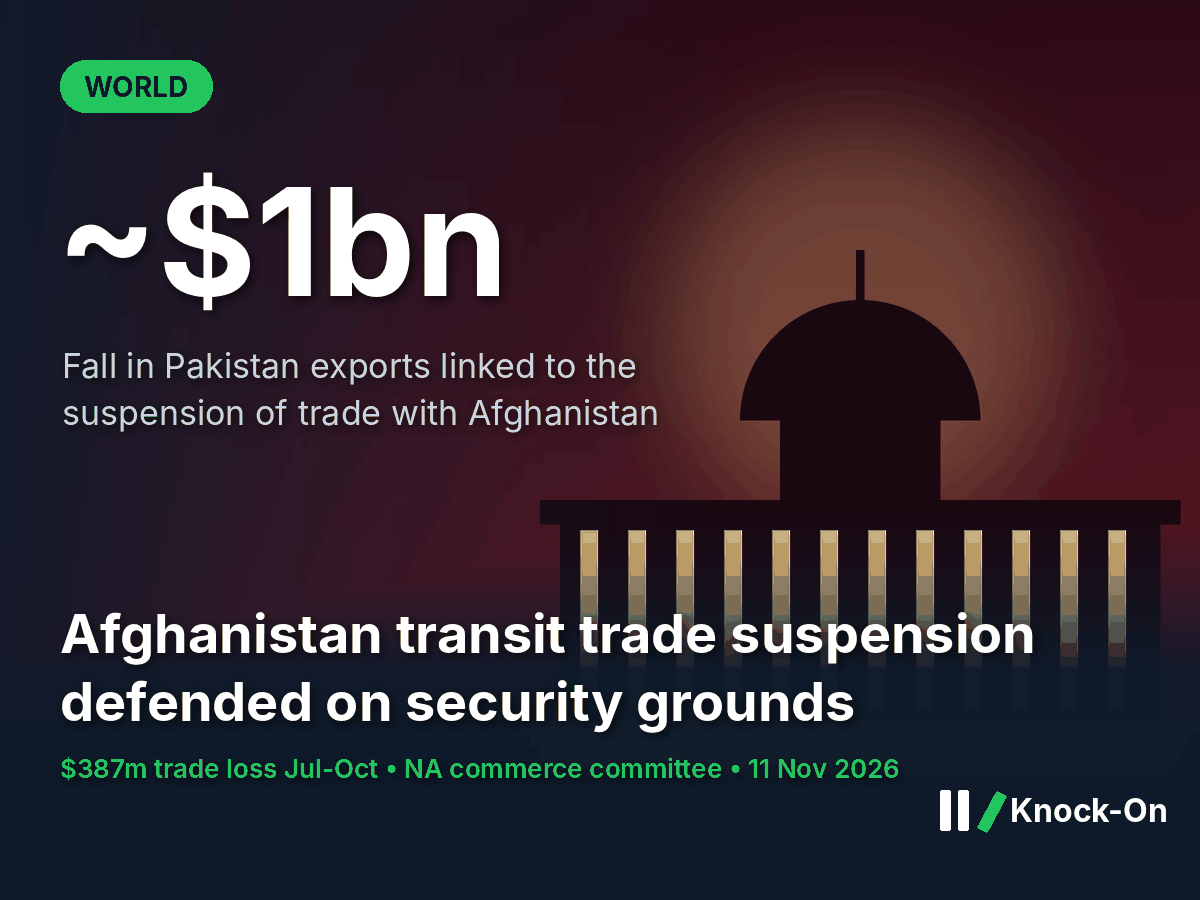
Pakistan’s suspension of trade and Afghanistan transit trade will stay in place for now. Commerce Secretary Jawad Paul told the National Assembly Standing Committee on Commerce on Wednesday that the decision was “taken on national security grounds”, and that Pakistan “could not afford further loss of human lives in the name of trade”, Business Recorder reported. He also put a price on it: a decline of around $1bn in Pakistan’s exports. For exporters of fruit, vegetables and goods bound for Central Asia, the message is that the route is not reopening soon.
The short version
- The commerce ministry defended the suspension of trade with Afghanistan before an NA committee, citing national security.
- The secretary linked the suspension to a fall of around $1bn in exports, including to Central Asia via Afghanistan.
- Separately, Pakistan’s trade loss from regional conflict disruptions was $387m in July–October.
- The $1bn equals about a third of the gap between last year’s $32bn merchandise exports and this year’s $35bn target (Knock-On calculation).
What happened
At the committee hearing chaired by Javed Hanif Khan, the commerce secretary said “national security is the most important”. He said exports to Central Asia through Afghanistan had also declined and that oranges and potatoes were among the products hit. The committee chair questioned the economic consequences of the decision. The hearing record, as reported, did not include a response from Kabul, and the article did not give the date the suspension began. Our earlier reports on Pakistan–Afghanistan tensions and trade and on Pakistan–Afghanistan trade falling 28% set out how the border closure has built up.
The same hearing set out the wider export picture. Total exports including services were $40bn in FY2025-26, merchandise exports about $32bn, and the FY2026-27 merchandise target is $35bn. Monthly exports currently average about $2.9bn. The secretary also said the Gabd–Rimdan crossing with Iran was closed over sanctions concerns, though partial trade continues.
Why it matters
The Afghanistan transit trade route was Pakistan’s land bridge to Central Asian buyers, and Afghanistan itself was a ready market for perishable farm produce. Losing about $1bn of exports is equal to roughly a third of a typical month’s merchandise shipments, and a third of the extra $3bn needed to hit this year’s target (Knock-On calculation). With both western land routes, to Afghanistan and partly to Iran, restricted, exporters have fewer options outside the sea ports.
The Afghan suspension has cost about a third of a month’s exports
US$ millions, as told to the NA commerce committee on 11 Nov 2026
The knock-on effects
First order: perishable exporters
Growers and traders of oranges and potatoes lose a nearby market. Without a land route, produce must find buyers at home or travel by sea, which raises costs and spoilage risk for low-value goods.
Second order: Central Asia ambitions
Pakistan has promoted itself as a transit corridor for Central Asia. With exports via Afghanistan down, trucking, warehousing and border businesses in Khyber Pakhtunkhwa and Balochistan lose volume. The shift in regional trade also shows in our report on the widening regional trade deficit.
Third order: the export target
Reaching $35bn of merchandise exports this year now relies more on textiles and sea-borne markets. The committee also told the commerce and industries ministries to reconcile differing export statistics, so the true size of the gap may still change.
Who could benefit
- Sea freight and port operators, if some Central Asia-bound cargo is rerouted.
- Domestic food buyers, who may see more local supply of produce that cannot be exported.
Who may face pressure
- Fruit and vegetable exporters, especially of oranges and potatoes.
- Border transporters and traders in Khyber Pakhtunkhwa and Balochistan.
- Exporters targeting Central Asia, who lose the shortest land route.
What to watch
- Any statement from Kabul or new Pakistan–Afghanistan talks on the border.
- Monthly PBS trade data for exports to Afghanistan and Central Asia.
- The reconciled export figures the NA committee requested from the two ministries.
Sources
- Business Recorder, MoC defends suspension of transit trade with Afghanistan, 12 Nov 2026
This is analysis, not investment advice. Figures are as of 12 November 2026. Knock-On is not affiliated with any political party.

Leave a Reply