
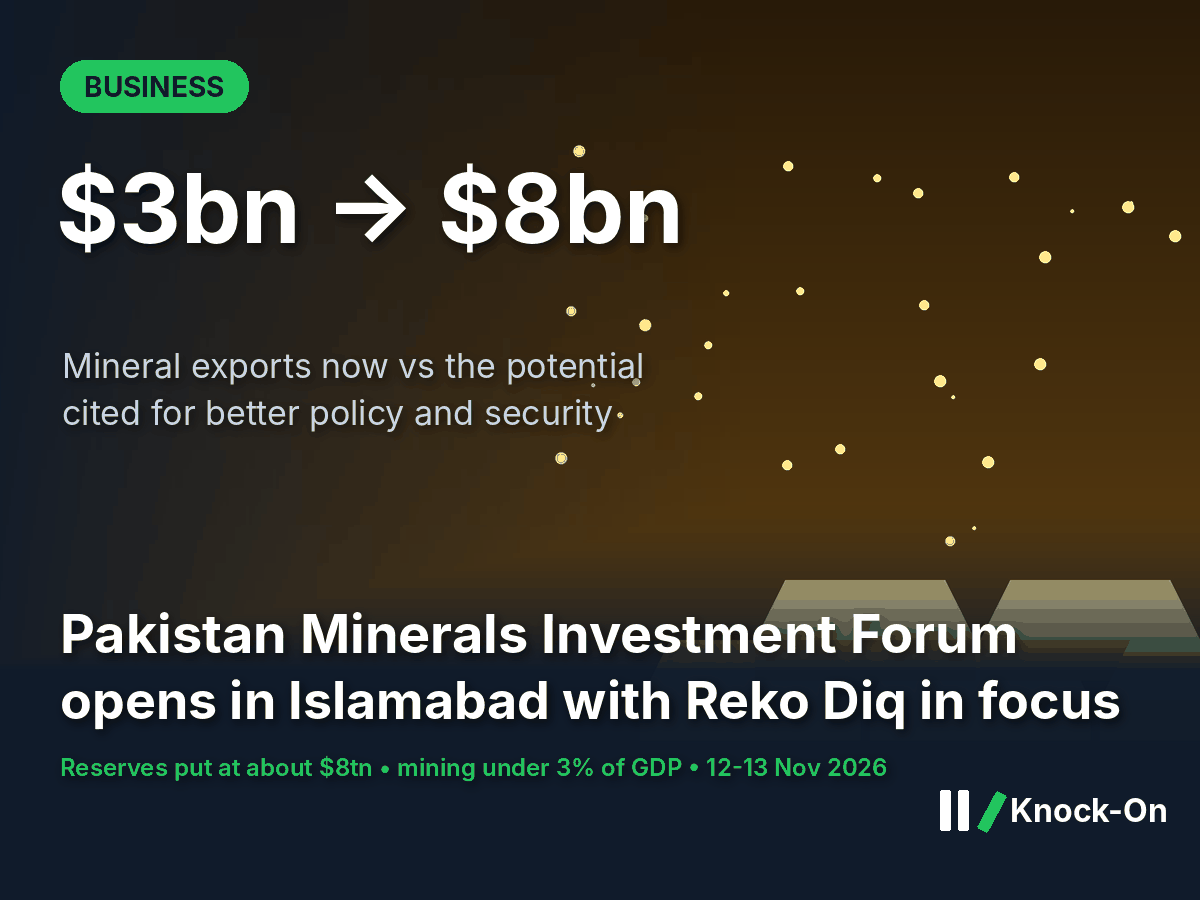
The two-day Pakistan Minerals Investment Forum 2026 (PMIF26) opens in Islamabad today, 12 November, with the government and the Special Investment Facilitation Council (SIFC) pitching the country’s mining sector to foreign companies. Officials and industry bodies put Pakistan’s mineral reserves at about $8 trillion, yet mining still contributes less than 3% of GDP. For business, the question is not how big the reserves are, but how quickly projects such as Reko Diq can turn them into exports, contracts and foreign exchange.
The short version
- PMIF26 runs on 12–13 November in Islamabad, backed by the SIFC, with the Prime Minister, the Deputy Prime Minister and the Army Chief listed as key speakers.
- Reserves are estimated at about $8tn, but mineral exports are only about $3bn a year.
- The Institute of Cost and Management Accountants (ICMA) says exports could reach $8bn with strong governance and security.
- The government is courting US investment in Balochistan, where no US company currently operates, according to The Express Tribune.
What happened
Business Recorder reported that the Pakistan Minerals Investment Forum is being organised by the government in collaboration with the SIFC, with Prime Minister Shehbaz Sharif, Deputy Prime Minister and Foreign Minister Ishaq Dar and Field Marshal Syed Asim Munir among the key speakers. Energy Minister Ali Pervaiz Malik is due to give the welcome address, and an exhibition on the mining value chain runs alongside. PMIF President Ahmed Hayat Lak said “globally renowned industrial companies” would take part. The Nation reported that the chief ministers of Punjab, Sindh and Balochistan, the Khyber Pakhtunkhwa governor and the AJK prime minister are also due at the opening session.
Foreign interest is visible. Alfred Topf, chief executive of Mining Construction International, said the forum was an ideal platform to connect with local partners, while Jens-Peter Lux of Germany’s DMT pointed to cooperation with Europe on critical raw materials, The Nation reported. Last year’s edition drew 5,000 delegates from more than 50 countries and saw 16 MoUs signed, according to The Express Tribune.
Reko Diq has secured under a third of its capital bill
Reko Diq capital need and financing arranged, US$ billions, as reported in October 2026
Why it matters
Pakistan needs dollar earnings that do not depend on textiles and remittances alone. ICMA, cited by The Express Tribune, says that with strong governance and security, annual mineral exports could rise from about $3bn to $8bn and GDP growth from roughly 3% to 6%. Those are scenarios, not forecasts of what PMIF26 will deliver. The anchor project is Reko Diq, where Phase I is expected to produce about 240,000 tonnes of copper and 297,000 ounces of gold a year from the end of 2028. Our earlier report on the Reko Diq delay and rising costs shows how fragile that timetable is: the Tribune says a Canadian firm slowed work after the US-Iran war began.
Mineral exports could more than double, ICMA says
Pakistan annual mineral exports, US$ billions: current level vs potential with strong governance and security
The knock-on effects
First order: deals and memoranda
The immediate output of the Pakistan Minerals Investment Forum will be MoUs and partnership announcements. MoUs are not investment: last year’s 16 signings matter only if they turn into exploration licences, equipment orders and financing.
Second order: suppliers and services
If projects move, demand rises for local contractors, logistics, cement, steel, power and security services. US Exim Bank approved $1.25bn in December 2025, which the US embassy said could unlock up to $2bn of American mining equipment and services exports, a reminder that much of the early spending may go on imported kit. It also links to the wider US trade picture covered in our story on Pakistan exports to the US and rising imports from America.
Third order: the balance of payments
Mining FDI brings dollars in during construction and export earnings later. Today’s foreign inflows lean towards government debt, as shown in our report on foreign investment in Pakistan bonds. Long-term project capital would be a steadier source, but only once output starts.
Who could benefit
- Engineering and logistics firms, including the Frontier Works Organisation, which signed critical-minerals MoUs with US Strategic Metals in September 2025.
- Federal state-owned enterprises, three of which together hold 25% of Reko Diq, alongside Barrick’s 50%.
- Balochistan’s provincial finances, which hold 25% of Reko Diq.
Who may face pressure
- Investors exposed to security risk in Balochistan, which the Tribune says is why no US company operates there.
- Local miners without capital, who may struggle to compete for licences with well-financed foreign partners.
- Fiscal planners, if export projections are booked before projects are financed.
What to watch
- 13 November: the forum’s closing day, and the number and value of any MoUs announced.
- Whether any US company commits to Balochistan.
- Reko Diq financing and the end-2028 Phase I production target.
Sources
- The Nation, Two-day Pakistan Minerals Investment Forum kicks off today, 12 Nov 2026
- Business Recorder, PMIF26 commences in Islamabad on 12th, 9 Nov 2026
- The Express Tribune, Govt seeks US investment in minerals, 17 Oct 2026
- Minute Mirror, Pakistan’s Mineral Reserves Estimated at $8 Trillion, 19 Oct 2026
This is analysis, not investment advice. Figures are as of 12 November 2026.
Leave a Reply