
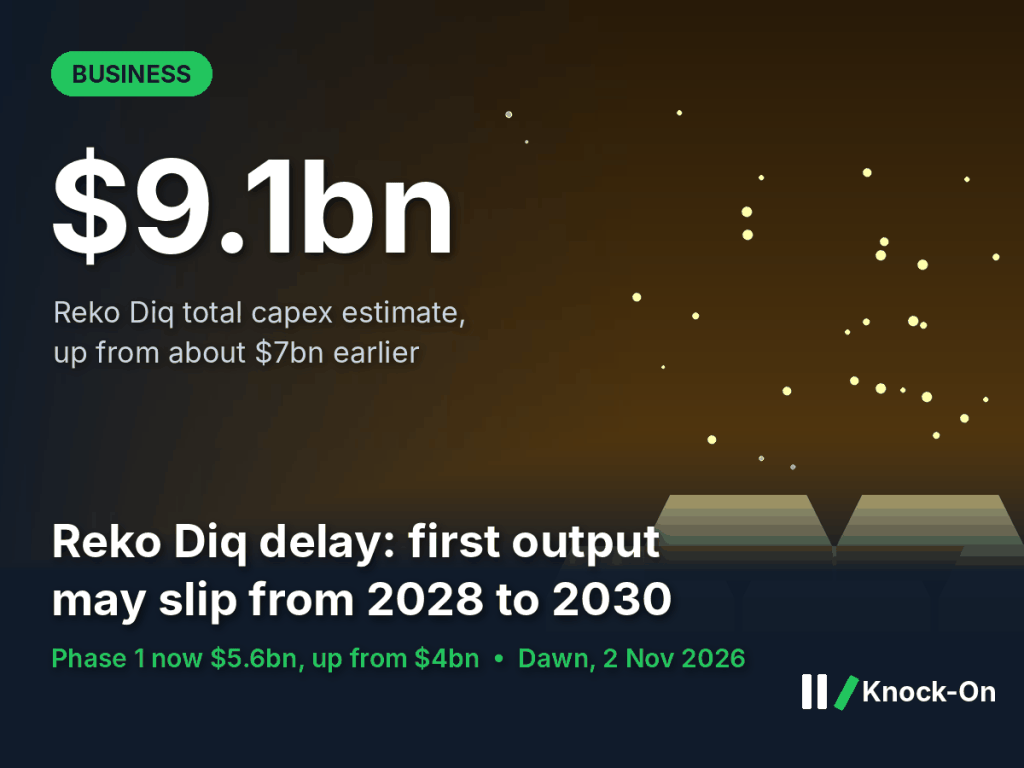
A Reko Diq delay of up to two years is now being discussed openly. Government sources and industry insiders told Dawn on 2 November that first production at the Balochistan copper-gold mine could slip from 2028 to 2030, pending better security in the province and a calmer Middle East. Barrick, which owns half the project, has made no official announcement on a new timeline. For Pakistan, the stakes are large: Reko Diq is a multibillion-dollar export project, and its state-owned partners include OGDCL and PPL, two of the biggest companies listed on the PSX.
The short version
- First output at Reko Diq may move from 2028 to 2030, according to unnamed government and industry sources quoted by Dawn.
- Phase 1 capex has risen from $4bn to $5.6bn; with Phase 2’s $3.5bn, total capex is about $9.1bn, against earlier estimates of about $7bn.
- Barrick’s chief executive has said the company needs “some sort of security improvement” before full construction.
- The site has kept its 700 permanent and roughly 2,000 contract workers, but some third-party service contracts have lapsed.
What happened
In February 2026 Barrick began a formal review of Reko Diq, slowed development and extended its assessment into early 2027, Dawn reports. The newspaper now says the war in neighbouring Iran and persistent security problems in Balochistan have reportedly pushed investors to adjust the original 2028 timeline. Barrick is expected to resume full-scale development by mid-2027, after the internal review ends. Speaking at the Mining Forum Americas last month, Barrick’s chief executive said: “We are revisiting it because we need some sort of security improvement before we would embark on a full construction schedule.” He gave no new date. Barrick, federal officials and Balochistan officials did not respond to Dawn’s requests for comment.
The cost picture has already shifted. Phase 1 capex has risen from $4bn to $5.6bn, and Phase 2 is projected at another $3.5bn, taking the total to roughly $9.1bn. Views on what a further Reko Diq delay would add are far apart. One private-sector source involved in another Balochistan mining venture told Dawn costs could rise by $8bn to $10bn even if work resumes within a year. An insider with business ties to Reko Diq Mining Company called that “bordering on absurdity” and put the likely increase at 10% at most, or roughly $450m to $900m. Another official said nearly $1bn has already been invested.
Reko Diq’s price tag has risen by about $2bn
Capital expenditure estimates, US$ billion, as reported on 2 Nov 2026
Why it matters
Reko Diq is meant to be Pakistan’s flagship mining export. Under its updated feasibility study it would process 45m tonnes of ore a year at first, doubling to 90m tonnes after Phase 2, over a 37-year mine life, with projected free cash flow of $74bn over that period on long-term price assumptions. Barrick holds 50%; the other half is shared equally between the Balochistan government and three federal state-owned companies: Pakistan Petroleum, Oil and Gas Development Company and Government Holdings. A two-year Reko Diq delay therefore pushes back dollar export earnings, provincial revenue and dividends to listed state firms, while the bill to build the mine keeps rising.
The knock-on effects
First order: a later Reko Diq start means later dollars
Copper-gold concentrate exports were expected to start flowing from 2028. If production starts in 2030 instead, Pakistan waits two more years for one of the few large new sources of export income in the pipeline, at a time when oil costs from the Gulf conflict are already pressing on the import bill.
Second order: higher costs for the state partners
As partners, the federal companies share in the project’s funding. A capex estimate that has risen by about $2bn, and could rise further with delay, matters for OGDCL, which has just reported a 53% jump in quarterly profit, and for PPL, whose FY26 profit reached Rs99bn. How much of the extra cost falls on them depends on financing terms Dawn did not report.
Third order: a signal to other mining investors
Barrick’s chairman, John L. Thornton, is expected in Islamabad later this month for the Pakistan Minerals Investment Forum 2026. Investors at that event will read Reko Diq as a test case. The insider quoted by Dawn also regretted that the operator reportedly plans to process only 30% to 35% of output in Pakistan, which would limit local value addition.
Who could benefit
- Current workforce: all 700 permanent and about 2,000 contract workers have been kept on, and research, administrative and community projects are continuing, a company employee told Dawn.
- Security and logistics providers: any plan to restart full construction is tied to stronger security, which implies more spending on protection and safe transport.
Who may face pressure
- Construction and service suppliers: some third-party service contracts have already been allowed to expire, and peak construction employment of 7,500 is now further away.
- Balochistan: the province’s share of revenue and roughly 4,000 permanent post-construction jobs arrive later.
- State-owned partners: OGDCL, PPL and Government Holdings face a bigger and later investment, at a time when the KSE-100 has just closed a 3,560-point losing month.
What to watch
- Any official timeline from Barrick, which has so far made no announcement.
- The Pakistan Minerals Investment Forum 2026 in Islamabad later in November, and whether Barrick’s chairman speaks on Reko Diq.
- The end of Barrick’s internal review, expected in early 2027, and a possible return to full-scale development by mid-2027.
- Security conditions in Balochistan and any easing of the Iran conflict, both named as conditions for resuming work.
Sources
- Dawn, Reko Diq project may face further delay, 2 November 2026
This is analysis, not investment advice. Figures are as of 2 November 2026.

Leave a Reply