
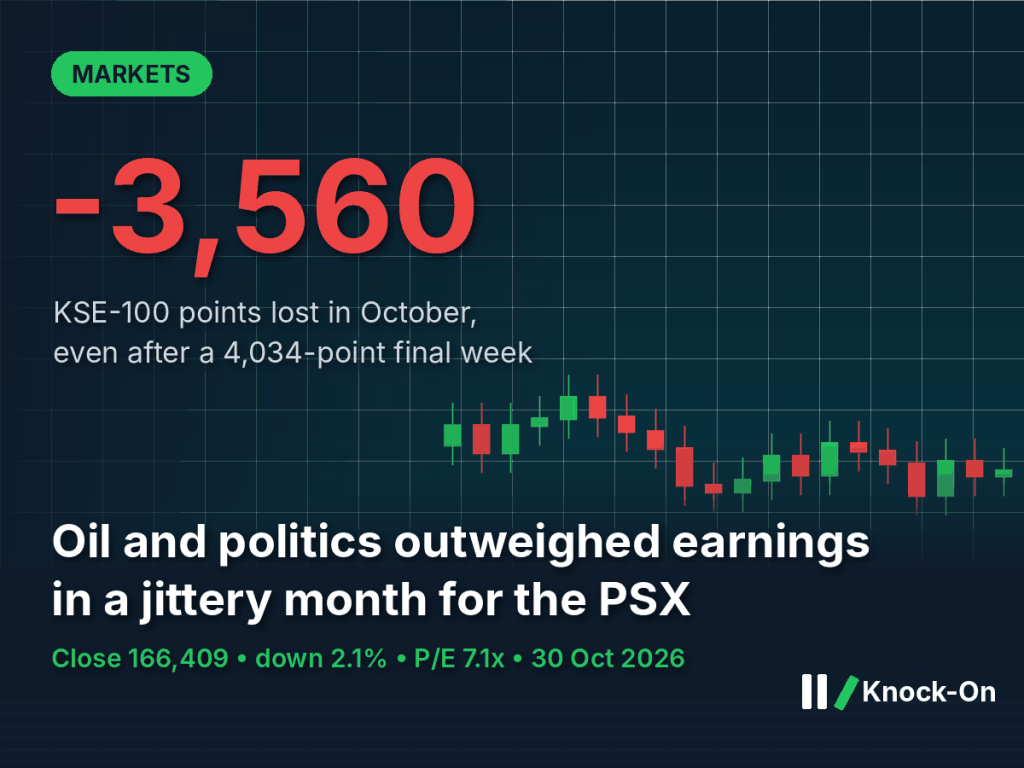
The KSE-100 in October lost 3,560 points, or 2.1%, to close the month at 166,409, even though the index gained 4,034 points in the final week. The KSE-100 October result shows a market where strong company earnings are being outweighed by oil prices, the US–Iran conflict and political uncertainty at home. For businesses that raise money on the Pakistan Stock Exchange (PSX), or hold shares as savings, the month was a reminder that results alone are not setting the direction.
The short version
- The KSE-100 fell 3,560 points (2.1%) in October to 166,409, Arif Habib Ltd said.
- A 4,034-point (2.5%) rally in the last week recovered only part of an earlier slide of about 7,600 points (Knock-On calculation).
- Trading was busier: average daily volume rose 27% to 600m shares, Topline Securities said.
- Shares look cheap at 7.1 times earnings with a 7% dividend yield, but Brent near $117 keeps the pressure on.
What happened
According to Arif Habib Ltd (AHL), cited by Dawn, the benchmark index shed 3,560 points in October. AHL and Topline Securities pointed to Middle East tensions and the US–Iran conflict, domestic political uncertainty after the emergency and governor’s rule in Khyber Pakhtunkhwa, foreign portfolio outflows, profit-taking in heavyweight stocks and volatile global markets.
The last week of the month was different. AKD Securities said the KSE-100 rose 4,034 points, or 2.5%, as average daily volume jumped 121% to 1.095bn shares. Dawn reported that the late recovery came from renewed diplomacy on the US–Iran conflict, better-than-expected corporate results, Pakistan-proposed talks in Tehran between the Makkah Pact states and Iran, and reports of fresh US outreach to Tehran. Banks, fertiliser, cement, investment banks and oil and gas explorers led the gains, with Fauji Fertiliser, MCB Bank, Engro Holdings, United Bank and OGDCL adding the most points. We tracked the start of that recovery in our report on the KSE-100 wiping out the previous week’s loss.
The final-week rally won back only about half of October’s slide
KSE-100 change in index points, October 2026
Why it matters
The KSE-100’s October fall came while company profits were rising. Corporate earnings were up 26% year on year to Rs1.638trn in the first nine months of 2026, for companies making up 96% of the index weight, Dawn reported. That the index still fell suggests investors are pricing in risk from outside company accounts: oil, interest rates and politics. Brent rose 0.7% in the week to $117.10 a barrel on Friday, after Houthi attacks on Saudi Arabia and tanker incidents near the Strait of Hormuz, and local diesel rose Rs8.9 to Rs400 a litre, as covered in our analysis of the Hormuz mines impact on Pakistan. The State Bank also raised its policy rate by 50 basis points to 12% on 26 October, its first increase since April (our SBP interest rate story).
The knock-on effects
First order: a KSE-100 October loss makes new listings harder
A falling month with foreign outflows is a poor backdrop for companies hoping to raise equity. Firms planning share sales or rights issues may prefer to wait for steadier prices, or turn to debt instead.
Second order: higher rates compete with shares
With the policy rate at 12%, bank deposits and government paper offer savers a safer return. Treasury bill auctions raised Rs1.8trn against a Rs1.7trn target, Dawn said, showing how much money is still flowing to the government rather than to shares or private borrowers.
Third order: valuations could pull money back if risks ease
AHL put the market at 7.1 times earnings with a 7% dividend yield. If oil eases or diplomacy holds, those valuations, together with liquid foreign exchange reserves of $26.8bn as of 23 October, give investors a reason to return. That is a possibility, not a forecast.
Who could benefit
- Banks: higher rates support interest income, and banks led the final-week gains.
- Oil and gas explorers: high crude prices lift their revenue, and OGDCL was among the top contributors.
- Dividend investors: a 7% market yield is available to those willing to hold through volatility.
Who may face pressure
- Companies planning to list or raise equity: weak prices mean selling shares more cheaply.
- Fuel-heavy businesses: transport and manufacturers face diesel at Rs400 a litre.
- Brokers: volumes rose in October, but a renewed sell-off would hit activity again.
What to watch
- Early November: October inflation from the Pakistan Bureau of Statistics; the Finance Division forecasts 9.5–10.5% (our inflation forecast story).
- IMF board: approval of the fourth review, which would release about $1.21bn after the 8 October staff-level agreement.
- US–Iran diplomacy and Brent: the main swing factor for oil-sensitive shares.
- Khyber Pakhtunkhwa: any change in the emergency and governor’s rule.
Sources
- Dawn, PSX sheds 3,560 points amid panic selling in jittery October, 1 November 2026
This is analysis, not investment advice. Figures are as of 30 October 2026.

Leave a Reply