
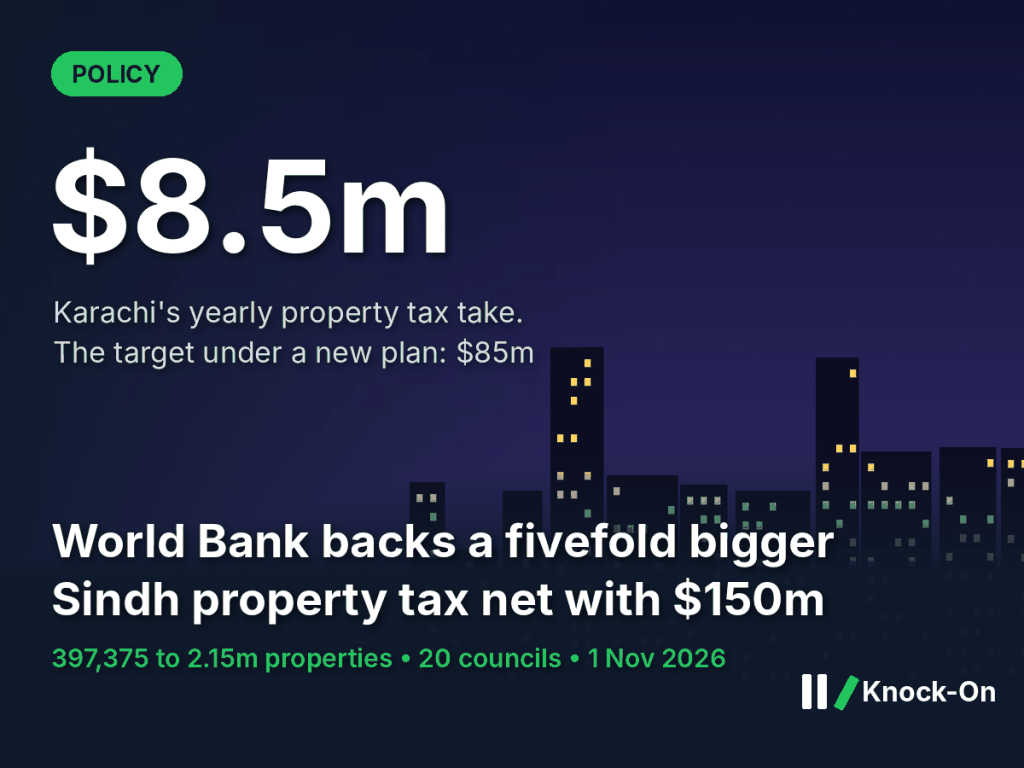
Karachi property tax collection is tiny for a city of its size, and the World Bank now wants to change that. Its board has approved $150 million for the Sindh Property Revenues Enhancement Program (Sindh PREP), under which the provincial government plans to expand the recorded urban property tax base more than fivefold and lift Karachi’s annual take from about $8.5 million to $85 million. For property owners, landlords and businesses, it signals a tougher, map-based tax net; for the city, it could mean money for drains, roads and fire stations.
The short version
- The World Bank board approved $150m for Sindh PREP to raise urban immovable property tax (UIPT) collection.
- The recorded base in 20 councils outside Karachi is planned to rise from about 397,375 to 2.15 million properties.
- Karachi collects about $8.5m a year; the target is $85m, by raising compliance from 20% to 50%.
- About 70% of collections will be reinvested in local infrastructure and services.
What happened
The World Bank Group’s Board of Executive Directors approved the $150 million financing, Business Recorder reported on 1 November. The programme aims to improve UIPT collection and strengthen municipal service delivery in selected local councils. It will build a property tax management information system for billing, payments and complaints, and roll out integrated financial management systems across local councils.
Institutional strengthening covers all 45 participating local councils, including 25 in Karachi, whose 3.58 million residents are described as the primary beneficiaries. A separate $40 million component will extend property surveys and tax administration to 20 councils in Sindh’s other urban centres: nine in Hyderabad division, three in Sukkur, four in Larkana, two in Mirpurkhas and two in Shaheed Benazirabad. A GIS-based, door-to-door survey will geo-tag properties and record their features, which is expected to lift the recorded base in those councils to about 2,149,080 properties.
Karachi’s property tax target is ten times what it collects today
Annual urban property tax collection in Karachi, US$ million, as reported 1 Nov 2026
Why it matters
Sindh’s local councils rely on provincial transfers for more than 95% of their revenue, so they have little money of their own to fix the services businesses depend on. The Karachi property tax gap is stark: cities of similar size collect 82 to 350 times more, according to the report. “Cities that can raise their own revenues can plan and invest for the long term,” said Bolormaa Amgaabazar, the World Bank’s Country Director for Pakistan. Pakistan’s wider tax problem is similar, as the latest income tax return figures show: more filers, but less tax.
The knock-on effects
First order: more Karachi property tax bills
Door-to-door surveys and geo-tagging mean many properties that are not on the books today are likely to start receiving bills. Raising compliance from 20% to 50% implies that far more owners, including commercial landlords, will be expected to pay.
Second order: money tied to results
Each council’s share of funding will depend on annual performance checks by an Independent Verification Agent. Allocations are meant to pay for climate-resilient drainage, sewerage, schools, fire stations, roads and street lighting, so councils that collect more should be able to spend more.
Third order: a model for other provinces
The World Bank is backing a similar push for provincial revenue elsewhere, as with its loan to raise Khyber Pakhtunkhwa’s own taxes. If Sindh’s survey-led approach works, it could shape how other cities fund themselves, a live question as debate continues over the cost of running new provinces.
Who could benefit
- Businesses in Karachi and Hyderabad that lose money to flooding, poor roads and weak drainage, if collections are reinvested as planned.
- Compliant property owners, who currently carry a larger share of a small tax base.
- Survey, GIS and IT firms that could win work on mapping and billing systems.
Who may face pressure
- Owners of unrecorded properties, who may face new bills once surveys reach them.
- Commercial landlords and tenants, if higher property tax costs are passed into rents.
- Local councils, whose funding will depend on meeting verified performance targets.
What to watch
- When the GIS door-to-door survey starts, and which councils go first.
- Whether Sindh changes property tax rates or valuations alongside the wider net; none were announced.
- The first annual performance assessments, which decide each council’s funding.
- The financing terms and timeline, which were not given in the report.
Sources
- Business Recorder, Urban property tax base expansion: WB board approves USD150m for Sindh PREP, 1 November 2026
- Business Recorder, Tax Assan Scheme: 222 new filers take the total to 1,945 by Oct 31st: FBR, 1 November 2026
This is analysis, not investment advice. Figures are as of 1 November 2026.


Leave a Reply