
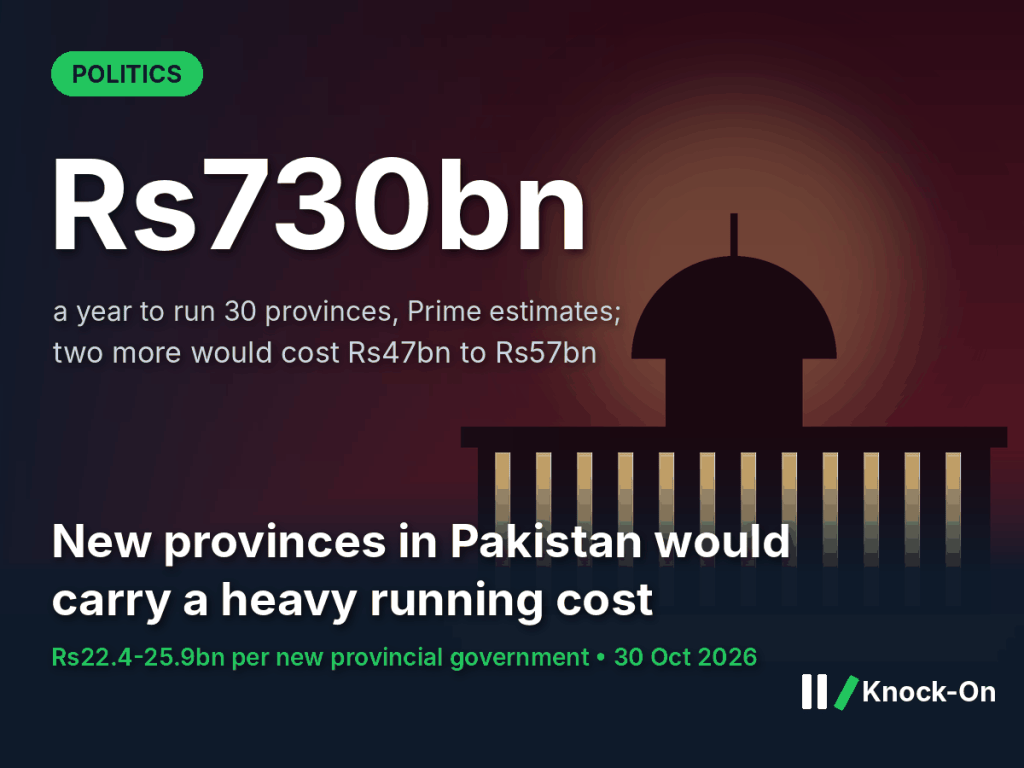
The debate over new provinces in Pakistan now has a price tag. The Policy Research Institute of Market Economy (Prime), an Islamabad think tank, estimates that each new provincial government would cost Rs22.4bn to Rs25.9bn a year just to run, and that splitting the country into 30 units could cost up to Rs730bn a year. Its advice: cost any plan formally before parliament touches the Constitution.
The short version
- Two more provinces (South Punjab and Bahawalpur) would add Rs47bn to Rs57bn a year in recurring costs, Prime estimates.
- A 30-province model could cost up to Rs730bn a year.
- Small units would spend a third or more of their federal share on running government: about 49% in Loralai and 45% in Zhob.
- Prime says stronger local governments may deliver services more cheaply than new provinces.
What happened
In a market analysis released on Thursday and reported by Dawn and Minute Mirror on 30 October, Prime costed the core structure a new province needs: a governor’s office, a chief minister’s secretariat, a provincial assembly, a high court and departments. It put that at Rs22.4bn a year in a low-cost scenario and Rs25.9bn in a high-cost one.
It then tested the cost against illustrative National Finance Commission (NFC) shares. In a six-province model, South Punjab would receive around Rs1trn and Bahawalpur Rs537bn, so the running cost is manageable. In a 30-province model, Karachi would get Rs691bn but Loralai only Rs46bn and Zhob Rs50bn, and 11 of the 30 units would receive less than Rs150bn a year. Against a 10% sustainability benchmark, 16 of the 30 would stay within it and 14 would exceed it on the low-cost estimate.
Small provinces would spend up to half their money just running government
Share of illustrative NFC allocation absorbed by core provincial structure, low-cost estimate, 30-province model (%)
Why it matters
The cost of new provinces in Pakistan is a business question as much as a political one. Every rupee spent on new assemblies, secretariats and courts is a rupee not spent on roads, schools or power, and it has to come from the same tax base. That base is already stretched: the state is borrowing to cover a growing pension bill and is under IMF pressure to trim Rs2.35trn of yearly tax exemptions.
The idea is live. MQM-P has campaigned for new administrative units, and Interior Minister Mohsin Naqvi and Planning Minister Ahsan Iqbal have backed restructuring, according to The Friday Times. The Sindh Assembly unanimously rejected any division of Sindh on 3 September, and the PPP opposes it. PTI’s Barrister Gohar Ali Khan has said any change needs broad consensus. Parliamentary Affairs Minister Tariq Fazal Chaudhry said in September that both houses would debate the issue. Any boundary change needs a two-thirds majority in both houses, plus the affected provincial assembly’s consent under Article 239(4).
The knock-on effects
First order: a bigger fixed bill for government
Two new provinces would add Rs47bn to Rs57bn a year, before any new development spending. Thirty would add many times that.
Second order: a reopened NFC award
New units would need new NFC shares, which means renegotiating how federal revenue is split. That would add uncertainty for provincial budgets and the contractors and suppliers that depend on them.
Third order: rules and taxes that differ more by place
More provinces would mean more provincial revenue authorities and regulators. For firms operating nationally, that could mean more registrations and compliance, at a time when the federal government says it wants to cut duplicate business rules. This is analysis, not a forecast of any decision.
Who could benefit
- Larger proposed units such as South Punjab, where Prime finds the running cost is a small share of the money they would receive.
- Construction and services firms in new provincial capitals, if new offices and courts are built.
- Local government, if parliament follows Prime’s advice to strengthen districts instead.
Who may face pressure
- Small proposed provinces, where a third or more of their share would go on administration.
- Taxpayers and businesses, who would fund the extra recurring cost.
- National firms, if provincial tax and licensing rules multiply.
What to watch
- Whether the promised National Assembly and Senate debate takes place, and whether any bill is tabled.
- The PPP’s position, since PML-N needs its votes for a two-thirds majority.
- Whether any proposal comes with the formal fiscal costing Prime recommends.
- The next NFC award talks, where any new units would need a share.
Sources
- Dawn, New provinces to carry heavy cost, 30 October 2026
- Minute Mirror, New provinces could cost Pakistan Rs730bn annually, 30 October 2026
- The Friday Times, New Provinces Debate: Constitutional Hurdles, Party Positions and PPP’s Political Opening, 16 October 2026
- The Express Tribune, Debate on new provinces to be held in next session of National Assembly, Senate in October: Tariq Fazal Chaudhry, 10 September 2026
- The Nation, MQM-P calls for national dialogue on new provinces, 17 August 2026
This is analysis, not investment advice. Figures are as of 30 October 2026. Knock-On is not affiliated with any political party.

Leave a Reply