
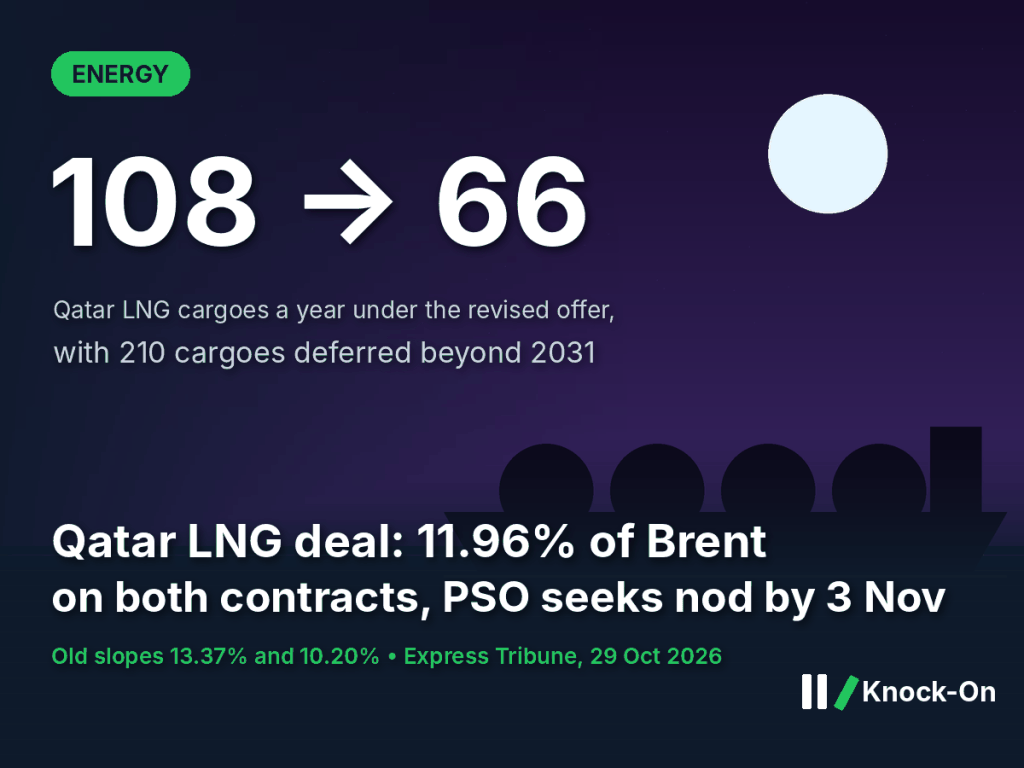
A revised Qatar LNG deal would cut the liquefied natural gas Pakistan takes from QatarEnergy to 66 cargoes a year from 108, at a single price of 11.96% of Brent crude on both long-term contracts, sources at Pakistan State Oil (PSO) told The Express Tribune. PSO wants the federal government’s approval to seal it by 3 November. For mills, fertiliser plants and power producers that use imported gas, it sets how much contracted LNG arrives until 2031, and at what price.
The short version
- QatarEnergy’s final offer is 11.96% of Brent for both contracts, against 13.37% and 10.20% now, PSO sources say.
- Yearly supply would fall to 66 cargoes from 108, with 210 cargoes deferred over four years after 2031.
- At Thursday’s Brent price, the new formula works out far below the spot LNG Pakistan is buying for winter.
- PSO is seeking the government’s nod by 3 November; Qatari deliveries remain under force majeure until December.
What happened
PSO has two take-or-pay supply contracts with QatarEnergy: a 15-year deal from 2016 and a 10-year deal from 2021, both ending in 2031. Together they oblige PSO to take 6.75 million tonnes of LNG, or 108 cargoes, each contract year. QatarEnergy served a price review notice on the second contract on 7 March 2026, and PSO on the first on 19 March. Without agreement within six months, either side may terminate, The Express Tribune reported.
Pakistan asked to cut the first contract’s price from 13.37% to 10.20% of Brent and to keep the second at 10.20%. QatarEnergy instead sought 11.98% on the second contract. Its final offer, reported by The Express Tribune and Energy Update, is 11.96% of Brent for both. (The Tribune report also mentions an 11.36% figure; Knock-On uses the 11.96% final offer that both outlets report.) The offer covers 66 cargoes a year, with 210 cargoes deferred over four years after 2031. Pakistan already takes less: 24 cargoes were diverted in the 2026 delivery plan.
The revised Qatar LNG deal cuts committed cargoes by 39%
Qatari LNG cargoes PSO must take each year, existing contracts vs final offer
Why it matters
The new Qatar LNG deal price is a blend: cheaper than the first contract, dearer than the second. Brent was $114.05 a barrel on Thursday, Reuters reported. Applying each slope gives the oil-linked cost per million British thermal units (mmBtu). Even at the higher blended rate, contracted gas is roughly half the $26.30 per mmBtu quoted in Pakistan’s latest spot tender for winter cargoes. How much Pakistan saves overall depends on how volumes split between the two contracts, which the reports do not give.
Contract gas costs about half of spot, even at the new slope
US$ per mmBtu: Brent slope × $114.05 Brent (29 Oct 2026) vs latest spot tender price
The knock-on effects
First order: a smaller Qatar LNG deal means less take-or-pay risk
Fewer committed cargoes reduce the risk of paying for gas Pakistan cannot use, as happened when 24 cargoes had to be diverted this year. The trade-off: extra winter demand must come from the spot market, where Pakistan plans 10 cargoes for November to February at about double the Qatari price, as covered in our report on the late LNG import decision for winter gas.
Second order: gas prices and circular debt
The import price feeds into what industry and fertiliser plants pay for RLNG, and into gas-sector arrears. A lower average price would ease costs; unsold contracted cargoes would add to them. See our earlier report that Pakistan’s Qatar gas deal is up for review.
Third order: supply security after the war
QatarEnergy has extended force majeure on deliveries to Pakistan and Bangladesh until the end of the year, a Petrobangla source told Reuters. QatarEnergy’s chief executive, Saad Sherida Al-Kaabi, said on Thursday it is buying US LNG to hedge against a Hormuz closure. Pakistan is weighing other suppliers too, including US LNG for Pakistan.
Who could benefit
- PSO and the gas chain: lower take-or-pay exposure and a cheaper first contract.
- Gas-using industry: a lower blended contract price could ease RLNG costs if passed on.
Who may face pressure
- Winter gas users: CNG, industry and fertiliser if demand outruns 66 contracted cargoes and spot cargoes stay costly.
- Buyers under the second contract: its price would rise from 10.20% to 11.96% of Brent.
- Long-range planners: 210 deferred cargoes push supply into the years after 2031.
What to watch
- By 3 November: whether the federal government approves PSO’s revised deal.
- November to February: delivery and pricing of Pakistan’s 10 planned spot cargoes.
- 31 December: the current end date of QatarEnergy’s force majeure.
- Brent: every $10 move changes the 11.96% slope price by about $1.20 per mmBtu (Knock-On calculation).
Sources
- The Express Tribune, Pakistan, Qatar close to revised LNG deal, 29 October 2026
- Energy Update, Pakistan, Qatar Near Revised LNG Deal with Lower Prices, 29 October 2026
- The Express Tribune (Reuters), QatarEnergy buys US, other LNG to hedge future Hormuz disruptions, 29 October 2026
- OilPrice.com, QatarEnergy Extends LNG Force Majeure to End of 2026, 28 October 2026
- The Express Tribune (Reuters), Oil falls as diplomacy hopes outweigh Middle East escalation fears, 29 October 2026
- The Express Tribune, LNG imports to cost over $1b in winter, 13 October 2026
This is analysis, not investment advice. Figures are as of 29 October 2026. Knock-On is not affiliated with any political party.

Leave a Reply