
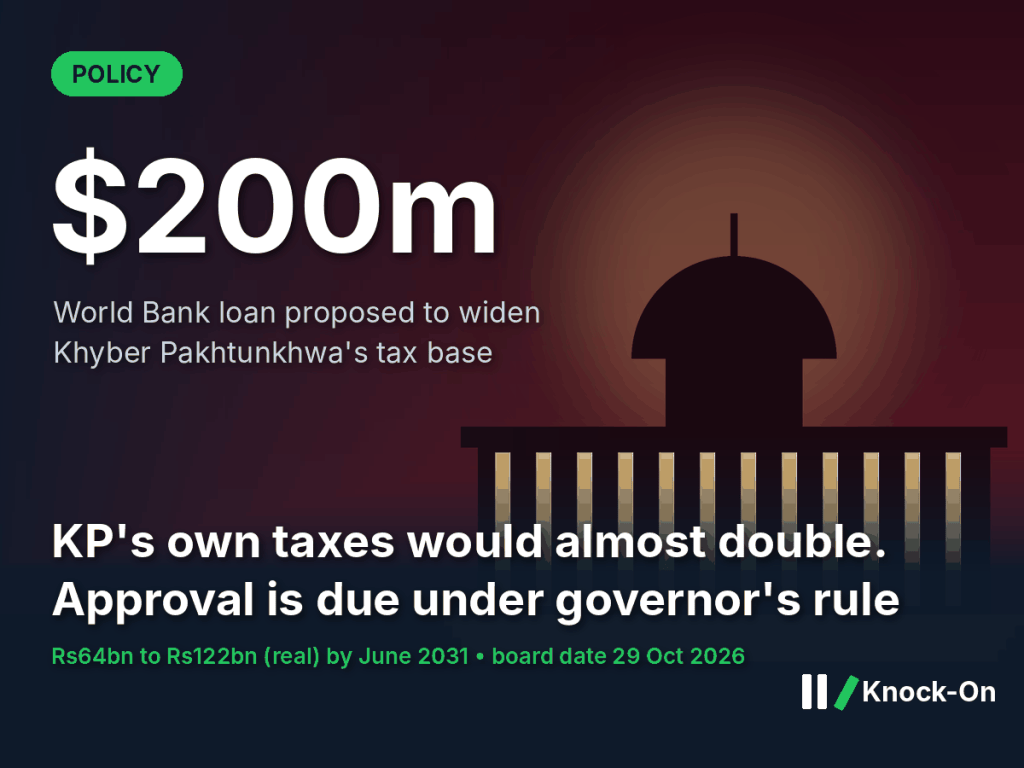
A proposed World Bank KP loan of $200m would back a plan to almost double Khyber Pakhtunkhwa’s own tax revenue, from Rs64bn to Rs122bn in real terms by June 2031. The bank’s board is scheduled to approve it on 29 October. The timing is unusual: the province has been under federal emergency and governor’s rule since 11 October. For businesses in KP, the plan points to a wider tax net, especially for property, agriculture and services, alongside a promise of simpler, digital tax administration.
The short version
- The World Bank has proposed $200m in IDA financing for a $650m KP programme; the province is to fund the other $450m.
- The target is to raise KP’s own-source tax revenue from Rs64bn to Rs122bn in real terms by June 2031, an increase of about 91% (Knock-On calculation).
- Property, agriculture and much of the services sector are largely untaxed today, the bank says.
- Board approval is scheduled for 29 October, while the province is run under governor’s rule.
What happened
According to Business Recorder, the World Bank has proposed a $100m IDA credit and a $100m IDA loan for the Pakistan Public Resources for Inclusive Development programme in KP, running from fiscal year 2027 to 2032. Dawn reports that the programme uses results-based financing, and that a separate $20m component will fund technical assistance in the merged districts, whose tax-exempt status has been extended.
The plan has three parts: widening the tax base and digitising the KP Revenue Authority, the Excise and Taxation department and the Board of Revenue; needs-based budgeting and digital procurement in health and education; and a new KP Development Data Hub for provincial statistics. By June 2031, 60% of contractual payments are to be verified through the e-procurement system and paid electronically.
KP’s own taxes would need to rise by almost Rs58bn
Khyber Pakhtunkhwa own-source tax revenue, Rs bn, real terms
Why it matters
The World Bank KP loan goes to the heart of a long-running problem: the province depends heavily on federal transfers, and its own revenue covers a small and shrinking share of fast-rising spending on salaries, pensions, the merged districts and development. The bank also notes that three provincial tax agencies have overlapping mandates and share little data. For businesses, that has meant multiple registrations and uneven enforcement. The same push to widen the net is under way nationally, as our look at the retailers’ tax scheme showed.
The political backdrop has shifted sharply. The federal cabinet recommended, and President Asif Ali Zardari approved, emergency and governor’s rule under Articles 232 and 234, citing security and failed talks with the provincial leadership, Business Recorder reports. PTI chairman Barrister Gohar Ali Khan called it a “grave political mistake” and asked the Centre to reverse it, according to Geo News. We covered the market reaction in our story on the KP emergency and the PSX. The reports on the loan do not say whether the change affects the timetable.
The knock-on effects
First order: more people in the tax net
Dawn lists the groups the programme expects to reach: more than 700,000 property owners, around 10,000 agricultural income taxpayers and more than a million vehicle owners. Digitised stamp duty and property tax records are already being rolled out in 12 cities. Landlords, farmers and service providers who have paid little provincial tax should expect more scrutiny.
Second order: simpler compliance, if it works
Harmonising rules across three agencies and moving registration, filing and payment online could cut the time firms spend on provincial taxes. Faster, electronic payments to contractors could also help suppliers to KP’s health and education departments, where the bank found fund releases unpredictable.
Third order: better data for investors
A provincial data hub and better economic statistics would give lenders and investors a clearer view of KP’s economy. That benefit depends on the programme being carried out over six years, through whatever political arrangement follows governor’s rule.
Who could benefit
- Contractors and suppliers to provincial departments, if electronic payments speed up settlement.
- IT and fintech firms that could build or run the digital tax and procurement systems.
- Compliant businesses that already pay tax and now compete with untaxed rivals.
Who may face pressure
- Property owners and landlords, as property tax records are digitised.
- Large farmers, given the bank’s note on possible effects of agricultural income tax reforms.
- Service businesses that sit outside the provincial sales tax net today.
What to watch
- World Bank board approval, scheduled for 29 October 2026.
- A joint sitting of Parliament on the governor’s rule proclamation, which lapses after two months without approval.
- Talks between the federal government and the PTI, which JUI-F chief Maulana Fazlur Rehman is to help facilitate.
- KP’s next budget, and whether it carries the new tax measures.
Sources
- Business Recorder, World Bank proposes USD200m to boost KP tax base, 12 Oct 2026
- Dawn, KP to launch six-year fiscal reform programme, 11 Oct 2026
- Business Recorder, Governor’s rule, Emergency imposed on KP, 12 Oct 2026
- Geo News, PTI calls Centre’s move to impose emergency in KP a ‘grave political mistake’, 11 Oct 2026
This is analysis, not investment advice. Figures are as of 13 October 2026. Knock-On is not affiliated with any political party.





Leave a Reply