
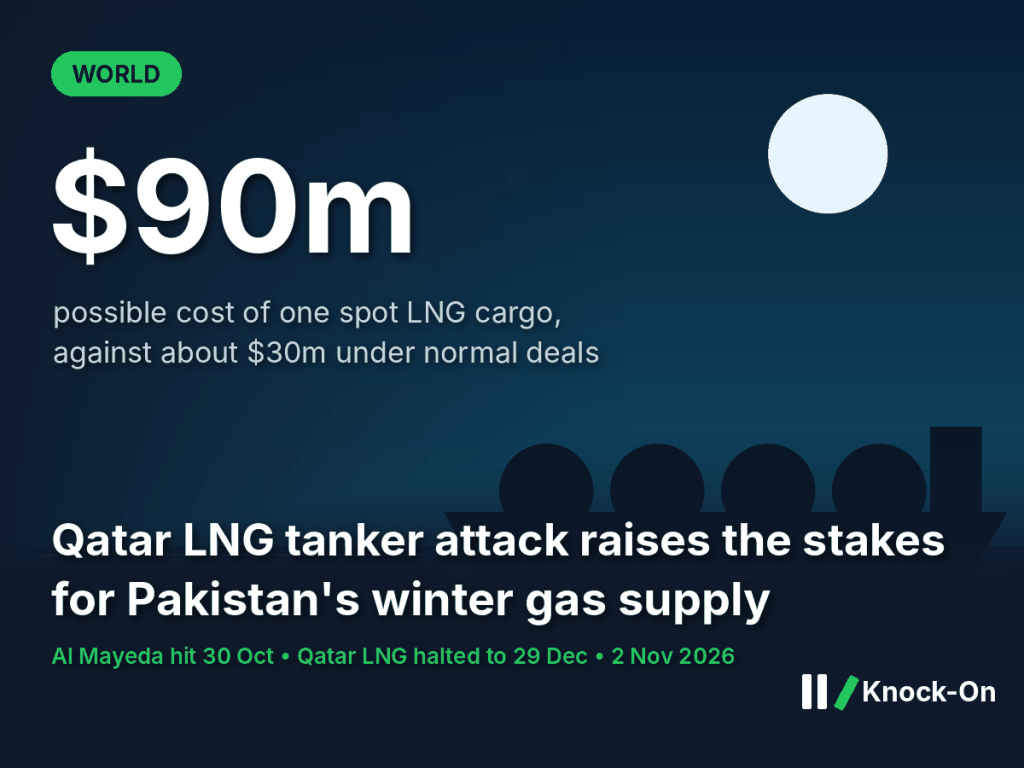
The Qatar LNG tanker attack reported on Sunday is a warning for Pakistan’s winter gas supply. Qatar’s state shipping company said its LNG carrier Al Mayeda was struck by “unidentified objects” in the Gulf on Friday evening. No one was hurt, but the incident adds to the risk on the route that, until this year, carried almost all of Pakistan’s winter LNG. Qatar has already halted LNG supplies until 29 December, and replacement cargoes bought on the spot market can cost up to three times the normal price.
The short version
- The Qatari LNG carrier Al Mayeda was hit by unidentified objects in the Gulf on 30 October; the crew are safe and no environmental damage was reported.
- At least 29 ships were hit in October, the worst month of the war, Al Jazeera reports, citing IMO and UKMTO data.
- Pakistan took 35 of its 36 LNG cargoes from Qatar last winter; Qatar’s supply halt now runs to 29 December.
- A spot cargo can cost $80m–$90m against about $30m normally, a Petroleum Ministry official told Arab News.
What happened
Qatar Gas Transport Company (Nakilat) said in a statement published on the Qatar Stock Exchange that Al Mayeda was “struck by unidentified objects while transiting the Arabian Gulf on Friday evening, October 30”, Gulf News reported. The vessel is in a “safe condition” and operational, and the impact is being assessed. Nakilat did not say where the ship was hit or who was responsible. Al Jazeera, citing International Maritime Organization and UK Maritime Trade Operations data, said more than 120 commercial ships have been hit since the war began in February, and that October, with at least 29, was the worst month so far.
For Pakistan, the timing matters. Officials said on Saturday that QatarEnergy has extended its force majeure on LNG supplies until 29 December, as Knock-On reported in the winter gas shortage Pakistan now faces. Last winter Qatar supplied 35 of the 36 cargoes Pakistan imported, and demand peaked in December and January.
Pakistan’s LNG imports peak in January, when Qatar’s halt bites hardest
LNG cargoes imported by Pakistan, winter 2025–26 (35 of 36 came from Qatar)
Why it matters
Any cargo Pakistan buys to fill the gap must come from somewhere else, and much of it still has to cross the same dangerous waters or be bought at short notice. “A cargo which normally costs around $30 million can cost around $80 to $90 million from the spot market,” a senior Petroleum Ministry official told Arab News. An attack on a Qatari LNG carrier, while Iran and Qatar are still negotiating in Doha, shows that the shipping risk has not gone away, and that risk is priced into freight, insurance and cargo costs.
A spot LNG cargo can cost three times a normal one
Cost of one LNG cargo for Pakistan, US$ million, as of 31 October 2026
The knock-on effects
First order: the Qatar LNG tanker attack raises the cost of filling the gap
Every spot cargo bought instead of a contract cargo can add $50m–$60m to the import bill (Knock-On calculation from the official’s figures). That adds pressure on the current account and on reserves at a time when oil is also expensive.
Second order: gas prices and rationing
Costlier cargoes feed into the regasified LNG price charged to industry and power plants, which already rose up to 15.3% for October. If cargoes are not bought, the alternative is tighter supply, with officials having warned of possible load-shedding for some users.
Third order: the peace talks
Iran’s foreign minister Abbas Araghchi said Iran and Qatar have discussed a plan under which the US would take agreed steps on day one and the Strait of Hormuz would reopen on day two, Gulf News reported; he said no final result had been reached. The US military says Hormuz is open, Gulf News noted, while Iran says ships need its permission to pass. Oil slipped more than 1% to $111.92 a barrel for Brent in early Asian trade on Monday as the talks continued, Reuters reported. A deal would ease the shipping risk; a breakdown would raise it.
Who could benefit
- Local gas producers, whose domestic supply becomes more valuable when imports are scarce.
- Solar, battery and efficiency suppliers, as businesses look to cut gas and grid use.
- Non-Gulf LNG sellers, if Pakistan seeks cargoes that avoid the Gulf.
Who may face pressure
- Gas-using industry, including textiles, that relies on RLNG.
- Households in Punjab and Khyber Pakhtunkhwa, where winter gas demand rises most.
- Government finances, if expensive cargoes are bought and not fully passed on.
What to watch
- 3 November: the decision PSO has sought on its revised Qatar LNG deal, and the US midterm elections.
- Coming days: Nakilat’s damage assessment and any finding on who was responsible.
- Ongoing: the Doha talks on reopening Hormuz; see the Hormuz mines impact on Pakistan.
- 29 December: the current end date of Qatar’s LNG force majeure.
Sources
- Al Jazeera, Qatar LNG carrier struck by ‘unidentified objects’ in Gulf, 1 November 2026
- Gulf News, Qatar LNG tanker hit in Gulf; crew safe, no oil spill reported, 1 November 2026
- Arab News (AFP), Qatari gas tanker struck in Gulf: state media, 1 November 2026
- Arab News, Pakistan braces for winter gas crunch as Qatar halts LNG supply till end-December, 31 October 2026
- Gulf News, Iran proposes ‘2-day plan’ to reopen Strait of Hormuz amid US talks, 2 November 2026
- Global Banking & Finance Review (Reuters), Oil slips more than 1% as talks continue on ending Iran war, 2 November 2026
This is analysis, not investment advice. Figures are as of 2 November 2026. Knock-On is not affiliated with any political party.

Leave a Reply