
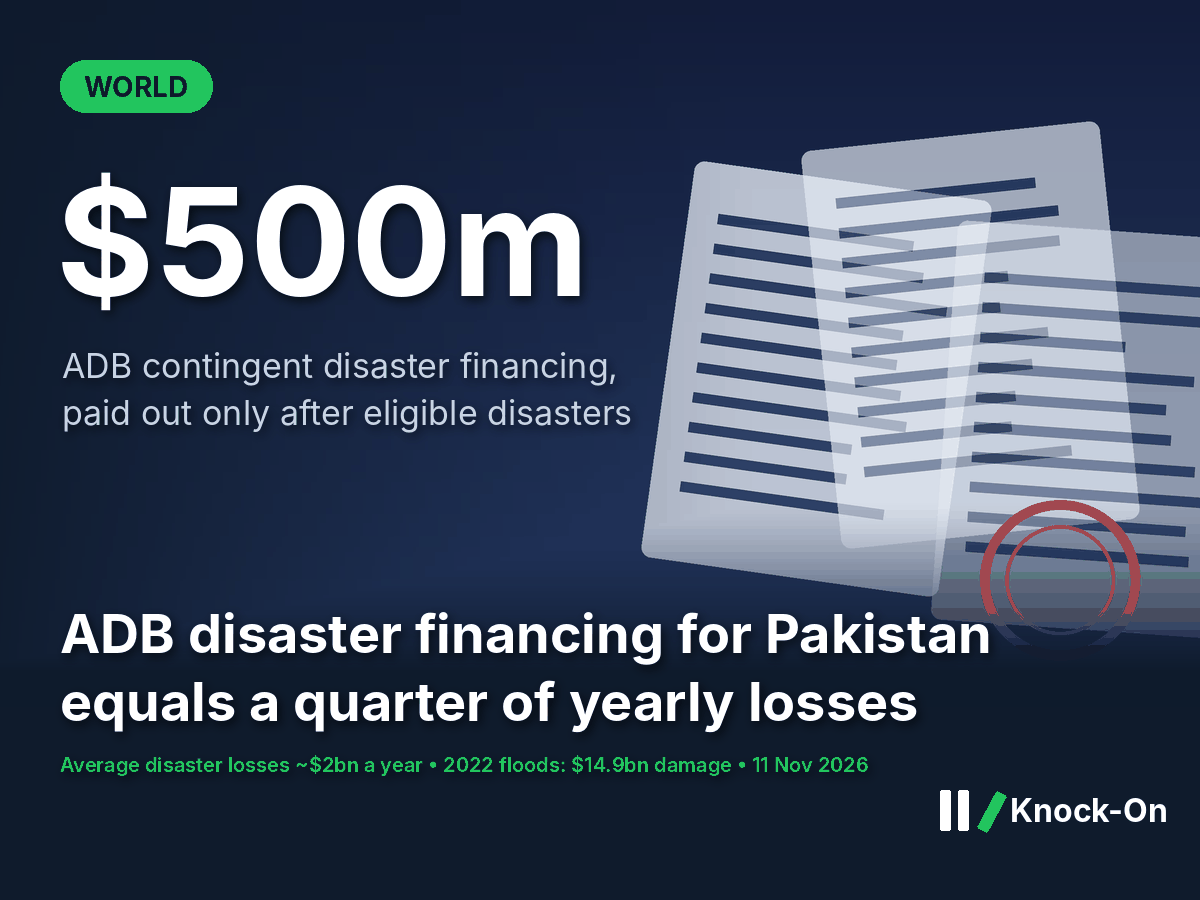
The Asian Development Bank has approved $500 million in disaster financing for Pakistan, reports published on 11 November 2026 say. Unlike a normal loan, the money is held ready and released as budget support only after an eligible disaster. ADB disaster financing of this kind is meant to stop floods and earthquakes from forcing the government to raid development budgets or delay payments. For business, the question is how far $500 million goes in a country where, according to the bank, disasters cause about $2 billion of losses in an average year.
The short version
- ADB approved $500m through contingent disaster financing (CDF) facilities under its policy-based lending.
- The money is released as prompt budget support after eligible disaster events.
- It is part of the second subprogram of ADB’s Climate and Disaster Resilience Enhancement Program.
- $500m equals about a quarter of Pakistan’s estimated $2bn in average yearly disaster losses (Knock-On calculation).
What happened
According to The Standard, ADB approved “contingent disaster financing (CDF) facilities totaling $500 million under its policy-based lending”. The facilities form part of the second subprogram of the Climate and Disaster Resilience Enhancement Program, which supports reforms to strengthen disaster preparedness and risk management and to build resilience into Pakistan’s development planning and investment. It also strengthens Pakistan’s disaster risk financing framework. The reports do not set out the exact events that would trigger a payout.
Emma Fan, ADB’s Country Director for Pakistan, said: “When disaster strikes, it is often the most vulnerable communities that are hit hardest. Investing in preparedness can help protect lives and livelihoods, reduce economic losses, and safeguard the development gains Pakistan has worked hard to achieve.” The ADB disaster financing follows a separate $750m ADB loan plan aimed at Pakistan’s pension bill, which Knock-On covered last month.
Why it matters
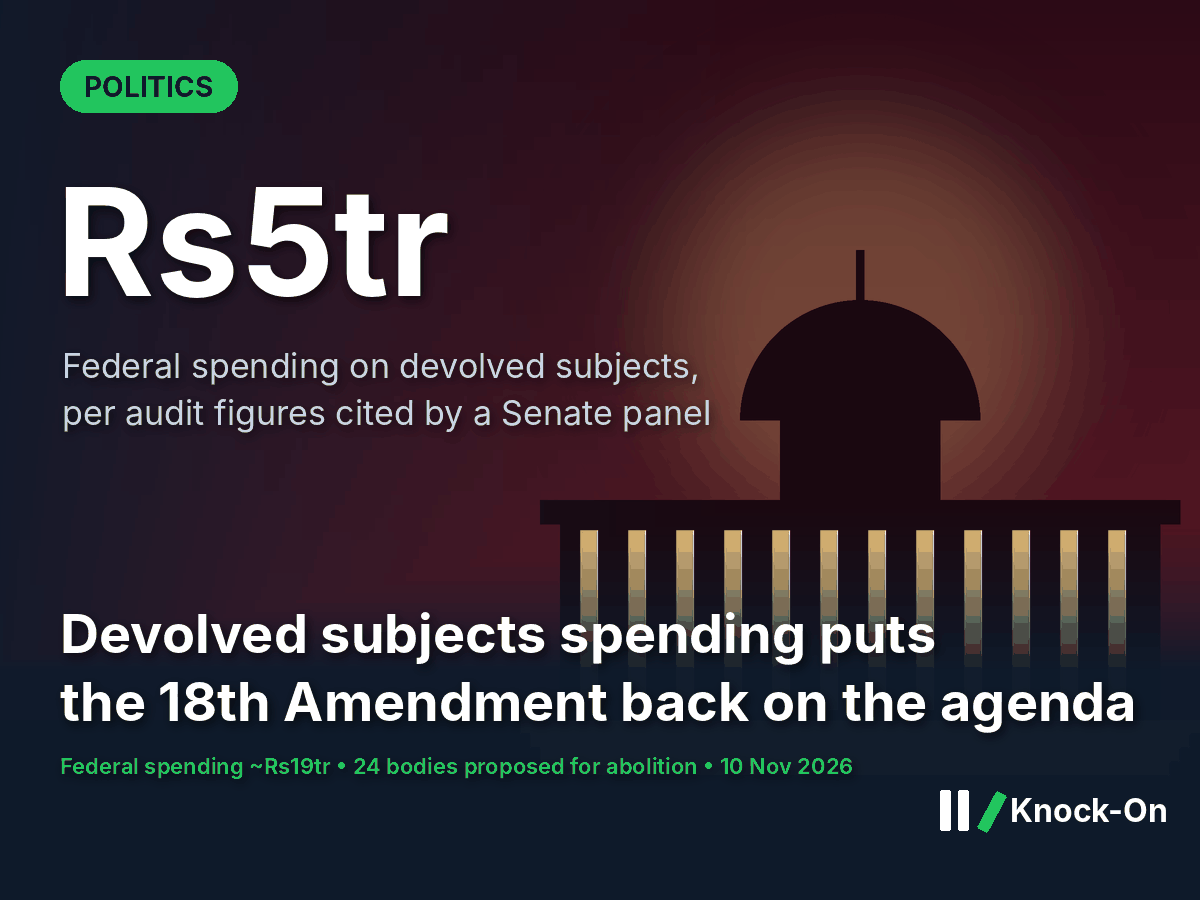
Pakistan’s disaster bills are large and arrive without warning. The 2022 floods caused $14.9bn in direct damage and $15.2bn in economic losses and pushed as many as 9.1 million people into poverty, the reports say, citing ADB. When money for relief has to be found at short notice, it usually comes out of development spending, which hits contractors and suppliers. A pre-agreed facility means some cash is available quickly, without fresh negotiations. Spending pressure on the federal budget is already a live issue, with a Senate panel head saying the Centre spent over Rs5tr on devolved subjects.
$500m is a first cushion, not full cover
Pakistan disaster losses vs ADB contingent financing, US$ billion
The knock-on effects
First order: faster cash after a disaster
The facility gives the finance ministry money it can draw soon after an eligible event, so relief and repairs need not wait for new loans or emergency budget cuts.
Second order: development spending is better protected
Cuts to development budgets after past disasters have meant delayed payments to builders and suppliers. A ready buffer reduces that risk, although $500m would not cover a disaster on the scale of 2022.
Third order: reforms change how projects are planned
Because the money is policy-based, it is tied to reforms that build disaster risk into development planning. Over time, public projects may face stricter resilience requirements, which could raise costs at the start but reduce losses later.
Who could benefit
- Contractors on public projects: less risk that disaster relief swallows their budgets.
- Firms in flood-prone districts: quicker public spending on repairs after an event.
- Engineering and resilience consultants: reforms that build disaster risk into planning can create new work.
Who may face pressure
- The federal budget: any drawdown adds to Pakistan’s external debt.
- Project sponsors: stricter resilience standards could raise upfront costs.
- Businesses in high-risk areas: $500m covers only part of a severe year, so private insurance and own reserves still matter.
What to watch
- ADB’s own release and programme documents, for the exact trigger rules.
- How the finance ministry records the facility in the budget.
- Progress on the ADB pension-reform loan and other multilateral financing.
- Next year’s monsoon season, the most likely test of the facility.
Sources
- The Standard, ADB Approves $500m for Pakistan under Contingent Disaster Financing, 11 Nov 2026
- Daily Pakistan, Pakistan secures $500 Million ADB Lifeline amid Growing Climate Disaster Threats, 11 Nov 2026
- TechJuice, Pakistan Secures $500 Million ADB Funding to Tackle Natural Disasters, 11 Nov 2026
This is analysis, not investment advice. Figures are as of 11 November 2026. Knock-On is not affiliated with any political party.

Leave a Reply