
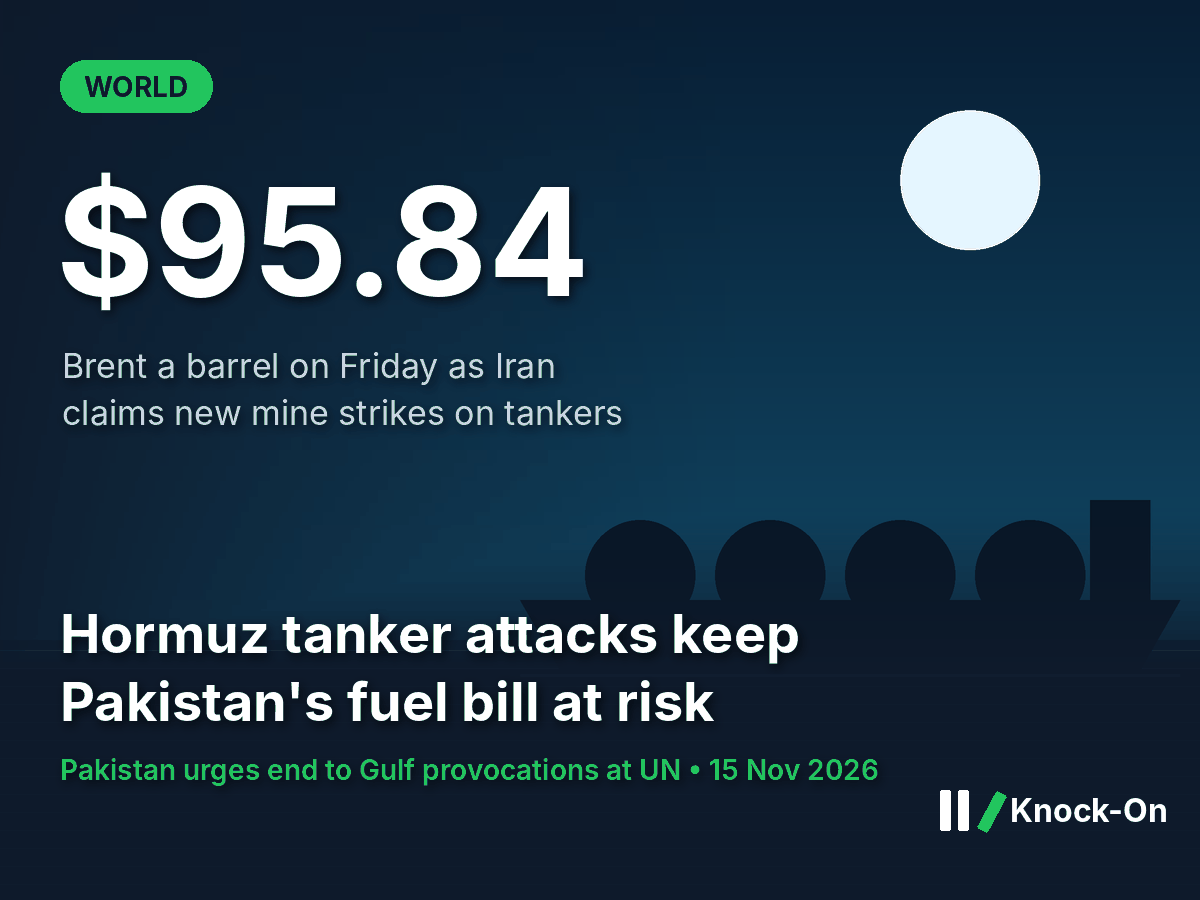
Iran’s armed forces have claimed a fresh round of Hormuz tanker attacks, saying several oil tankers caught fire after hitting naval mines on Friday night and Saturday morning. None of the claims has been independently verified. At the same time, Pakistan used a UN Security Council meeting to call for an end to military provocations in the Gulf and for the protection of commercial shipping. For Pakistani businesses, the question is whether these incidents push oil and freight costs back up after two weeks of falling prices.
The short version
- Iran’s Revolutionary Guards and navy say tankers hit mines in and east of the Strait of Hormuz on 13 and 14 November; Reuters could not verify the claims.
- Brent crude settled at $95.84 a barrel on Friday, heading for a second weekly fall of about 2.5%, according to Reuters.
- Pakistan’s UN envoy said threats to shipping in Hormuz and Bab el-Mandeb raise energy and food insecurity for vulnerable economies.
- Reuters reports President Trump may hold off further strikes on Iran if Tehran and the Houthis avoid new provocations; no decision has been announced.
What happened
On Friday night, Iran’s IRGC Navy said two oil tankers, including a supertanker, exploded and caught fire after hitting mines while using what it called an “unauthorized” route. On Saturday morning, Iran’s navy said another tanker caught fire after striking a mine in the eastern part of the strait, according to Iranian state media cited by Reuters and the Jerusalem Post. Iran says it is escalating attacks in response to the US naval blockade of its ports and tougher sanctions. Maritime monitoring firms counted at least 37 attacks on ships in and near Hormuz in October, the highest monthly total since the war began, Al Jazeera reported.
At the UN, Pakistan’s Permanent Representative Syed Haider Shah called for an immediate end to provocations and attacks in the Gulf, condemned attacks on GCC states and Houthi attacks on Saudi Arabia, and urged the restoration of normal passage through Hormuz and Bab el-Mandeb, The Nation reported. Separately, Gulf News, citing Reuters, said a third US aircraft carrier is heading to the region and that Saudi Arabia and Turkey have urged Washington to avoid renewed strikes.
Why it matters
Pakistan relies on oil and gas imports from the Gulf, a dependence the IMF described this weekend as “a significant headwind.” So far, the market has looked past the latest Hormuz tanker attacks: Reuters said traders are now more worried about a global supply surplus than a shortage. That calm has allowed Pakistan’s fuel prices to fall, but it rests on claims and counter-claims that can change quickly, as the Yanbu pipeline attack claims on Pakistan’s Red Sea oil route showed on Friday.
Oil’s slide has slowed sharply despite new tanker claims
Weekly change in Brent crude, %. Brent settled at $95.84 a barrel on Friday 13 Nov 2026
The knock-on effects
First order: Hormuz tanker attacks and Pakistan’s fuel price reviews
Pakistan’s petrol price is set with reference to international prices. If Brent holds near $96, the run of cuts can continue; a jump on a confirmed attack would reverse it. Knock-On has explained why Pakistan’s run of fuel price cuts looks fragile.
Second order: insurance and freight
Repeated attack claims, verified or not, keep war-risk insurance and charter costs high for ships serving Gulf routes. Pakistani importers of fuel, LNG and petrochemicals pay those costs through landed prices.
Third order: subsidies and the budget
The IMF has just said any future fuel support must be limited and paid for within the budget, as covered in the IMF fuel subsidy phase-out call. A new oil spike would therefore land more directly on consumers and the fiscal plan.
Who could benefit
- Fuel consumers, if Brent’s slide continues and the surplus outlook holds.
- Refiners and oil marketing companies with stocks bought earlier, if prices rise again on a confirmed attack.
- Pakistan’s diplomacy, which positions the country as a voice for shipping security at the UN.
Who may face pressure
- Importers of Gulf fuel and LNG, through freight and insurance costs.
- Transport and logistics firms, whose diesel costs follow oil prices.
- Exporters shipping through the Gulf and Red Sea, if routes face more disruption.
What to watch
- Whether shipping monitors such as UKMTO confirm any of the latest mine claims.
- Talks between President Trump, Xi Jinping and Vladimir Putin in Shenzhen on Thursday, 19 November, which a US official said would focus on Iran.
- Brent when trading resumes on Monday, and Pakistan’s next fuel price announcement.
Sources
- The Jerusalem Post (Reuters), Oil tanker catches fire after hitting naval mine in Strait of Hormuz, Iranian state media says, 14 Nov 2026
- Euronext (Reuters), Oil prices set for second straight weekly drop on signs of growing supply surplus, 13 Nov 2026
- The Nation, At UN, Pakistan calls for end to military provocations in Gulf region, 15 Nov 2026
- Gulf News, Middle East War: 7 things UAE residents need to know tonight, November 14, 14 Nov 2026
- Al Jazeera, Iran denies talks with US, says Hormuz will stay shut until demands are met, 11 Nov 2026
- Arab News, IMF reiterates Pakistan should phase out fuel subsidy, 14 Nov 2026
This is analysis, not investment advice. Figures are as of 15 November 2026. Knock-On is not affiliated with any political party.



Leave a Reply