
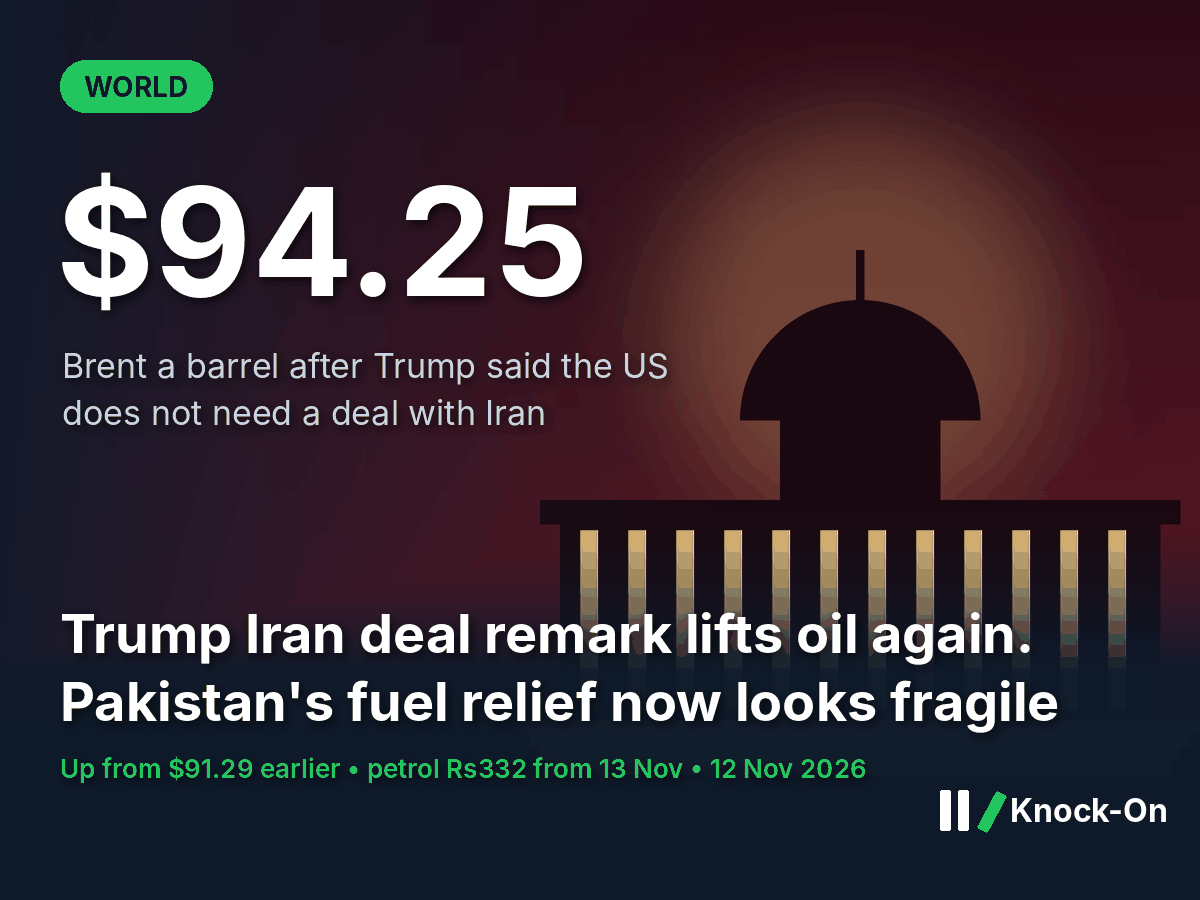
The Trump Iran deal track took a sharp turn on Thursday, 12 November, when President Donald Trump said the United States no longer needs an agreement with Tehran. Oil reversed its early losses and Brent climbed back to about $94 a barrel. For Pakistan, which buys most of its fuel abroad and has just cut petrol for an eighth straight time, the remark is a reminder that the relief at the pump depends on a diplomatic process that has now stalled.
The short version
- Trump wrote: “We don’t need a deal with Iran. Those days have long since passed,” and said the US has “their Strait”.
- Brent swung from $91.29 in early Asian trade to $94.25 by mid-afternoon in London.
- Pakistan cut petrol by Rs3 to Rs332 a litre and diesel by Rs4 to Rs360 from 13 November.
- Petrol is still Rs66 above its pre-war level, and Hormuz shipping remains disrupted.
What happened
In a social media post reported by Dawn, Trump said: “We don’t need a deal with Iran. Those days have long since passed,” adding: “We’ve got their money, hundreds of billions of dollars, and we’ve got their Strait!” Dawn reported that he also pulled Vice President JD Vance away from peace efforts, a day after the Wall Street Journal reported Vance was considering face-to-face talks with a senior Iranian security official. Dawn noted that Qatar and Pakistan have both made continuous diplomatic efforts to end the war, which began on 28 February.
Iran’s position has also hardened. Mohsen Rezaei, secretary of Iran’s Supreme National Security Council, said Tehran would not allow “even a single particle of enriched nuclear material” to leave the country and warned of consequences if the US strikes again, Reuters reported. Washington says nuclear issues must be part of any initial negotiations. Turkish President Recep Tayyip Erdogan urged both sides to return to talks “without further delay”, according to Dawn.
Brent bounced back after Trump’s post, but sits well below last month
Brent crude, US dollars a barrel, at the points shown
Brent had fallen 1.6% to $91.29 in early Asian trade on Thursday, Reuters reported, as an unexpectedly large 9 million barrel build in US crude stocks and higher OPEC+ output weighed on prices. After Trump’s post it reversed, trading at $94.25, up 1.6%, at 15:51 GMT, with WTI at $87.62, according to CNBC data cited by Trading and Investment News. Oilprice.com reported that Brent briefly traded near $96. Shipments through the Strait of Hormuz still rely on alternative routes, ship-to-ship transfers and military protection, Oilprice.com said.
Why it matters
Pakistan now revises fuel prices almost daily in line with world markets, so a stalled Trump Iran deal track reaches local pumps quickly. Petrol fell to Rs332 a litre and high-speed diesel to Rs360 from 13 November, Dawn reported, the eighth cut in a row. That is far below the April peak, but still above the Rs266 petrol price of early March, before the war pushed prices up. Taxes and duties of Rs114 a litre on petrol and Rs100 on diesel remain in place, Dawn said, which limits how much more relief the government can pass on without giving up revenue.
Petrol has given back most of the war spike, but not all of it
Petrol price in Pakistan, rupees a litre, 2026
The knock-on effects
First order: the run of fuel cuts may slow
The eight straight cuts followed a slide in crude driven largely by hopes of a settlement, covered in Knock-On’s report on the oil price fall as US–Iran talks gained ground. If Brent holds near $94 or rises, the room for further cuts narrows. See the latest petrol price in Pakistan for the full run of revisions.
Second order: the import bill and the rupee
Pakistan’s trade deficit was $14.6bn in July–October, with imports of $26bn against exports of $11.4bn, Dawn reported. Fuel is one of the largest items, so a sustained rebound in crude would work against the record reserves the State Bank has built. SBP reserves stood at $21.57bn in the week to 6 November, and total liquid reserves at $26.84bn.
Third order: supply deals and diplomacy
Disrupted Gulf shipping has pushed Pakistan to lock in supply, such as the renewed PSO Kuwait diesel supply arrangement. Pakistan has also been one of the mediators, so a long stalemate would keep both energy security and diplomatic workload high.
Who could benefit
- Exploration and production companies: earnings track crude prices.
- Ports and logistics firms: rerouted Gulf traffic has lifted Karachi volumes.
- Refiners holding cheaper stock: inventory gains if prices rise.
Who may face pressure
- Transporters, farmers and airlines that had begun to plan on cheaper fuel.
- Importers, if a larger fuel bill puts pressure on the rupee.
- The government’s budget, if it has to choose between pump relief and petroleum tax revenue.
What to watch
- The next daily fuel price notifications from Ogra.
- The US–China summit scheduled for next week, which traders expect to keep tensions contained.
- 29 November: OPEC+ ministerial meeting.
- Any response from Tehran, Qatar or Islamabad on resuming talks, and any new tanker attacks near Hormuz.
Sources
- Dawn, Trump says Washington does not need Iran deal, 13 Nov 2026
- Trading and Investment News, Brent Crude Prices Jump 1.6% After Trump Rules Out Iran Deal, 12 Nov 2026
- Oilprice.com, Brent Briefly Hits $96 After Trump Says U.S. Has No Need for Iran Deal, 12 Nov 2026
- Yahoo Finance (Reuters), Oil falls over $1 on easing geopolitical fears and oversupply worries, 12 Nov 2026
- Fortune, Current price of oil as of November 12, 2026, 12 Nov 2026
- Dawn, High-speed diesel price dips by Rs4 per litre, petrol by Rs3, 12 Nov 2026
- Dawn, SBP reserves rise, 13 Nov 2026
- Dawn, Pakistan builds record reserves amid Gulf war, 6 Nov 2026
This is analysis, not investment advice. Figures are as of 13 November 2026. Knock-On is not affiliated with any political party.


Leave a Reply