
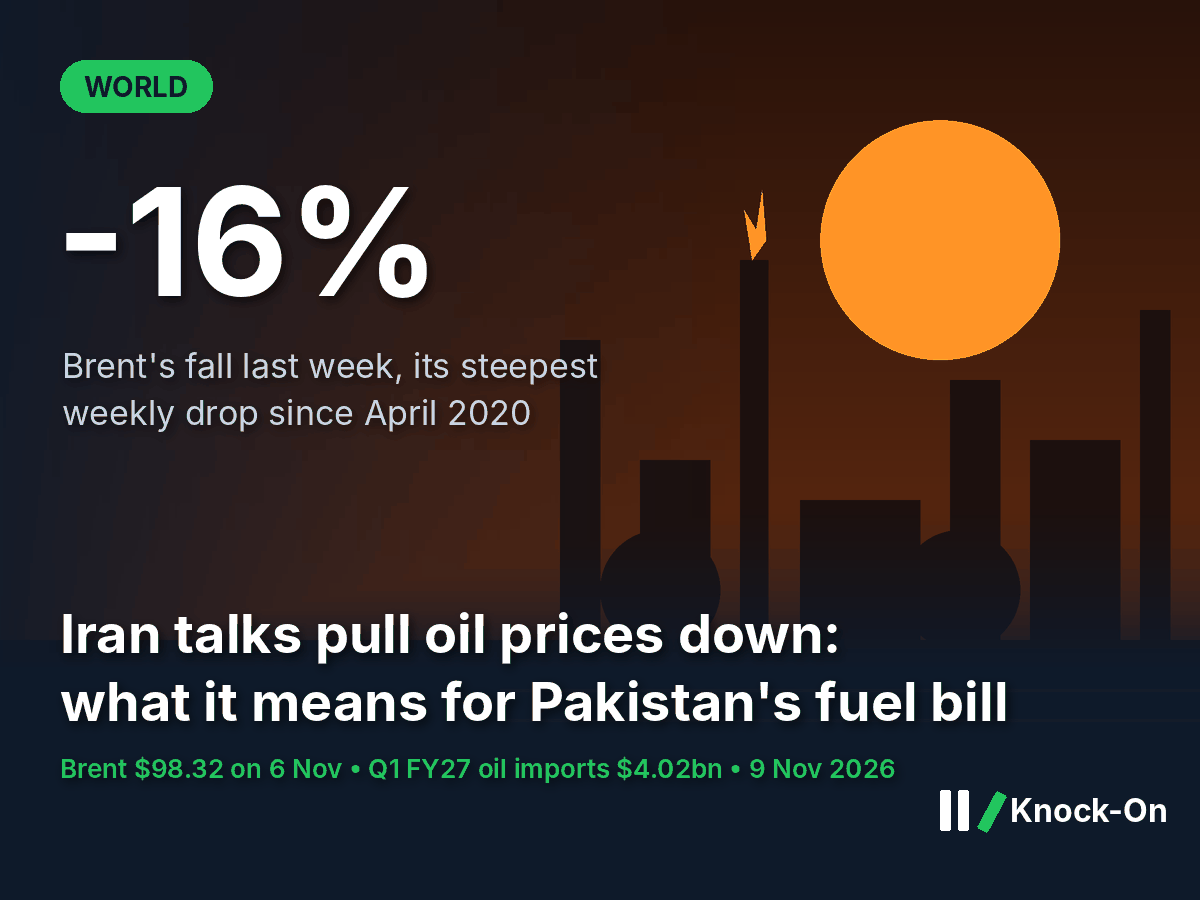
The oil price fall of the past week was the sharpest in more than six years. Brent crude lost more than 16% to settle at $98.32 a barrel on Friday, 6 November, its steepest weekly drop since April 2020, as markets bet that talks between the United States and Iran could end the conflict that has disrupted Gulf shipping. For Pakistan, which imports most of its fuel, a cheaper barrel feeds straight into pump prices, the trade deficit and inflation. But no deal has been signed, and tankers are still being attacked near the Strait of Hormuz.
The short version
- Brent fell from $117.64 to $98.32 a barrel over the week to 6 November; WTI fell nearly 13% to $90.83.
- Iran reportedly sent a nuclear proposal to Washington through Qatar; no agreement has been announced.
- Pakistan’s petroleum imports were $4.02bn in July–September, and its trade deficit widened to $3.88bn in October.
- Petrol has been cut five times in a row to Rs346 a litre, but analysts warn the war premium could return.
What happened
Brent January futures settled at $98.32 on Friday, up 3 cents on the day, and WTI at $90.83, Reuters reported. Reuters said Brent was on track for a 17% weekly decline, the steepest since the start of the Covid-19 pandemic, after an 8% fall on Wednesday alone when the US midterm results raised hopes of an end to the Iran conflict. CNBC put the weekly fall at more than 16%. Knock-On covered that first leg in how the US midterms reached Pakistan through oil.
On the diplomatic side, President Donald Trump said he would soon decide whether to pursue a peace agreement with Iran, according to Reuters. Iran reportedly sent a nuclear proposal to Washington through Qatar, CNBC reported, citing Reuters. IranWire said Tehran wants an end to the US naval blockade, sanctions relief and unfrozen assets before any full deal. Bloomberg reported on 8 November that Trump said further airstrikes would be very unlikely if talks made substantial progress, while Secretary of State Marco Rubio said some of Iran’s demands were difficult to accept. Bloomberg also reported Brent slipping below $98 as the new week began.
Brent lost $19.32 a barrel in one week
Brent crude January futures, settlement price, US dollars a barrel, 30 Oct to 6 Nov 2026
Why it matters
Pakistan is one of the countries most exposed to the oil price fall, in both directions. According to Pakistan Bureau of Statistics data reported by The Nation, the petroleum group cost $4.02bn in the first quarter of FY27 (July–September), up 6.5% from a year earlier. Crude oil imports rose 23.1% and petroleum products 11.6%. Together the two made up about 82% of the bill (Knock-On calculation). In October, imports rose nearly 12% to $6.81bn while exports grew only 2.8%, pushing the monthly trade deficit to $3.88bn, Business Recorder reported. A lower oil price is the quickest way to narrow that gap.
Crude and fuel products are 82% of Pakistan’s oil import bill
Petroleum group imports by type, US$ million, July–September 2026 (Q1 FY27), total $4,020m
The knock-on effects
First order: oil price fall reaches the pump
Pump prices have followed crude down. Petrol was cut for a fifth straight time to Rs346 a litre and diesel to Rs378 for 7 to 10 November, Aaj English reported. The government is also negotiating the petroleum levy with Jamaat-i-Islami, so the next price notification will depend on both crude and tax decisions.
Second order: the trade gap and the rupee
If prices stay lower, a smaller fuel bill would ease the four-month trade deficit of $14.63bn and support the reserves built up through the Saudi rollover and a September Eurobond, covered in Knock-On’s piece on record forex reserves. Lower freight and power costs would also help bring down inflation, which in turn shapes the SBP’s interest-rate path.
Third order: diplomacy and trade routes
Pakistan has facilitated the “Islamabad Talks” between the US and Iran, Foreign Minister Ishaq Dar told the UN Secretary-General in October, Arab News reported. A settlement could ease shipping costs through the Gulf, while US enforcement on Iran’s borders, discussed in Knock-On’s report on Iran sanctions and Pakistan’s border trade, still weighs on cross-border business.
Who could benefit
- Transporters and farmers: cheaper diesel lowers freight, tractor and tube-well costs.
- Airlines and fuel-heavy industries: lower fuel bills if prices hold.
- Importers and manufacturers: a narrower trade gap reduces pressure on the rupee.
Who may face pressure
- Oil marketing companies and refineries holding stock bought at higher prices.
- Exploration companies whose earnings track crude prices.
- Businesses that plan on cheaper fuel, if fighting resumes: Rapidan Energy Group’s Bob McNally told CNBC he sees an 80% probability of that, with both benchmarks back above $100 (a forecast). Reuters-based analysis cited by IranWire says Hormuz flows are running at less than 60% of capacity.
What to watch
- 10 November: final round of government–JI levy talks; US October inflation data and the EIA’s short-term energy outlook.
- The next petrol and diesel price notification after 10 November.
- 11 November: OPEC’s monthly oil market report.
- 29 November: OPEC+ ministerial meeting.
- Any formal US–Iran agreement, or new attacks on tankers in the Gulf.
Sources
- Global Banking & Finance Review (Reuters), Crude gains on worries about renewed US attacks on Iran, 6 Nov 2026
- FinanceFeeds, Brent Crude Oil Price: $98.32 Saturday as US-Iran Deal Bets and Tuesday’s CPI Frame the Week, 7 Nov 2026
- Bloomingbit (citing Bloomberg), Oil Logs Biggest Weekly Drop Since 2020 as Market Watches US-Iran Talks, 8 Nov 2026
- The Nation, Imports of petroleum group up 6.50pc in Q1, 27 Oct 2026
- Business Recorder, Pakistan’s trade deficit surges 20% YoY to $3.9bn in October 2026, 6 Nov 2026
- Aaj English, Govt reduces petrol, diesel prices for fifth straight day, 7 Nov 2026
- Arab News Pakistan, Pakistan briefs UN chief on US-Iran mediation efforts during Islamabad talks, 6 Oct 2026
This is analysis, not investment advice. Figures are as of 9 November 2026. Knock-On is not affiliated with any political party.


Leave a Reply