
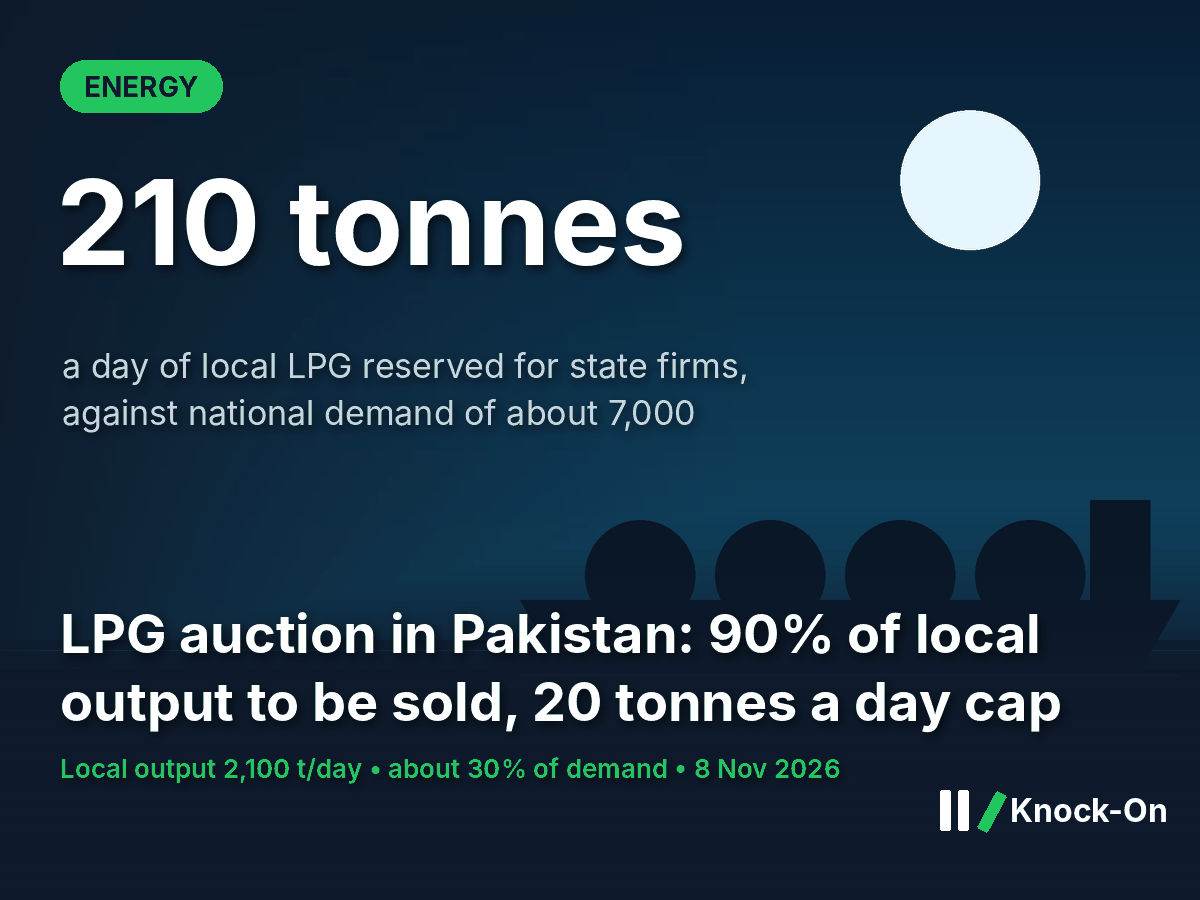
The new LPG auction in Pakistan now has its rules. A government committee decided on Saturday that local LPG producers will hand 10% of their output to state-owned marketing companies for remote areas, and sell the other 90% at open auctions, with each private bidder limited to 20 tonnes a day. The petroleum minister says this will make distribution fairer. The main marketers’ association calls it an “eyewash”, because local production covers only about 30% of what the country uses.
The short version
- Local LPG producers must give 10% of output to state-owned marketing firms, priced at the producer price based on Saudi Aramco’s CP rate.
- The other 90% will be auctioned in front of the media, with a cap of 20 tonnes a day per company.
- The marketers’ association says daily demand is about 7,000 tonnes and local output only about 2,100, so the 10% share is about 210 tonnes.
- It wants lower taxes and port charges on imported LPG instead.
What happened
The committee set up to run the LPG auction framework held its first meeting on Saturday, 7 November, chaired by the petroleum secretary and attended by Petroleum Minister Ali Pervaiz Malik, Dawn reported. The federal cabinet approved the framework on 4 November, alongside the new LPG policy that brings four state firms back into imports. Committee members include the OGRA chairman, the heads of OGDCL and PSO, the president of United Energy Pakistan and the director general for liquefied gases. Daily LPG production will be monitored and reported to the prime minister.
Mr Malik said the 20-tonne daily cap gives all participants a level playing field, and that the auction system will support fair distribution, a stable supply chain and energy security, according to Radio Pakistan as cited by Dawn.
The state share of local LPG is 3% of national demand
LPG, tonnes per day, as of 7 November 2026
Why it matters
LPG is the cooking and heating fuel for homes without piped gas, and demand climbs as winter sets in. Supply has been squeezed since crossings on the Iran border closed, and Dawn reports cylinders selling at up to twice the official rate on the open market. LPG was one of the two items behind the jump in SPI inflation to 12.31% last week. The LPG auction in Pakistan addresses who gets the local 30% of supply. It does not add new supply.
Ali Haider, senior vice chairman of the Pakistan LPG Marketers Association (PLMA), told Dawn that high prices come from black marketing caused by the shortage, and that most of the country’s needs were met by LPG from Iran. He said prices would rise after bidding and that companies with deeper pockets would end up controlling the market.
The knock-on effects
First order: a new way to buy local LPG
Marketing companies that bought local LPG through existing arrangements now have to bid for it at public auctions, up to 20 tonnes a day each. State firms get a guaranteed slice at the producer price.
Second order: imports set the price
Because roughly 70% of supply must be imported, the import cost still sets the price at the margin. PLMA wants sales tax on imports cut from 19% to 10%, the 5.5% withholding tax waived, terminal charges halved, port royalties lowered and the demurrage period extended. None of these has been announced.
Third order: gas use shifts in winter
The minister said on 7 November that the government would bring in even the most expensive fuel, LNG, to keep piped gas flowing at meal times in December and January. That puts pressure on the import bill at a time when Qatari LNG cargoes are paused until late December.
Who could benefit
- State marketing firms: a guaranteed share of local output at the producer price.
- Households in remote areas: the 10% allocation is meant for hard-to-reach regions.
- Smaller bidders: the daily cap is designed to stop one company buying most of the auctioned volume.
Who may face pressure
- Private LPG marketers: they now compete in auctions for a smaller pool and still depend on costly imports.
- Restaurants, small eateries and households: cylinder prices stay tied to import supply in peak season.
- Distributors in border regions: they relied most on supply from Iran.
What to watch
- The date and clearing prices of the first auction.
- OGRA’s monthly LPG price notification for December.
- Whether the government responds to PLMA’s request for tax and port-charge cuts on imports.
- Any reopening of trade crossings on the Iran border.
Sources
- Dawn, Govt reserves 10pc of local LPG for state-owned firms, 8 November 2026
- Dawn, LPG availability, fair pricing among govt priorities, says petroleum minister, 7 November 2026
This is analysis, not investment advice. Figures are as of 8 November 2026.


Leave a Reply