
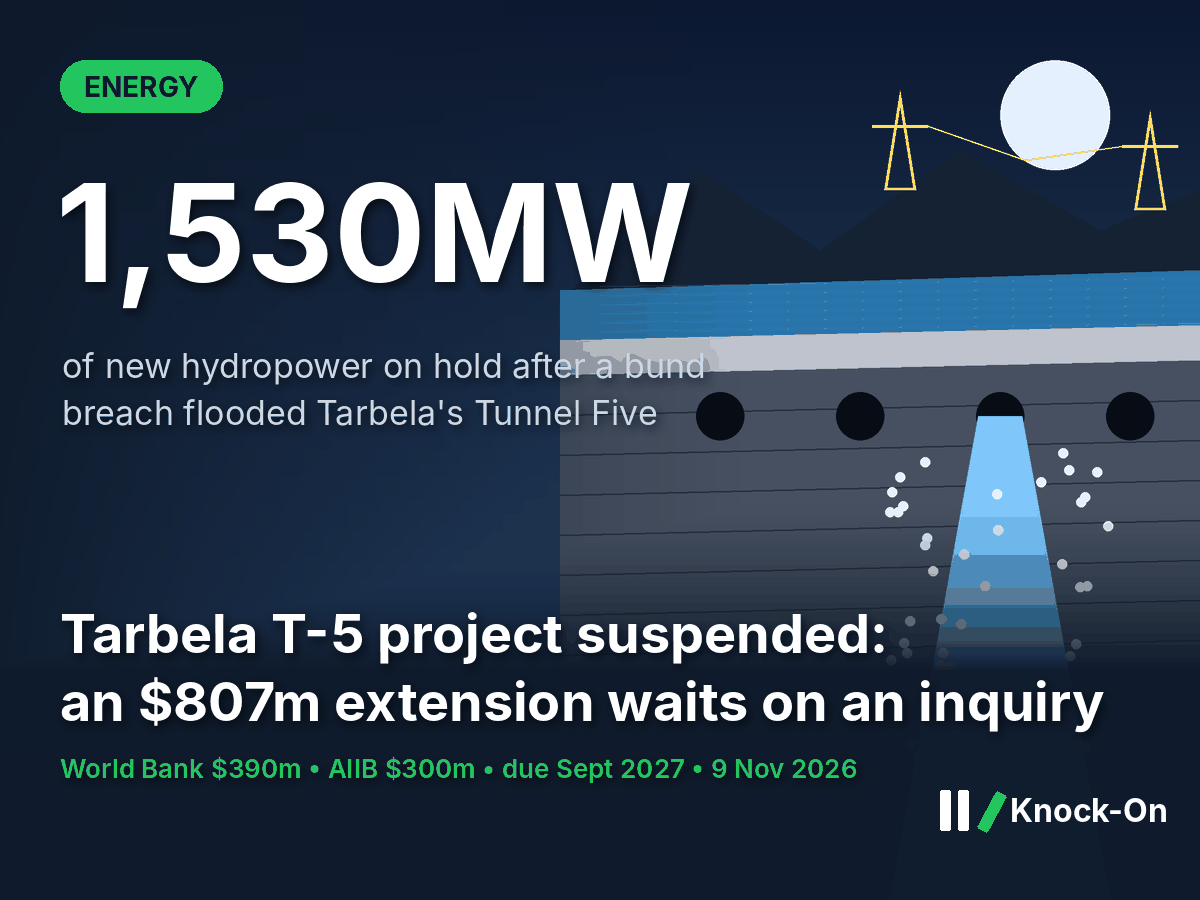
Work on the Tarbela T-5 project, the fifth extension of Pakistan’s largest dam, has been suspended indefinitely after a protective bund collapsed on Monday, 9 November, and a large volume of water flooded Tunnel Five. All Pakistani and foreign workers were evacuated, and no casualties were reported. For business, the question is not only how long the stoppage lasts, but what a further delay means for a 1,530MW source of cheap, fuel-free electricity that the power system has been waiting for since 2021.
The short version
- A protective bund at the Tarbela T-5 site gave way on 9 November, flooding Tunnel Five; work is suspended indefinitely.
- The project is meant to add 1,530MW, lifting Tarbela’s installed capacity from 4,888MW to 6,418MW.
- Its approved cost is $807m, with $390m from the World Bank and $300m from the Asian Infrastructure Investment Bank (AIIB).
- Completion had already slipped to September 2027; a high-level inquiry will now decide what happens next.
What happened
According to The Express Tribune, the breach let water pour into Tunnel Five, where WAPDA’s Tarbela 5th Extension Hydropower Project is being built. Haripur Deputy Commissioner Waseem Ahmed visited the site and confirmed that water entered the tunnel after the bund gave way. One Pakistani worker was swept into the water and rescued by emergency teams. A high-level inquiry will establish whether a structural weakness or a technical fault caused the failure, and Mr Ahmed said the next course of action would be decided once the investigation report is received.
The Tarbela T-5 project is designed to add three 510MW units and produce an average of 1.347 billion units of electricity a year. WAPDA awarded the $354.6m civil works contract to Power Construction Corporation of China in May 2021. The Tribune notes that the project has slipped from its original five-year schedule to September 2027, that a project director told a Senate committee in September 2024 that delays were partly caused by difficulty getting an IRSA no-objection certificate to close Tunnel 5, and that work was temporarily suspended in August 2025 when rising reservoir levels and inflows entered the site.
T-5 would lift Tarbela’s capacity by almost a third
Tarbela Dam installed capacity, megawatts (MW)
Why it matters
Hydropower has no fuel bill, so every unit Tarbela produces is a unit that does not have to be generated from imported oil, LNG or coal. That matters for a business sector already paying high grid tariffs: our analysis of the industrial power tariff in the Nepra incentive package showed how sensitive factories are to each rupee per unit. The T-5 extension was also one of the flagship projects in a donor portfolio that adds to Pakistan’s $135.1bn external debt, so delays mean paying for borrowed money before it earns anything back.
The knock-on effects
First order: an indefinite stop on site
Civil works, equipment installation and the contractor’s workforce are on hold until the inquiry reports. Any damage to the tunnel or works will need to be assessed before a new timetable can be set.
Second order: cost and schedule risk
The September 2027 completion date was already a slip from the original plan. A further delay could raise costs for repairs, idle equipment and supervision, and push back the 1.347 billion units a year the plant is expected to supply. Who bears any extra cost, between WAPDA, the contractor and insurers, will depend on what the inquiry finds.
Third order: the power mix and lender confidence
Every year without T-5 leaves the system leaning more on thermal plants with fuel costs that flow into consumer bills. The timing is also sensitive: a World Bank energy mission is in Pakistan from 9 to 13 November and is due to meet WAPDA in Lahore on 10 November. How quickly the authorities explain the failure may shape how lenders view the wider hydropower pipeline.
Who could benefit
- Engineering and repair contractors may see work on assessment, dewatering and remedial construction.
- Thermal generators could see their plants needed for longer if new hydropower capacity arrives later than planned.
Who may face pressure
- WAPDA, which must manage the inquiry, its lenders and a slipping schedule.
- The civil works contractor, Power Construction Corporation of China, whose role will be examined in the inquiry.
- Power consumers and industry, who wait longer for low-cost hydropower units to enter the grid.
What to watch
- 10 November: the World Bank energy mission’s meetings with WAPDA and the National Grid Company in Lahore.
- The inquiry report: whether it finds a structural weakness or a technical fault, and when work can resume.
- A revised completion date against the current September 2027 target, and any change to the $807m cost.
- Privatisation and power reforms: how this setback sits alongside the government’s plans for selling airports and power firms.
Sources
- The Express Tribune, Water floods Tunnel Five after protective bund collapses at Tarbela, 9 November 2026
- Emra News, Tarbela T-5 project halted after tunnel flooding, 9 November 2026
- Emra News, World Bank energy mission visits Pakistan to review projects, 9 November 2026
This is analysis, not investment advice. Figures are as of 9 November 2026.



Leave a Reply