

Pakistan external debt rose 4% to $135.1bn at the end of 2025, according to the World Bank’s International Debt Report 2026, as reported by Business Recorder on 6 November. That is almost twice the $68.7bn the country owed abroad in 2015. For businesses, the more telling figure is that servicing this debt took about a third of export earnings last year, which limits how much foreign exchange is left for imports, machinery and profit repatriation.
The short version
- External debt stood at $135.1bn at end-2025, up from $68.7bn in 2015, a rise of about 97% (Knock-On calculation).
- Debt service equalled 33% of exports; total external debt was 324% of exports and 34% of gross national income.
- Multilateral lenders are owed $56.8bn; China is the largest bilateral creditor at $22.4bn.
- New loans from private creditors in 2025 cost an average 8.6% with three-year maturities, against 3.6% and 16 years from official lenders.
What happened
The World Bank’s annual debt report, which covers positions at the end of 2025, puts Pakistan’s external debt stock at $135.1bn. Of this, $107.1bn is public and publicly guaranteed debt, $17.6bn is owed by private borrowers without a government guarantee, and $10.5bn is short-term debt.
Within public debt, multilateral lenders account for $56.8bn, bilateral lenders $42.4bn and private creditors such as bondholders and commercial banks $7.8bn. The World Bank group (including IDA) is owed $19.2bn and the Asian Development Bank $16.8bn. China, at $22.4bn, is the largest single bilateral creditor; the report notes China extended maturities on about $2bn that fell due in 2025. The IMF disbursed $2.3bn during the year under its Extended Fund Facility and Resilience and Sustainability Facility.
Multilateral lenders hold the biggest slice of Pakistan’s foreign debt
Pakistan external debt by type of creditor, US$ billion, end-2025 (total $135.1bn)
Why it matters
The size of Pakistan external debt matters less than the share of foreign earnings it consumes. With debt service at 33% of exports, every dollar earned abroad is partly spoken for before importers, airlines or multinationals can use it. That is why the government keeps rolling over existing loans, as seen in the recent Saudi rollover of $3bn, and why it has turned down expensive money, such as the $490m loan offer it rejected at about 8%. The report’s terms show the gap: private lenders charged an average 8.6% for three years, while official lenders charged 3.6% for 16 years with a four-year grace period.
The knock-on effects
First order: dollars are rationed by repayments
Large scheduled repayments keep the State Bank focused on building reserves. That supports a stable rupee but leaves less room to relax import controls or speed up dividend payments abroad.
Second order: the budget squeezes everyone else
Interest on foreign and domestic debt crowds out development spending, a pattern visible in the first-quarter fiscal figures, where interest costs grew far faster than tax revenue. Speaking at a Sustainable Development Policy Institute conference, reported on 6 November, the IMF’s resident representative, Mahir Binici, said Pakistan’s revenue remains “considerably below” the 15% of GDP that emerging economies need and urged a wider tax base, including agriculture and real estate.
Third order: business pays through taxes and tariffs
If revenue does not rise, the burden tends to fall on the existing taxpayers and on energy tariffs, which raises costs for documented companies. Faster export growth is the main way to bring the 324% debt-to-exports ratio down without new taxes.
Who could benefit
- Exporters: policy priority shifts towards earning dollars, which may bring financing and tariff support.
- Banks: continued heavy government borrowing keeps demand for their funds high.
- Remittance channels: worker inflows remain a central source of foreign exchange.
Who may face pressure
- Importers of machinery and inputs: dollar availability stays tied to the repayment calendar.
- Multinationals: profit repatriation competes with debt service for reserves.
- Documented taxpayers: new revenue measures tend to land on the existing base first.
What to watch
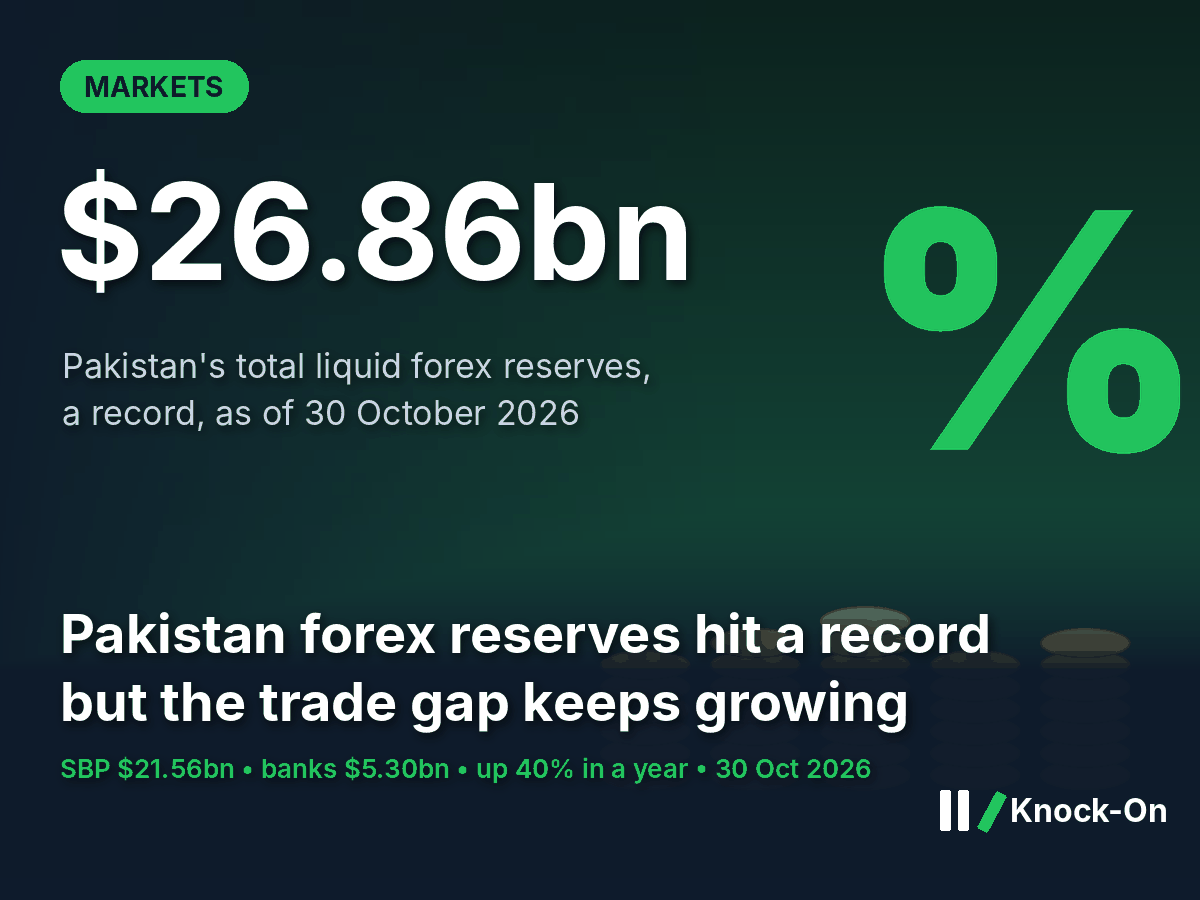
- Weekly SBP reserve data; reserves were $21.56bn in the week to 30 October.
- Further rollovers or maturity extensions from China, Saudi Arabia and other bilateral lenders.
- Progress on IMF programme reviews and the tax measures they require.
- The government’s choice between costly commercial borrowing and cheaper official loans.
Sources
- Business Recorder, Pakistan’s external debt doubles over a decade: World Bank, 6 November 2026
- Business Recorder, IMF urges Pakistan to widen tax base, accelerate reforms, 6 November 2026
- Business Recorder, PSX: selling engulfs bourse, KSE-100 sheds over 2,200 points (SBP reserves figure), 6 November 2026
This is analysis, not investment advice. Figures are as of 6 November 2026.

Leave a Reply